In B2B marketing, email remains a powerhouse for nurturing leads and closing deals. But the strategies that worked yesterday won't cut it in today's crowded inbox. Buyers are more sophisticated, inboxes are smarter, and generic blasts are a one-way ticket to the spam folder. To succeed, marketers must move beyond outdated tactics and adopt a more targeted, value-driven approach. This guide is your roadmap to doing just that.
We’ve compiled a comprehensive roundup of the 10 most crucial B2B email marketing best practices you need to master this year. We will move beyond the basics to provide step-by-step advice, real-world examples, and actionable takeaways for each point. You will learn precisely how to segment your lists for maximum impact, personalize content that resonates with decision-makers, and build automated sequences that guide prospects through the buying journey. As you refresh your B2B email strategy, evaluating the latest advancements in secure email marketing automation tools for 2025 can provide a significant competitive advantage by enhancing both efficiency and data protection.
This article is designed to be a practical playbook. Forget high-level theory; we’re diving straight into modern strategies you can apply immediately to build campaigns that not only get opened but drive measurable business results. Let’s get started.
1. List Segmentation and Targeting
In B2B email marketing, sending the same message to every single contact is a guaranteed path to the unsubscribe link. List segmentation is the practice of dividing your email list into smaller, more specific groups based on shared characteristics. This ensures your campaigns resonate deeply with each recipient's unique context, dramatically increasing relevance, engagement, and conversion rates.

Instead of a one-size-fits-all approach, you can tailor your messaging based on firmographic data like industry or company size, behavioral data like website engagement, or their position in the sales funnel. For instance, a lead who downloaded a top-of-funnel ebook about "social media trends" should receive different content than a Marketing Qualified Lead (MQL) who requested a demo of your social media scheduling tool.
Why This Practice Matters
Effective segmentation is a cornerstone of modern B2B email marketing best practices because it transforms generic blasts into personalized conversations. Companies like HubSpot excel at this by segmenting users based on lifecycle stage (e.g., Subscriber, Lead, Customer), ensuring that a long-term customer never receives an introductory "What is HubSpot?" email. This precision builds trust and positions your brand as a relevant, attentive partner. To dive deeper into the fundamentals of this strategy, you can explore this detailed guide on what email segmentation is and how to use it.
Actionable Takeaways:
- Step 1: Start with Foundational Segments. Don't get overwhelmed. Begin by creating 3-5 core segments. Good starting points for B2B include job title, industry, company size, and engagement level (e.g., contacts who opened an email in the last 90 days).
- Step 2: Leverage Behavioral Data. Use data from your website and email platform. Create segments for contacts who have visited your pricing page, clicked on links related to a specific service, or attended a webinar.
- Step 3: Implement Progressive Profiling. Use smart forms to gather new information over time. Instead of asking for 10 details at once, ask for their job title on the first form, company size on the second, and primary business challenge on the third. This gradually enriches your contact profiles without creating friction.
2. Personalization and Dynamic Content
Moving beyond simply segmenting your list, personalization involves using subscriber data to customize email elements for individual recipients. This goes beyond a simple [First Name] merge tag. True B2B personalization means tailoring subject lines, body copy, calls-to-action, and even the sender's name to create a one-to-one communication experience at scale. Dynamic content takes this a step further, automatically swapping out entire content blocks based on the recipient's attributes or behavior.

For example, a marketing automation platform could send an email to two contacts at the same company. The email sent to the CMO might feature a dynamic block about ROI and budget allocation, while the one sent to the social media manager displays a block about content scheduling features. The core email is the same, but the dynamic content makes it hyper-relevant to each recipient's role.
Why This Practice Matters
Personalization is a critical B2B email marketing best practice because it cuts through the noise of generic B2B communication. It shows your contacts that you understand their specific role, industry, and challenges. Companies like Marketo and HubSpot have popularized this by enabling marketers to use behavioral triggers, like a pricing page visit, to send highly contextual follow-up emails. This level of relevance fosters a stronger connection and significantly accelerates the buyer's journey. You can explore a deeper dive into the power of personalization in email marketing to master its nuances.
Actionable Takeaways:
- Step 1: Start with Simple Personalization. Begin by personalizing the subject line with the recipient's company name or addressing them by their first name in the email body. These small touches can immediately boost open and engagement rates.
- Step 2: Use Behavioral Triggers. Set up automated emails based on user actions. If a contact downloads a guide on SEO, trigger a follow-up email sequence that offers more advanced SEO resources or a case study relevant to their industry.
- Step 3: Implement Role-Based Dynamic Content. Create different versions of your key value propositions tailored to specific job titles. A CTO is interested in security and integration, while a VP of Sales cares about CRM connectivity and lead generation impact. Use dynamic blocks to show the right message to the right person.
- Step 4: Test and Validate. Before launching a complex dynamic campaign, rigorously test all variations to ensure conditional logic works correctly. You must avoid sending emails with blank fields or awkward phrasing like "Hello, [First Name]" which instantly damages credibility.
3. Mobile Optimization and Responsive Design
In today's B2B landscape, a significant portion of decision-makers check their email on the go. Mobile optimization is the practice of designing emails to display perfectly and function flawlessly across all devices, especially smartphones and tablets. It's about more than just making text readable; it involves creating a seamless and engaging user experience that encourages action, regardless of screen size.
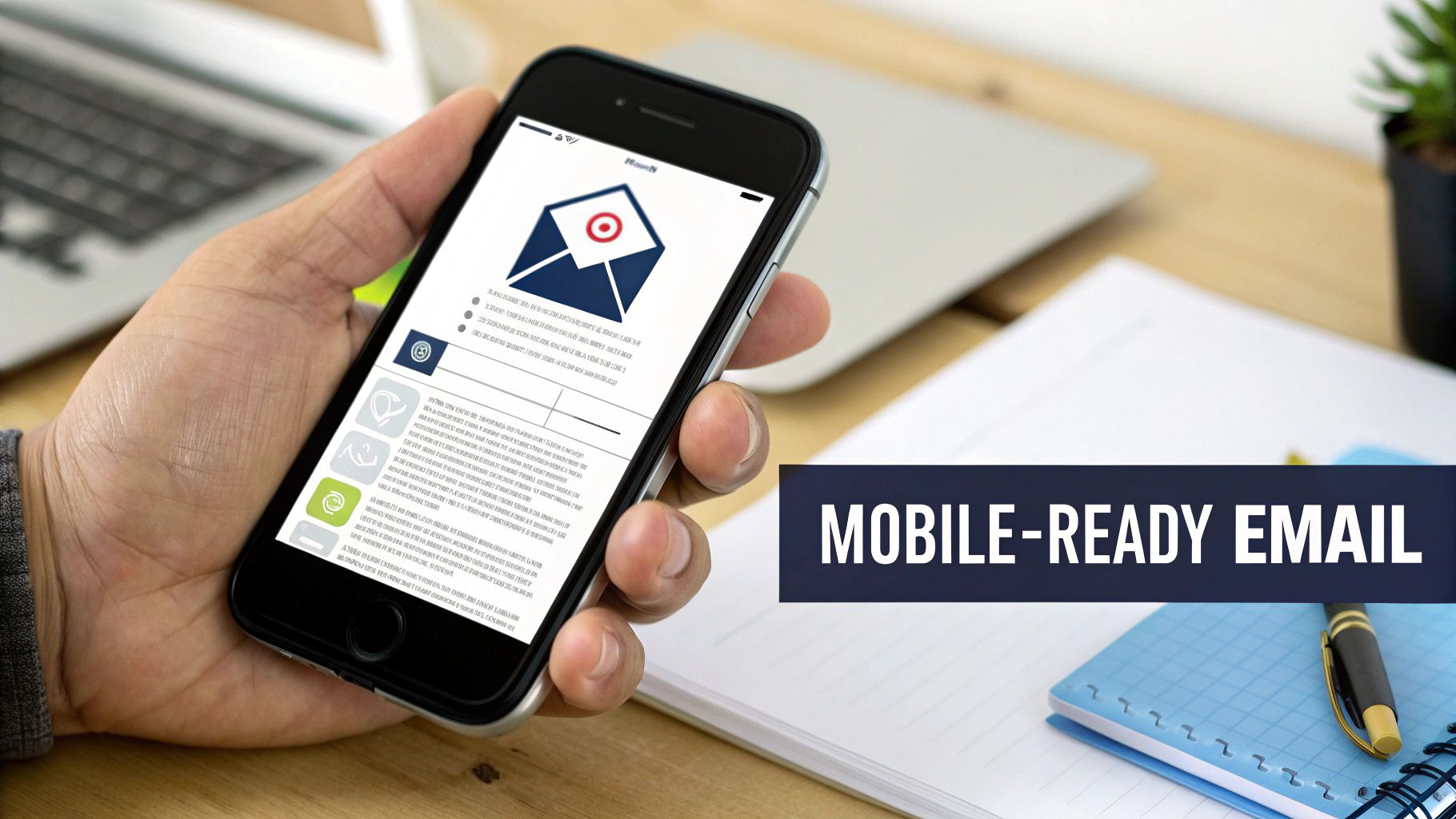
A non-responsive email forces users to pinch, zoom, and scroll endlessly, creating a frustrating experience that often leads to an immediate delete. Responsive design uses flexible grids and layouts that automatically adapt to the viewing environment. Think of Slack's concise email notifications or LinkedIn's mobile campaigns; they use single-column layouts, large fonts, and prominent buttons that make them incredibly easy to navigate on a small screen.
Why This Practice Matters
Ignoring mobile users is no longer an option. A poor mobile experience directly impacts engagement rates and brand perception, making it one of the most critical b2b email marketing best practices to master. Companies that prioritize mobile design see higher click-through rates because their message is accessible and their call to action is easy to complete. Testing platforms like Litmus and Email on Acid have championed this cause, providing the tools marketers need to preview and perfect their campaigns across dozens of devices and clients.
Actionable Takeaways:
- Step 1: Adopt a Mobile-First Design. Start your design process by creating the mobile version first, then expand the layout for larger desktop screens. This ensures the core message and user experience are optimized for the most constrained environment.
- Step 2: Keep Content Scannable and Concise. Use short paragraphs, clear headings, and bullet points. Keep subject lines under 50 characters to prevent them from being cut off on mobile displays.
- Step 3: Ensure CTAs are Tappable. Use large, high-contrast buttons for your calls to action. Ensure there is ample white space around them to prevent accidental taps, a common frustration for mobile users.
- Step 4: Test on Real Devices. While simulators are helpful, nothing beats testing your email on actual iOS and Android devices. This helps you catch rendering issues that simulators might miss.
4. Subject Line Optimization and A/B Testing
Your subject line is the gatekeeper to your email's content. No matter how valuable your offer or insightful your newsletter is, a weak subject line will land it in the digital graveyard of unopened emails. Subject line optimization is the art and science of crafting compelling, concise phrases that grab attention in a crowded inbox, while A/B testing is the process of scientifically determining which version performs best with your audience.
In a B2B context, this isn't about clickbait; it's about conveying immediate value and relevance to a busy professional. A great subject line acts as a powerful first impression, signaling that the content inside is worth their limited time. By systematically testing variables, you can replace guesswork with data, ensuring your open rates steadily improve over time.
Why This Practice Matters
Mastering subject lines is a high-leverage activity and a core component of B2B email marketing best practices. It directly impacts your open rate, which is the gateway metric for every other form of engagement. Campaign Monitor's research shows that even simple personalization in the subject line can increase open rates by 26%. This single element can be the difference between a campaign that drives leads and one that gets ignored. Testing removes subjectivity and allows your audience's behavior to guide your strategy, leading to more predictable and successful outcomes.
Actionable Takeaways:
- Step 1: Test One Variable at a Time. To get clean, reliable data, isolate your tests. If you're testing subject lines, keep the "from" name and send time consistent. You can test different variables, but only change one per A/B test campaign.
- Step 2: Explore Different Angles. Don't just test slight word changes. Test fundamentally different approaches. For example, you could A/B test a question-based subject line ("Is your data secure?") against a benefit-driven one ("A new way to protect your company data").
- Step 3: Keep It Concise and Mobile-Friendly. A significant percentage of B2B emails are opened on mobile devices where screen space is limited. Aim for subject lines between 6-10 words (roughly 40-60 characters) to ensure they are fully visible without being truncated.
- Step 4: Avoid Spam Trigger Words. Words like "Free," "Guaranteed," "Act Now," or using excessive punctuation and all caps can land your email in the spam folder. Focus on creating intrigue and communicating value rather than using high-pressure sales language.
5. Lead Scoring and Behavioral Tracking
In the complex B2B sales cycle, not all leads are created equal. Lead scoring is the methodology of assigning point values to each lead based on their characteristics and actions, such as visiting your pricing page or opening a specific email. This system, powered by behavioral tracking, transforms your marketing automation platform into a powerful prioritization engine, ensuring your sales team focuses their efforts on prospects who are most ready to engage.
Instead of treating every new contact with the same level of urgency, you can systematically identify sales-ready leads. For example, a contact who downloaded an introductory whitepaper might get 5 points, while one who requests a product demo gets 25 points. This data-driven approach bridges the gap between marketing engagement and sales readiness, a crucial element of B2B email marketing best practices.
Why This Practice Matters
Effective lead scoring prevents valuable, high-intent leads from slipping through the cracks while stopping sales teams from wasting time on cold prospects. It quantifies engagement, creating a clear, objective threshold for when a lead should be passed from marketing to sales. Platforms like Marketo and HubSpot have popularized this by creating models that combine demographic fit with behavioral signals, ensuring that sales outreach is both timely and highly relevant. For a cutting-edge approach to identifying and prioritizing prospects, delve into the power of AI lead scoring.
Actionable Takeaways:
- Step 1: Define Your Ideal Customer Profile (ICP). Before scoring actions, score the people. Assign higher point values for firmographic and demographic data that matches your ICP, such as specific job titles (e.g., "VP of Marketing"), industries, or company sizes.
- Step 2: Identify Key Engagement Signals. Work with your sales team to identify 5-7 high-value actions that indicate purchase intent. These often include visiting the pricing page, downloading a case study, attending a webinar, or repeat visits to a specific product page.
- Step 3: Implement Negative Scoring. Just as important as identifying good leads is disqualifying bad ones. Apply negative scores for actions like visiting your careers page, having a student email address, or long periods of inactivity. This keeps your pipeline clean and focused.
- Step 4: Set a Marketing Qualified Lead (MQL) Threshold. Establish a specific point total (e.g., 100 points) that, once reached, automatically triggers a handoff to the sales team. This threshold should be reviewed and adjusted quarterly based on lead-to-customer conversion rates.
6. Strategic Timing and Send Time Optimization
In B2B email marketing, when you send your email can be just as crucial as what you send. Strategic timing involves scheduling your campaigns to land in your recipient's inbox when they are most likely to be engaged. Simply sending an email at a random time risks it being buried under a pile of other messages, but optimizing your send time can significantly boost open and click-through rates.
This practice goes beyond just picking a day of the week. Advanced send time optimization (STO) tools use machine learning to analyze past engagement data for each individual contact. The algorithm then predicts the precise time that specific person is most likely to open an email, deploying your campaign to them at that unique moment. This transforms a batch-and-blast send into a series of perfectly timed, personalized deliveries.
Why This Practice Matters
Timing optimization is a vital B2B email marketing best practice because it respects the recipient's routine and workflow. A well-timed email feels less like an interruption and more like a helpful resource. For example, Salesforce’s Einstein Send Time Optimization analyzes billions of data points to pinpoint the ideal delivery window for each contact. Similarly, studies from platforms like GetResponse consistently show that B2B emails sent mid-week between 9-11 AM and 1-3 PM generally see the highest engagement, aligning with typical work schedules.
Actionable Takeaways:
- Step 1: Follow General B2B Guidelines. As a starting point, schedule your most important campaigns for Tuesday, Wednesday, or Thursday. The most common high-engagement windows are 9-11 AM and 1-3 PM in the recipient’s local time zone. Avoid early Monday mornings (inbox overload) and late Friday afternoons (weekend mindset).
- Step 2: Analyze Your Own Data. Look at your past campaign reports. Does your audience defy the norms? Perhaps your C-suite contacts check emails at 7 AM, or your tech industry audience is more active in the evening. Your own data is the ultimate source of truth for your specific list.
- Step 3: Leverage Send Time Optimization Tools. If your email service provider offers it (like HubSpot, Klaviyo, or ConvertKit), enable send time optimization. This automates the process by using algorithms to determine the best time for each individual subscriber over several campaigns.
- Step 4: Implement Frequency Capping. Good timing also means not sending too often. Set a rule to limit the number of promotional emails a contact receives in a given period, such as a maximum of two per week, to prevent subscriber fatigue and maintain list health.
7. Account-Based Marketing (ABM) Email Campaigns
Account-Based Marketing (ABM) flips the traditional lead generation funnel on its head. Instead of casting a wide net to capture as many individual leads as possible, ABM focuses marketing and sales resources on a select set of high-value target accounts. Email campaigns in an ABM strategy are hyper-personalized, coordinated, and designed to engage multiple stakeholders within a single organization, treating each account as a market of one.
This approach moves beyond individual personas to address the entire buying committee. An email sent to a CFO at a target company will focus on ROI and financial benefits, while a message to an IT Manager at the same company will highlight technical specifications and ease of integration. The goal is to build consensus and drive a unified decision across the organization through highly relevant, coordinated communication.
Why This Practice Matters
ABM is a critical B2B email marketing best practice because it dramatically improves ROI by concentrating efforts on accounts most likely to convert and deliver significant lifetime value. It forces a tight alignment between sales and marketing, ensuring that both teams are working from the same playbook to engage key contacts. Companies like 6sense use AI to identify accounts showing buying signals, allowing marketing teams to launch perfectly timed, multi-touch email campaigns that feel less like marketing and more like a direct, helpful consultation.
Actionable Takeaways:
- Step 1: Identify Your High-Value Accounts. Collaborate with your sales team to define your Ideal Customer Profile (ICP). Select a small, manageable list of 10-20 target accounts that perfectly match this profile to start.
- Step 2: Map Key Stakeholders. For each target account, use tools like LinkedIn Sales Navigator to identify and research the key decision-makers and influencers. Map out their roles, challenges, and how your solution impacts their specific function.
- Step 3: Craft Account-Specific Messaging. Develop personalized email sequences for different personas within each account. Reference their company’s specific initiatives, recent news, or industry challenges to make your outreach incredibly relevant.
- Step 4: Coordinate Multi-Channel Outreach. Ensure your email campaigns are synchronized with other touchpoints. If your sales team is reaching out on LinkedIn, your email messaging should complement that conversation, creating a cohesive and persistent brand presence.
8. Email Deliverability and Compliance Management
Crafting the perfect B2B email is pointless if it never reaches the inbox. Email deliverability is the art and science of getting your messages past spam filters and into your recipient's primary folder. It involves technical authentication, diligent list hygiene, and strict adherence to anti-spam regulations like CAN-SPAM (U.S.), GDPR (EU), and CASL (Canada).
Managing these elements is non-negotiable in B2B email marketing best practices. Internet Service Providers (ISPs) like Google and Microsoft use sophisticated algorithms to protect users from unsolicited mail. Failing to meet their standards or legal requirements can damage your sender reputation, leading to your domain being blacklisted and your messages being blocked entirely.
Why This Practice Matters
Strong deliverability and compliance build a foundation of trust with both mailbox providers and your subscribers. When you consistently follow the rules, you signal that you are a legitimate, reputable sender, which ISPs reward with higher inbox placement rates. Conversely, non-compliance can lead to severe penalties; for instance, GDPR violations can result in fines of up to 4% of a company's annual global revenue. By prioritizing these practices, you safeguard your sender reputation and ensure your valuable content has a chance to be seen. To get a comprehensive overview of the technical and strategic steps involved, you can learn more about how to improve your email deliverability.
Actionable Takeaways:
- Step 1: Set Up Email Authentication. Immediately implement SPF, DKIM, and DMARC records for your sending domain. These are technical standards that prove your emails are legitimate and haven't been forged, a critical first step for any serious sender.
- Step 2: Practice Strict List Hygiene. Regularly clean your email list. Monitor bounce rates closely and remove any email address that results in a hard bounce. Suppress contacts who have been inactive for over 120 days to keep your engagement rates high.
- Step 3: Ensure Clear and Simple Unsubscribing. Every email must include a clearly visible unsubscribe link. All opt-out requests must be honored promptly, typically within 10 business days as required by laws like CAN-SPAM.
- Step 4: Maintain Detailed Consent Records. For regulations like GDPR and CASL, you must be able to prove that a contact gave you explicit consent to email them. Use double opt-in processes and keep organized records of when and how each contact subscribed.
9. Value-Driven Content Strategy and Email Sequencing
In the world of B2B, a hard sell from the very first email is a recipe for deletion. A value-driven content strategy focuses on building trust and establishing authority before asking for the sale. This is achieved through coordinated email sequences that deliver genuinely helpful, educational, and insightful content, positioning your brand as a trusted expert rather than just another vendor.

Instead of immediately pushing a demo, this approach nurtures leads by providing resources that help them solve their problems. An email sequence might start with a foundational blog post, followed by a case study, an invitation to a relevant webinar, and then a link to a detailed whitepaper. Each step provides value and gently guides the prospect through their buyer's journey. This is a cornerstone of modern B2B email marketing best practices.
Why This Practice Matters
This strategy shifts the dynamic from a sales pitch to a partnership. By consistently providing value, you earn your audience's attention and trust, making them far more receptive when you eventually introduce a product or service. SaaS companies like Intercom master this by using onboarding sequences that teach users product best practices, which increases user retention and demonstrates the product's value firsthand. The goal is to educate and empower, not just to sell.
Actionable Takeaways:
- Step 1: Map Content to the Buyer Journey. Create separate email sequences for each stage: Awareness (e.g., educational blog posts, industry reports), Consideration (e.g., case studies, webinar invites), and Decision (e.g., product comparisons, free trial offers).
- Step 2: Maintain a 70/30 Value-to-Promotion Ratio. For every promotional email you send, ensure you've sent at least two or three that are purely educational and valuable. This builds goodwill and keeps your audience engaged.
- Step 3: Vary Your Content Formats. Keep your sequences interesting by including a mix of content types. Share links to articles, embed short videos, invite subscribers to webinars, and offer downloadable whitepapers or checklists.
- Step 4: Incorporate Storytelling. Use case studies and customer success stories to illustrate how your solutions solve real-world problems. This makes the value you offer more tangible and relatable to your B2B audience.
10. Analytics, Testing, and Continuous Improvement
Launching an email campaign without tracking its performance is like driving with your eyes closed. Analytics, testing, and a commitment to continuous improvement form a crucial feedback loop that turns guesswork into a data-driven strategy. This practice involves systematically measuring campaign results, A/B testing variables to understand what works, and using those insights to refine future emails for better outcomes.
Instead of sticking to a single template or subject line style because it "feels right," you can test one variable at a time, such as the call-to-action button color or the sender name. By analyzing the results, you can make incremental changes that compound over time, significantly boosting engagement, click-through rates, and ultimately, conversions. This methodical approach is a cornerstone of effective B2B email marketing best practices.
Why This Practice Matters
A data-driven optimization cycle separates stagnant email programs from high-performing ones. It ensures your efforts are constantly evolving to meet audience preferences and business goals. For example, marketing automation leader HubSpot constantly tests elements within their email nurture sequences. They might test a plain-text email from a sales rep against a highly designed HTML email to see which one generates more demo requests from a specific segment, using the data to optimize the entire funnel. This removes subjectivity and ensures every decision is backed by evidence.
Actionable Takeaways:
- Step 1: Define Your Key Performance Indicators (KPIs). Before you send, know what success looks like. Is it open rate, click-through rate, demo requests, or webinar registrations? Align your KPIs with the specific goal of each campaign.
- Step 2: Test One Variable at a Time. To get clean, reliable data, isolate a single element for each test. Test your subject line, but keep the email body and sender name the same. This allows you to accurately attribute any change in performance to that specific variable.
- Step 3: Ensure Statistical Significance. A test run on a list of 50 people won't yield trustworthy results. Aim for a minimum of 1,000 recipients per variant to ensure the outcome isn't just random chance. Most modern email service providers have built-in A/B testing tools that calculate this for you.
- Step 4: Document and Review Learnings. Create a simple spreadsheet or document to track every test you run, including the hypothesis, the variable tested, the results, and the key takeaway. Review these findings monthly to identify trends and adjust your overall strategy quarterly.
B2B Email Marketing: 10 Best Practices Comparison
| Strategy | Implementation Complexity 🔄 | Resource Requirements ⚡ | Expected Outcomes ⭐📊 | Ideal Use Cases 💡 | Key Advantages ⭐ | Key Considerations |
|---|---|---|---|---|---|---|
| List Segmentation and Targeting | Medium–High 🔄 — initial setup + ongoing maintenance | Medium ⚡ — CRM, data hygiene, automation | ⭐⭐⭐⭐ — higher opens/CTR (14–100%), better conversion 📊 | Targeted campaigns, lifecycle messaging, ABM prep | More relevant messaging → higher engagement | Needs clean data; risk of over-segmentation |
| Personalization and Dynamic Content | High 🔄 — conditional logic + templates | High ⚡ — rich first‑party data, AI/tools | ⭐⭐⭐⭐⭐ — strong engagement lift (40–50%) 📊 | 1:1 scale, product recommendations, re‑engagement | Increased conversions and stronger relationships | Privacy concerns; complex data maintenance |
| Mobile Optimization and Responsive Design | Medium 🔄 — template design + cross‑client testing | Low–Medium ⚡ — responsive templates, testing tools | ⭐⭐⭐⭐ — CTR ↑15–25%, better mobile conversions 📊 | Mobile‑first audiences, transactional and notification emails | Improved UX and conversion on mobile devices | Email client CSS limits; ongoing device testing |
| Subject Line Optimization and A/B Testing | Low–Medium 🔄 — iterative tests | Low ⚡ — testing tool + sample size | ⭐⭐⭐ — opens ↑10–30%, quick wins 📊 | Any campaign with sufficient list size for testing | Fast, low‑cost engagement improvements | Requires statistical sample; risk of fatigue/spam perception |
| Lead Scoring and Behavioral Tracking | High 🔄 — scoring models + integrations | High ⚡ — tracking, CRM, analytics | ⭐⭐⭐⭐ — better lead prioritization, shorter sales cycles 📊 | Sales‑marketing alignment, complex B2B funnels | Focuses sales on highest‑potential leads | Complex setup; scoring errors can miss opportunities |
| Strategic Timing and Send Time Optimization | Medium 🔄 — AI/algorithms + testing | Medium ⚡ — historical data, STP tools | ⭐⭐⭐⭐ — opens ↑10–50% when optimized 📊 | Global audiences, time‑sensitive sends, campaigns needing lift | Higher engagement through timing precision | Needs sufficient historical data; varies by industry |
| Account-Based Marketing (ABM) Email Campaigns | Very High 🔄 — coordinated, multi‑stakeholder sequences | Very High ⚡ — account research, tech stack, sales alignment | ⭐⭐⭐⭐⭐ — high ROI for target accounts (up to +208%) 📊 | Enterprise sales, high‑value account pursuit | Larger deals, tighter sales/marketing alignment | Resource‑intensive; not scalable for high volume |
| Email Deliverability and Compliance Management | High 🔄 — authentication, policies, monitoring | Medium–High ⚡ — specialists, tools, IP warm‑up | ⭐⭐⭐⭐ — inbox placement, long‑term channel health 📊 | All senders; regulated industries and high‑volume senders | Protects sender reputation and legal compliance | Ongoing monitoring; evolving ISP/regulation changes |
| Value‑Driven Content Strategy and Email Sequencing | Medium–High 🔄 — content mapping and sequencing | High ⚡ — content creators, design, planning | ⭐⭐⭐⭐ — higher engagement and lead quality over time 📊 | Nurture programs, thought leadership, onboarding | Builds trust and shortens sales cycles through education | Content‑heavy; longer time to conversion; upkeep needed |
| Analytics, Testing, and Continuous Improvement | Medium–High 🔄 — measurement, tests, attribution | Medium–High ⚡ — analytics tools, expertise | ⭐⭐⭐⭐ — continuous gains, clearer ROI visibility 📊 | Maturing programs seeking scalable optimization | Data‑driven decisions and compounding improvements | Requires statistical expertise; testing takes time |
Summary: Your Path to B2B Email Mastery
Mastering B2B email marketing requires a blend of strategic thinking, technical precision, and a commitment to continuous improvement. We've walked through ten essential best practices that form the foundation of a successful program. From hyper-targeting your audience with segmentation and ABM to ensuring your messages are personalized, mobile-friendly, and perfectly timed, each practice builds on the last. By prioritizing value-driven content and maintaining impeccable deliverability, you can transform your email channel from a simple broadcast tool into a powerful engine for building relationships and driving revenue. The key is to move beyond theory and consistently apply these data-driven strategies.
Recommended Next Step
Don't try to implement all ten practices at once. Choose one area from this guide that represents your biggest opportunity for improvement and focus on it for the next 30 days. For example, if your open rates are low, commit to A/B testing every subject line you send. By mastering one practice at a time, you'll build sustainable momentum and see tangible results faster.
Ready to implement these best practices with a platform built for clarity and control? EmailGum provides the powerful segmentation, automation, and analytics tools you need to turn strategy into action, without the complex learning curve. Start building more effective B2B campaigns today by exploring EmailGum.