Everyone asks the question eventually: "When is the absolute best day to hit send on my newsletter?"
If you're just looking for a quick answer, the general consensus points to Tuesday morning. But honestly, relying on that advice alone is like a coffee shop opening at 8 AM everywhere on the planet—sure, it’s a decent guess, but it completely misses the unique rhythm of its own neighborhood.
The real, more valuable answer is that the best day depends entirely on your audience. This guide will give you the industry benchmarks as a starting point, then provide a step-by-step framework to find the perfect send day for your specific subscribers.
The Search for the Perfect Send Day

While there's no single magic bullet that works for everyone, industry-wide data gives us an excellent starting point. Think of these benchmarks as the foundation for your sending strategy. They come from analyzing billions of emails across countless industries, revealing clear patterns in when people are most likely to open, read, and click.
Why Midweek Often Wins
Midweek—specifically Tuesday, Wednesday, and Thursday—consistently comes out on top as the peak engagement window. This isn't just a coincidence; it's a reflection of the typical workweek mindset.
Mondays are often a whirlwind of catching up and planning, leaving little room for newsletters. By Friday, people's attention has already drifted toward the weekend. The middle of the week is that sweet spot where everyone has settled into their routine and is most receptive to new information, making it the perfect time for your email to land at the top of their inbox.
Tuesday, in particular, has a reputation as the premier day for sending newsletters. According to a comprehensive study by Omnisend that analyzed millions of campaigns, Tuesday hits the highest average open rate at 11.36%. It just barely beats out Wednesday (11.33%) and Thursday (11.29%), showing that this midweek cluster is where the action is.
Industry Benchmarks for Newsletter Send Days
To give you a clearer picture, here’s a quick rundown of how each day of the week generally stacks up based on aggregated data. Use this as a starting point, not the final word.
| Day of the Week | General Performance Rank | Commonly Recommended Time Window | Primary Audience Fit |
|---|---|---|---|
| Tuesday | #1 - Highest Engagement | 9 AM - 11 AM Local Time | B2B, SaaS, Professional Services, General Audiences |
| Wednesday | #2 - Very High Engagement | 9 AM - 11 AM Local Time | E-commerce, B2B, General Audiences |
| Thursday | #3 - High Engagement | 9 AM - 11 AM, 2 PM - 3 PM | B2B, E-commerce, Media/Publishing |
| Monday | #4 - Moderate Engagement | 10 AM - 12 PM (late morning) | B2C, Health & Wellness, Hobbies |
| Friday | #5 - Lower Engagement | 10 AM - 12 PM | Entertainment, Hobbies, B2C (weekend deals) |
| Saturday | #6 - Niche Engagement | 9 AM - 12 PM | Hobbies, E-commerce (leisure shopping), Personal Blogs |
| Sunday | #7 - Niche Engagement | 8 PM - 10 PM (evening) | E-commerce (weekly prep), B2C, Media/Publishing |
Remember, these are just averages. A "low engagement" day for one industry might be the perfect sweet spot for another. For example, a hobbyist newsletter might see its best results on a Saturday morning when subscribers have free time.
The Bigger Picture of Engagement Timing
The core principles of finding the right time to connect with your audience aren't limited to email. Every platform has its own peak engagement windows driven by user habits. For instance, the same strategic thinking applies to social media, as shown in guides that offer data-backed tips to find the best time to post on Twitter.
Ultimately, your goal isn't to follow the herd—it's to pinpoint that perfect moment when your specific subscribers are most eager to hear from you.
Understanding the Psychology Behind Send Times
To find the best day to send your newsletter, you need to think less like a marketer and more like your subscriber. It’s not just about industry data; it’s about understanding the human behavior that drives open and click rates. The reason midweek sends perform so well comes down to the predictable rhythm of a typical workweek.
Mondays are often about playing catch-up from the weekend and planning the week ahead. Inboxes are overflowing, and many people adopt a "delete first, ask questions later" mentality. Your carefully crafted newsletter can easily become collateral damage.
Fast forward to Friday, and the mindset has shifted. Focus turns to wrapping up tasks and looking forward to the weekend. Mental energy is low, and non-essential emails are often ignored, left to be cleared out during the next Monday morning purge.
Finding That Midweek Sweet Spot
This leaves a golden window of opportunity right in the middle of the week. By Tuesday, the initial storm has passed. People have settled into their workflow, they're actively managing their inbox instead of just clearing it, and they are far more receptive to genuinely useful content.
This focused, productive state usually lasts through Wednesday and Thursday, creating the perfect pocket of time for your newsletter to land. Understanding this psychological rhythm is the first step to making smarter, data-driven decisions about your send schedule.
Actionable Takeaway: Your goal isn't just to land in the inbox. It's to arrive when your subscriber is mentally prepared to open, read, and engage. Midweek is often that prime time for B2B audiences, but your audience's "sweet spot" might be different.
Real-World Example: A B2B software company sending a detailed case study at 10 AM on Tuesday hits professionals right when they're hunting for work solutions. In contrast, a travel brand sending weekend getaway deals at 3 PM on Thursday connects with people just as their minds start drifting toward weekend plans.
Understanding Daily Rhythms
While Tuesday and Wednesday have long been the champions, Thursday has recently emerged as a true powerhouse. It often ties or even beats its midweek neighbors for peak open rates, making it a reliable choice for consistent engagement.
In fact, some research shows that Thursday at 9 AM can pull in an exceptionally high average open rate, making it a favorite for major campaign launches. You can dig into more of the daily performance data in MailerLite's comprehensive study.
This insight really drives home the point that it’s not just about picking the right day, but also the right time. Getting that combination just right is a cornerstone of learning how to improve your email open rates and seeing real results from your campaigns.
Ultimately, understanding this psychology forces you to ask a better question. You stop asking, "What day is best?" and start asking, "When is my audience most receptive?" That simple shift is how you move beyond generic advice and find what truly works for you.
Moving Beyond The Benchmarks: A Step-by-Step Guide

While industry benchmarks offer a fantastic starting point, blindly following them is like using a map of New York to navigate London. The streets might look similar on paper, but the local context is completely different.
Your best day to send a newsletter isn’t hidden in a global average. It’s shaped by a unique combination of factors specific to your audience, your content, and your goals. To truly master your timing, you have to move from broad assumptions to a focused analysis of your own subscribers.
Step 1: Define Your Audience Persona
The single most important variable in your send-time equation is your audience. Period. A one-size-fits-all approach doesn't work because different groups of people have wildly different routines.
Start by sketching out a simple persona. Ask yourself:
- Who are they? (e.g., B2B professionals, e-commerce shoppers, hobbyists)
- What does their typical day look like? (e.g., 9-to-5 desk job, flexible remote work, evening downtime after kids are in bed)
- When are they most likely to be checking personal emails?
Let's look at a few examples:
- B2B Subscribers: These folks are typically glued to their inboxes during the standard workday. A Tuesday or Thursday morning send often hits the sweet spot because they’re at their desks and focused on professional tasks.
- B2C Subscribers: This group is more varied. Engagement can spike during lunch breaks, on the evening commute, or late at night. An e-commerce brand might see massive success with a weekend sale announcement sent on a Saturday morning.
- Parents: A newsletter targeting busy parents could see its highest engagement after 8 PM, once the kids are finally in bed and they have a moment to themselves.
Step 2: Align Content Type with Timing
Beyond who you're sending to, what you're sending plays a major role. The format of your content matters immensely, as it dictates the mental energy required to engage.
- Quick Tips or News Updates: These are low-commitment and can be consumed in a flash, making them perfect for busy weekday mornings.
- In-Depth Reports or Case Studies: This content requires more focus. Sending it during a quieter period, like mid-afternoon, might give subscribers the time they need to dig in.
- Promotional Offers or Sales: These often perform best leading into the weekend (think Thursday afternoon or Friday) when people are already in a planning or shopping mindset.
Step 3: Factor in Technical Details
Finally, don't forget the logistics.
- Time Zones: If you have a global subscriber list, blasting a single campaign at 10 AM EST means it’s landing at a terrible time for a huge chunk of your audience. Use your email tool's "send by time zone" feature. It’s essential, not just a nice-to-have.
- Performance Benchmarks: Before you can optimize, you need a solid baseline. A big part of that is knowing what is a good open rate for emails in your specific sector. This helps you set realistic goals. To get the context you need, check out our guide to email open rate benchmarks.
Finding Your Perfect Send Time with A/B Testing
Industry benchmarks and audience personas give you a great starting hypothesis, but to find the absolute best day and time to send your newsletter, you have to test. This is where A/B testing comes in. It’s a simple, data-backed process that replaces guesswork with facts.
Think of it as a science experiment. You take your audience, split them into two random groups, and send them the exact same email. The only thing you change is the send time. By comparing how each group engages, you get definitive proof of which time slot works better.
Step 1: Analyze Your Baseline Performance
Before you can improve anything, you need to know where you stand. Dive into your past campaign analytics to establish a performance baseline.
Pull up your last 5-10 newsletters and note the key metrics for each:
- Open Rate: What percentage of people opened the email?
- Click-Through Rate (CTR): Of those who opened it, how many clicked a link?
- Conversion Rate: How many people completed the goal (like making a purchase)?
As you review this data, a pattern will likely emerge. Maybe your Wednesday morning emails consistently get more clicks. This initial dig helps you identify your current "champion"—the send time that will act as the control in your first experiment.
Step 2: Form a Clear Hypothesis
Now, form a clear, testable hypothesis. A good hypothesis isn't a vague question like, "I wonder if Thursday is better?" It's a specific statement that predicts an outcome based on a reason.
Use this simple structure: "If I change [Variable], then I expect [Outcome] because [Reasoning]."
Here are a few real-world examples:
- Hypothesis 1 (Day): "If we send our newsletter on Wednesday at 10 AM instead of Tuesday at 10 AM, we predict a higher click-through rate because subscribers are more settled into their workweek and ready to engage."
- Hypothesis 2 (Time): "If we send our promo email on Thursday at 8 PM instead of 10 AM, our conversion rate will improve because our B2C audience has more downtime to shop in the evening."
- Hypothesis 3 (Weekend): "If we send our content roundup on Sunday at 9 AM instead of Friday, our open rate will be higher because subscribers have more leisure time for reading."
Actionable Takeaway: A strong hypothesis forces you to connect your audience knowledge to a specific, measurable goal, turning a random guess into a strategic test.
Step 3: Set Up and Run a Clean Test
Now it's time to put your hypothesis into action. Most modern email platforms like Mailchimp or ConvertKit have built-in A/B testing features that make this process incredibly simple.
Here’s your step-by-step plan:
- Create Your Campaign: Write and design your newsletter. The content, subject line, and sender name must be identical for both test groups.
- Isolate Your Variable: The only thing you will change is the send day or time.
- Split Your Audience: Randomly divide your email list (or a segment of it) into two equal groups. Group A (the control) gets the email at your current best time. Group B (the test) gets it at the new time from your hypothesis.
- Define a Winner: Decide on your primary success metric before you hit send. If your goal is driving traffic, the winner is decided by click-through rate. If it's about awareness, open rate is your key metric.
- Run the Test & Wait: Schedule both emails and let them go. It’s crucial to wait at least 24-48 hours before declaring a winner to give everyone enough time to interact with your email.
Here's a simple template to plan your test:
| Test Element | Control Group (A) | Test Group (B) | Primary Metric | Hypothesis |
|---|---|---|---|---|
| Send Time | Tuesday @ 10 AM | Wednesday @ 10 AM | Click-Through Rate | Sending on Wednesday will increase clicks because our audience is more engaged mid-week. |
| Audience | 50% of list (random) | 50% of list (random) | N/A | N/A |
| Content | Identical Newsletter | Identical Newsletter | N/A | N/A |
By following this methodical approach, you can move beyond relying on industry averages and start uncovering the precise moments your own audience is most likely to click "open."
Using Advanced Send Time Optimization Tools
Once you've mastered manual A/B testing, you can leverage more powerful, automated tools to optimize performance even further. This is where modern email marketing gets exciting.
Instead of finding the best time for your entire list, these tools help you find the perfect moment for each individual subscriber. It’s a shift from broadcasting to everyone at once to delivering with surgical precision. Many of the best email marketing tools now offer these features.
How Send Time Optimization (STO) Works
This automated approach is often called Send Time Optimization (STO). Instead of you picking a single "best" time, the platform's algorithm analyzes each subscriber's past engagement—when they've opened and clicked—to predict their future habits.
When you enable STO and schedule a campaign for "Tuesday," the system delivers the email to each person at their personal peak engagement time on that day. It might land at 9:15 AM for one subscriber and 8:00 PM for another, based on their unique digital behavior.
Platforms like Mailchimp and Klaviyo use machine learning, so the system is always adapting. If a subscriber's habits shift, the algorithm adjusts, ensuring you're always connecting at the optimal moment.
How Segment-Specific Timing Works
Another powerful strategy is timing your sends based on audience segments. This tactic involves sending the same campaign to different groups at different times based on what you know about them.
Real-World Example: A global e-commerce brand announcing a flash sale can use segmentation for maximum impact:
- Segment 1 (East Coast US): Gets the email at 9:00 AM EST.
- Segment 2 (West Coast US): Gets the email at 9:00 AM PST, three hours later.
- Segment 3 (London, UK): Gets the email at 9:00 AM GMT.
This simple adjustment ensures the announcement lands at the top of everyone's inbox right at the start of their day, no matter where they are.
This simple process flow visualizes the core steps behind any successful optimization test.
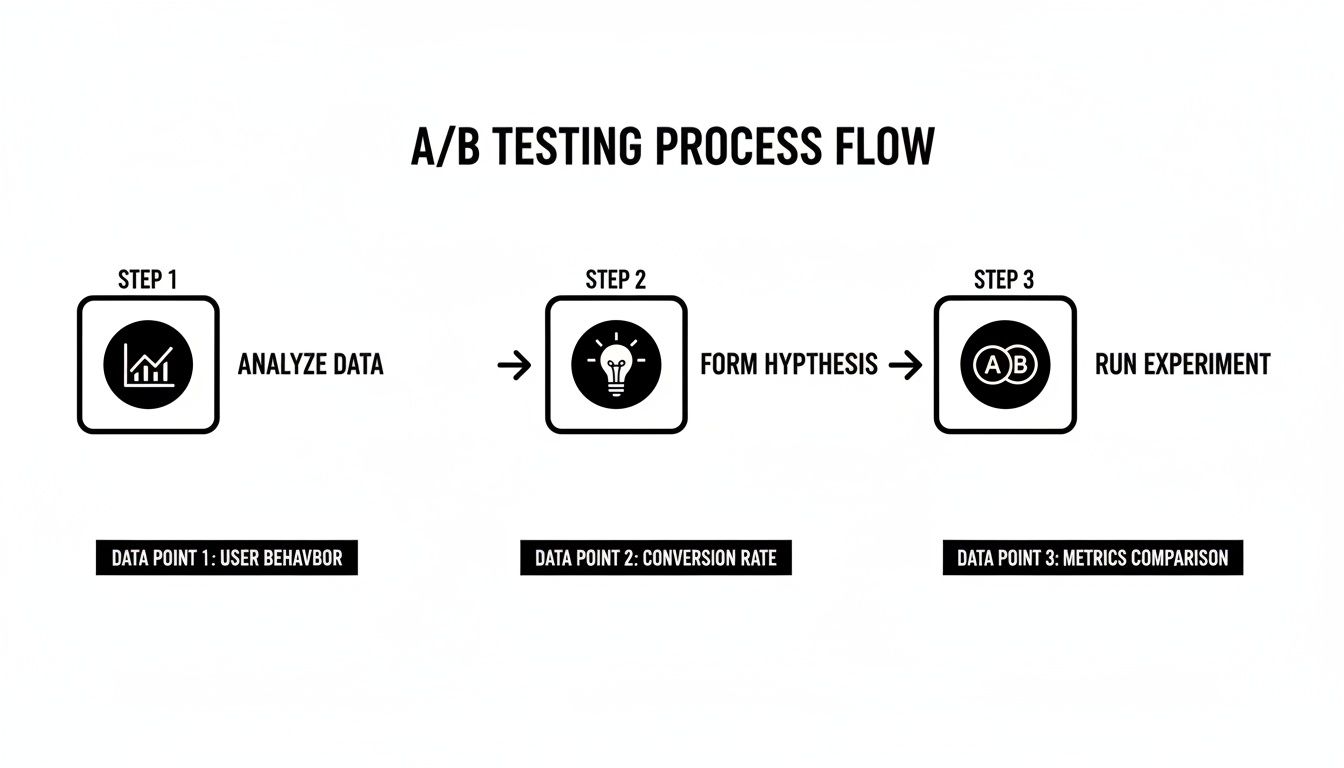
The key takeaway is that testing isn't a one-time fix. It's a continuous cycle of analysis, hypothesis, and experimentation. By embracing these advanced tools, you can automate that cycle and turn timing optimization into a consistent driver of engagement.
Creating Your Long-Term Optimization Strategy
Finding your best day to send a newsletter isn’t a one-and-done task; it’s an ongoing process of refinement. Think of it like tuning a guitar. Just because it sounded perfect last month doesn’t mean it’s still in tune today.
Your audience’s habits will shift, new trends will emerge, and your content will evolve. What worked wonders last quarter might be just okay today, which is why having a long-term testing strategy is so important.
Committing to Continuous Refinement
Treating optimization as a core part of your email marketing practice, instead of an occasional chore, is what separates the pros from the amateurs. This means getting into a regular rhythm of re-testing to keep your timing sharp.
You don't need to A/B test every single campaign. Instead, set a recurring calendar reminder to run a send-day experiment.
- Quarterly Check-In: A great starting point for most businesses. It’s frequent enough to catch meaningful shifts in subscriber behavior without creating a ton of extra work.
- Twice a Year: If your audience is stable and predictable, a bi-annual test is likely enough to keep your strategy aligned with their habits.
This simple habit ensures you’re always making decisions based on fresh, relevant data instead of coasting on outdated assumptions.
Expert Insight: Finding your ideal send day is not about discovering a single, permanent answer. It’s about building a sustainable process of listening to your audience and adapting your strategy to meet them where they are.
Summary & Your Next Step
Finding the best day to send your newsletter moves through three phases:
- Start with Benchmarks: Use industry data (midweek mornings) as your initial guide.
- Know Your Audience: Analyze your subscribers' routines and content needs to form a smart hypothesis.
- Test and Refine: Use A/B testing to replace guesswork with hard data, and continuously re-test to stay optimized.
Your Recommended Next Step
Don't overthink it. The goal is to start with one small, manageable test.
- Look at your last five campaigns and identify the day and time that performed best. This is your "control."
- For your next newsletter, schedule an A/B test. Send half your list the email at your control time, and send the other half at a new time based on a simple hypothesis (e.g., one day later, or in the evening instead of the morning).
By taking this one action, you're officially moving from guessing to a data-driven strategy.
Frequently Asked Questions
Even with a solid plan, a few questions always pop up when trying to nail down the perfect send day. Here are the most common ones.
How Long Should I Run an A/B Test?
A good rule of thumb is to wait at least 24 to 48 hours before you analyze the final results. Most opens happen in the first few hours, but there's always a long tail of engagement that trickles in over the next day or two. If you call the test too early, you're ignoring valuable data.
What’s More Important: Open Rate or Click-Through Rate?
The answer depends on the goal of your specific email.
- Open Rate is your key metric if your goal is brand awareness or sharing information (like a simple announcement). The goal is just for people to see you in their inbox.
- Click-Through Rate (CTR) is more important if you're trying to drive traffic or conversions. For newsletters with a clear call-to-action—like reading a blog post or shopping a sale—the click is what really counts.
Actionable Takeaway: Define your campaign's primary goal before you launch. That way, you’re measuring what truly matters.
Should I Send Newsletters on the Weekend?
It depends entirely on your audience. Weekdays are traditionally best for B2B, but weekends can be a goldmine for B2C, e-commerce, and hobby-focused newsletters when people have more leisure time. The only way to know for sure? Test it. Create a hypothesis and let the data tell you if it’s a smart move for your subscribers.
How Do I Handle Time Zones for a Global Audience?
If your list is spread across the globe, using a "send by time zone" feature is non-negotiable. Nearly every modern email marketing platform has this built-in. When you schedule your campaign for 9 AM, the system ensures it lands in each subscriber’s inbox at 9 AM their local time. It’s a simple toggle that dramatically lifts engagement by meeting people when it’s convenient for them.
What if My A/B Test Results Are Inconclusive?
It happens. If the open and click rates for both versions are nearly identical, you have a statistical tie. This isn't a failure—it's valuable information. It tells you that, for your audience, the two times you tested are equally effective. You can stick with what you were doing or simply pick one. More importantly, it’s a sign to start testing a different variable, like your subject lines or call-to-action.
At EmailGum, we provide the expert guides and practical tutorials you need to master every aspect of your email strategy. Dive deeper and turn your newsletter into your most powerful marketing channel. Explore more insights at EmailGum.