Email marketing remains one of the most powerful channels for connecting with customers, but simply sending a newsletter is no longer enough. The modern inbox is a competitive space where success is measured not by volume, but by value, relevance, and precision. Generic blasts are ignored; personalized, timely, and helpful communication is what builds trust and drives action. Moving beyond outdated tactics is essential for anyone looking to achieve meaningful results, whether that's nurturing new leads, increasing sales, or fostering long-term brand loyalty.
This guide is your practical blueprint for success. We've compiled a comprehensive roundup of the best email marketing strategies that top brands use to dominate the inbox. Forget surface-level tips and vague advice. We will provide a deep dive into ten high-impact tactics, from advanced segmentation and behavioral automation to sophisticated re-engagement campaigns and list hygiene.
For each strategy, you will find step-by-step advice, real-world examples, and actionable takeaways you can apply immediately to transform your email program into a powerful growth engine. Whether you're a small business owner, a seasoned digital marketer, or a content creator, these strategies will help you create emails that your subscribers genuinely want to open and act upon. Let's explore the techniques that will unlock your email marketing potential.
1. Segmentation and Personalization
Sending the same email to every subscriber is one of the fastest ways to land in the spam folder. Modern email marketing thrives on relevance, and that's where segmentation and personalization come in. This strategy involves dividing your audience into smaller, distinct groups (segments) and tailoring your messages to fit their specific characteristics and behaviors. This goes far beyond simply using a subscriber's first name; it’s about delivering content that feels uniquely relevant to each individual.
This approach is one of the best email marketing strategies because it directly boosts engagement. When subscribers receive content that aligns with their interests or past actions, they are significantly more likely to open, click, and convert.
Real-World Examples
Think about the masters of this strategy:
- Amazon sends you recommendations based on products you've viewed or purchased.
- Netflix suggests new shows based on your viewing history, ensuring you stay engaged with their platform.
- Spotify's "Discover Weekly" playlist is a powerful example of data-driven personalization delivered straight to your inbox.
These companies transform data into a personalized experience, making customers feel understood rather than just marketed to.
Step-by-Step Implementation
- Start with Basic Segments: Begin by grouping subscribers into simple categories like new subscribers, loyal customers, or inactive users. For example, create a segment of everyone who has purchased more than twice in the last year.
- Leverage Behavioral Data: Create segments based on user actions. A simple starting point is segmenting users who have abandoned a cart in the last 7 days or visited a specific product category page.
- Use Opt-in Preferences: During the sign-up process, add checkboxes that allow new subscribers to choose the type of content they want to receive (e.g., "Weekly Deals," "New Product Alerts," "Educational Content").
- Craft Your Message: Write tailored copy for a specific segment. For your "loyal customers" segment, you might send an exclusive "thank you" discount.
- Measure and Refine: Compare the open and click-through rates of your segmented campaigns to your general broadcasts to see the lift.
By tailoring your messaging, you show subscribers that you value their time and attention. For a deeper dive into making your emails feel more individual, explore these powerful techniques for personalization in email marketing.
2. Automated Email Workflows and Drip Campaigns
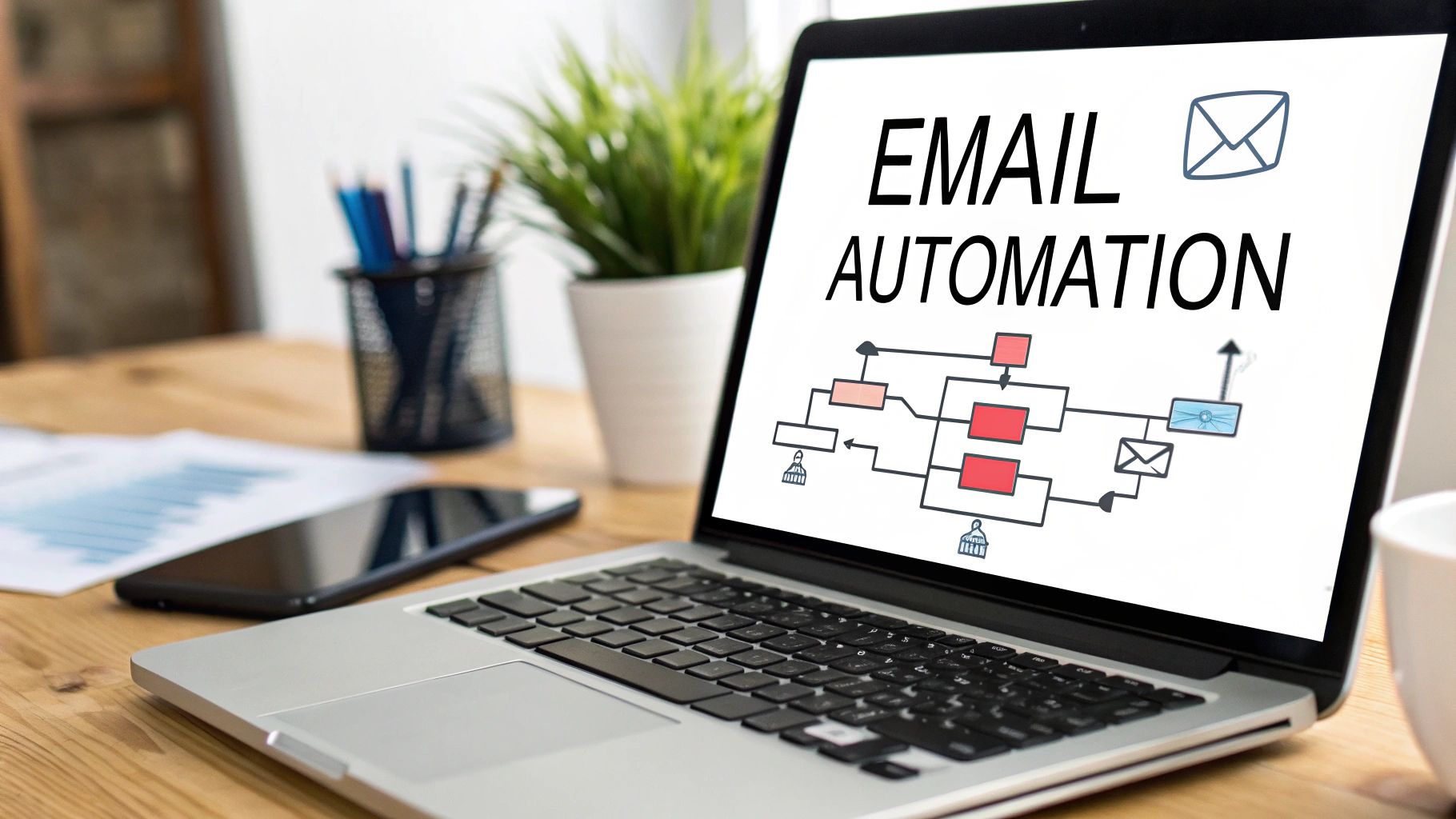
Manually sending emails for every customer interaction is impossible to scale. Automated workflows (often called drip campaigns) solve this by setting up pre-designed sequences of emails that are triggered automatically based on specific user actions or time intervals. This powerful strategy guides subscribers through the customer journey, delivering the right message at the right time without constant manual effort.
This approach is one of the best email marketing strategies because it ensures timely, relevant communication that nurtures leads and builds customer relationships efficiently. It allows you to create a consistent and personalized experience for every user, from their first welcome to their tenth purchase.
Real-World Examples
Leading brands have perfected this strategy, making it a cornerstone of their marketing:
- Shopify stores use automated abandoned cart sequences, sending reminders at 1 hour, 24 hours, and 3 days to recover lost sales.
- Airbnb sends a post-booking follow-up sequence with travel tips, local guides, and booking reminders to enhance the customer experience.
- HubSpot utilizes complex automation to nurture leads through the sales pipeline, scoring them based on engagement and delivering targeted content.
These companies use automation to create a seamless, responsive, and highly effective communication system that drives results while they focus on other tasks.
Step-by-Step Implementation
- Map the Customer Journey First: Before building a single workflow, outline the key touchpoints. For a new subscriber, the journey might be: Sign Up -> Welcome Email -> Educational Email -> First Offer.
- Start with a Welcome Series: Create a 3-5 email sequence for new subscribers. Email 1: Welcome and deliver lead magnet. Email 2 (2 days later): Introduce your brand story. Email 3 (4 days later): Share your most popular content or products.
- Define Triggers and Delays: In your email platform, set up the trigger (e.g., "Subscribes to list") and the time delays between each email in the sequence.
- Set Clear Exit Conditions: Ensure subscribers are removed from a workflow once they convert (e.g., make a purchase) to avoid sending irrelevant messages.
- Monitor Performance: Regularly review open rates, click-through rates, and conversion rates for each automation to identify areas for improvement.
By systemizing your communication, you can nurture leads and engage customers at scale. To get a head start, you can find inspiration and structure in this guide on crafting an email marketing campaign template.
3. A/B Testing and Multivariate Testing
Guesswork has no place in a high-performing email program. A/B testing (or split testing) is a methodical approach to optimizing your campaigns by comparing two versions of a single variable to see which one performs better. This data-driven process removes assumptions and allows you to make decisions based on how your audience actually behaves, not how you think they will.
This is one of the best email marketing strategies because it provides a clear, scientific path to improvement. By systematically testing elements like subject lines, calls-to-action, or send times, you can achieve incremental gains that compound into significant improvements in open rates, click-through rates, and conversions over time.
Real-World Examples
Top-tier email marketers rely on constant testing:
- Netflix famously tests different preview images and subject lines for its new show announcements, sometimes seeing a 20% lift in clicks from a single winning variation.
- HubSpot often runs tests on using emojis in subject lines, finding they can increase open rates by a significant margin depending on the audience and context.
- Ecommerce brands routinely A/B test their promotional offers, such as "20% Off" versus "Free Shipping," to discover which incentive drives more revenue for a specific campaign.
These companies don't guess what works; they test, learn, and iterate, ensuring their email efforts are as effective as possible.
Step-by-Step Implementation
- Form a Hypothesis: Start with a clear question. For example: "I believe using a question in the subject line will get a higher open rate than a statement."
- Choose One Element to Test: To get clear results, test only one variable at a time. Good starting points include the subject line, the call-to-action (CTA) button color, or the "from" name.
- Create Your Variations: In your email tool, create Version A (the control) and Version B (the test). For a subject line test, Version A might be "Our Fall Collection is Here," while Version B is "Ready for Fall? Our New Collection is Here."
- Run the Test: Send your test variations to a small but statistically relevant portion of your list (typically 10-20%). Most email platforms can automatically send the winning version to the rest of your list after a set period.
- Document Your Learnings: Keep a simple spreadsheet of what you tested, your hypothesis, the results, and what you learned. This becomes an invaluable internal resource.
4. Value-Driven Content, Educational Emails, and Storytelling
Constant sales pitches are a surefire way to drive unsubscribes. Instead, the most successful email programs prioritize building relationships by delivering genuine value through educational content and compelling storytelling. This strategy focuses on providing subscribers with useful insights, tips, and resources, establishing your brand as a trusted authority rather than just a seller.
This approach is one of the best email marketing strategies because it builds loyalty and trust. When you consistently offer help and tell engaging stories, subscribers look forward to your emails, making them far more receptive when you do present a promotional offer.
Real-World Examples
Think about the brands that have mastered this art:
- HubSpot sends a wealth of free guides, templates, and marketing tips that empower its audience, building immense goodwill.
- Grammarly provides engaging writing tips and language insights, reinforcing its value proposition without a hard sell.
- Patagonia uses powerful storytelling to share its environmental mission, creating a deep emotional connection with customers that transcends its products.
These companies understand that educating and inspiring their audience creates a stronger, more sustainable relationship than simply pushing for the next sale.
Step-by-Step Implementation
- Adopt the 80/20 Rule: Aim for 80% of your content to be valuable and educational, with only 20% being promotional. For every five emails, four should help the reader and one can sell.
- Identify Audience Pain Points: Brainstorm the biggest challenges your audience faces. If you sell project management software, your content could be about "5 Ways to Run More Efficient Meetings."
- Tell a Compelling Story: Frame your message with a narrative. Start with a relatable problem ("Struggling to keep your team on track?"), build tension, and present your content or service as the resolution.
- Make it Actionable: Provide clear, numbered steps or bulleted tips that subscribers can apply immediately to solve a problem or improve their lives.
- Share Unique Insights: Offer original research, data, or behind-the-scenes content that your audience can't get elsewhere. This positions you as an indispensable resource.
To ensure your email campaigns consistently provide genuine value and foster readership, it's crucial to learn how to write a good newsletter that truly connects with your audience. By shifting your focus from selling to serving, you cultivate a loyal following that is ready to listen.
5. Mobile-Optimized and Responsive Email Design
In an era where smartphones are rarely out of reach, ignoring mobile design is a critical mistake. Responsive design ensures your emails look and function perfectly on any screen, from a large desktop monitor to a small smartphone. With a significant portion of emails now opened on mobile devices, a non-responsive email often means a deleted email, resulting in lost engagement and revenue.

This approach is one of the best email marketing strategies because it directly impacts user experience and accessibility. An email that is easy to read and interact with on a phone will always outperform one that forces users to pinch, zoom, and struggle to find a tiny link.
Real-World Examples
Top brands master mobile-first communication:
- Uber sends simple, concise ride reminders with all essential information clearly visible on a small screen.
- Starbucks designs its rewards program emails so that barcodes are easy to scan directly from a phone at the register.
- Lyft's promotional emails feature large, thumb-friendly call-to-action (CTA) buttons that are impossible to miss.
These companies prioritize the mobile experience, recognizing that it is the primary way many customers will interact with their brand through email. Their designs are clean, scannable, and built for action.
Step-by-Step Implementation
- Use a Single-Column Layout: The simplest way to ensure mobile compatibility is to stack your content vertically. This prevents horizontal scrolling on narrow screens.
- Keep Subject Lines Short: Aim for under 50 characters so your core message is not cut off in mobile inboxes. Use your email platform's preview tool to check.
- Make CTAs Large and Tappable: Use high-contrast buttons with a minimum height of 44 pixels. This makes them easy for thumbs to tap without accidentally hitting another link.
- Use Readable Fonts: Choose a simple, sans-serif font (like Arial or Helvetica) and set the body text to at least 16px to ensure readability without zooming.
- Always Test Before Sending: Use tools like Litmus or your email service provider's built-in previewer to see how your email looks on popular mobile devices and clients like Gmail, Apple Mail, and Outlook.
6. Behavioral Email Triggers and Real-Time Personalization
Imagine sending the perfect email at the exact moment a customer is thinking about your brand. That's the power of behavioral triggers. This strategy involves sending automated emails in real-time or near-real-time based on a subscriber's specific actions, such as visiting a certain webpage, adding an item to their cart, or clicking a link. It’s about reacting to user intent instantly with highly contextual communication.
This approach is one of the best email marketing strategies because it capitalizes on peak interest. By responding to immediate user behavior, you deliver messages that are not just relevant but also incredibly timely, dramatically increasing the chances of engagement and conversion.
Real-World Examples
The most successful brands have mastered reacting to customer actions:
- Ecommerce stores like Shopify or BigCommerce automatically send an abandoned cart email just an hour after a shopper leaves, often including the exact items they left behind.
- Airlines send a helpful email with your boarding pass exactly 24 hours before a flight, providing value at a critical moment.
- Spotify might send a "we miss you" email if a user hasn't logged in for a while, encouraging them to rediscover new music.
These automated triggers make communication feel like a natural conversation, responding to a user's needs right when they have them.
Step-by-Step Implementation
- Identify High-Value Actions: Start by setting up triggers for your most important user behaviors. The top three to start with are abandoned carts, viewing a product but not adding it to the cart (browse abandonment), and post-purchase follow-ups.
- Set Up the Trigger: In your email tool, connect your website activity to email triggers. For an abandoned cart, the trigger would be "Adds item to cart" AND "Does not complete purchase within 1 hour."
- Personalize with Specific Details: Don't send a generic "You left something behind" email. Use dynamic content to automatically pull in the product image, name, and a direct link back to the user's cart.
- Create a Multi-Step Sequence: For abandoned carts, a simple three-email sequence is highly effective: Email 1 (1 hour later): A gentle reminder. Email 2 (24 hours later): Address potential concerns (e.g., shipping costs, FAQs). Email 3 (3 days later): A final reminder, possibly with a small incentive like a 10% discount.
- Set Frequency Caps: Be careful not to overwhelm subscribers. Set rules that prevent a single user from receiving too many triggered emails in a short period (e.g., no more than one browse abandonment email every 7 days).
By aligning your emails with user actions, you create a responsive and personalized experience that builds customer loyalty and drives immediate results.
7. List Building and Lead Magnet Strategies
Even the most sophisticated email marketing strategies are ineffective without a quality audience. List building is the foundational process of actively growing your email list, and powerful lead magnets are the fuel. This strategy involves offering a valuable, free resource or incentive in exchange for a visitor's email address, turning anonymous traffic into engaged subscribers.
This approach is one of the best email marketing strategies because it focuses on quality over quantity. By offering something that directly solves a problem for your target audience, you attract subscribers who are genuinely interested in what you have to say, setting the stage for higher engagement and conversions down the line.
Real-World Examples
Think about the masters of this strategy:
- HubSpot provides an extensive library of free ebooks, templates, and courses on marketing and sales, positioning themselves as an indispensable industry resource.
- Backlinko’s Brian Dean offers highly specific guides, like "The Skyscraper Technique," attracting SEO professionals eager for proven frameworks.
- Grammarly offers a free writing assessment tool, providing immediate value and demonstrating the power of its premium product.
These companies don't just ask for an email; they offer a compelling trade that provides immediate value, making the decision to subscribe an easy one for their ideal customers.
Step-by-Step Implementation
- Solve a Specific Pain Point: Create a lead magnet that offers a quick, tangible solution. Instead of a vague "eBook," create a "10-Point Website SEO Checklist" or a "Monthly Budgeting Template for Freelancers."
- Design a High-Converting Opt-in Form: Use a clear headline that states the benefit (e.g., "Get Your Free SEO Checklist"). Keep the form simple, asking for only a name and email address to minimize friction.
- Place Forms Strategically: Add your opt-in forms in high-traffic areas like your blog sidebar, at the end of relevant articles (content upgrades), and as a timed pop-up on key pages.
- Deliver Instantly: Set up an automated welcome email that delivers the promised lead magnet immediately after a user subscribes. This builds trust from the very first interaction.
- Promote Your Lead Magnet: Don't just wait for visitors to find it. Share your lead magnet on social media, in your email signature, and mention it in relevant guest posts or podcast appearances.
By creating an irresistible offer, you transform your website from a passive content platform into an active list-building engine.
8. Engagement-Focused Re-engagement and Win-Back Campaigns
Maintaining a healthy and engaged email list is just as important as growing it. Over time, some subscribers will naturally become inactive. A win-back campaign is a strategic series of emails sent to these disengaged subscribers to either rekindle their interest or confirm it's time to let them go. This approach cleans your list, improves deliverability, and can recover valuable customers.
This is one of the best email marketing strategies because it directly boosts your overall performance metrics. Inactive subscribers drag down open and click-through rates, which can harm your sender reputation with services like Gmail and Outlook. A successful win-back campaign either boosts engagement or efficiently prunes your list, ensuring you're only marketing to an interested audience.
Real-World Examples
Think about how leading subscription services handle this:
- Netflix sends emails titled "Come back and see what's new" to dormant accounts, highlighting new popular shows and movies to entice them back.
- Slack targets inactive workspaces with "See what you're missing" updates, summarizing recent conversations to create a sense of FOMO (fear of missing out).
- Spotify masterfully re-engages seasonal users with its annual "Wrapped" campaign, a personalized data-driven experience that brings people back to the platform.
These campaigns don't just ask users to return; they remind them of the value they're missing and make a compelling case for re-engagement.
Step-by-Step Implementation
- Define Inactivity Clearly: Create a segment of subscribers who have not opened or clicked an email in a specific timeframe, such as the last 90 or 180 days.
- Lead with a Compelling Subject Line: Use subject lines like "Is this goodbye?" or "We miss you. Here's 20% off" to grab their attention in a crowded inbox.
- Create a Multi-Email Series: Plan a 3-email sequence. Email 1: A gentle "we miss you" with a reminder of your brand's value. Email 2: A compelling offer or incentive to return. Email 3: A final "goodbye" email that lets them know you'll be removing them from the list if they don't act, with a clear link to stay subscribed.
- Provide a Preference Center Option: In your emails, give subscribers a chance to update their email frequency (e.g., switch from weekly to monthly) or content preferences instead of unsubscribing completely.
- Clean Your List: After the campaign, gracefully remove subscribers who still haven't engaged. The ultimate goal is a clean, healthy list. This improves your sender score and overall deliverability.
9. Social Proof and User-Generated Content Emails
Instead of telling subscribers your product is great, let your existing customers do it for you. This strategy leverages customer testimonials, reviews, ratings, and user-generated content (UGC) like photos and videos directly within your emails. By showcasing authentic experiences from real people, you build powerful credibility and trust that traditional marketing copy often struggles to achieve.

This is one of the best email marketing strategies because it taps into a core psychological principle: people trust other people more than they trust brands. When potential buyers see others succeeding with your product or service, it reduces their perceived risk and makes them feel more confident in their purchasing decision.
Real-World Examples
Think about the brands that make you feel confident in a purchase before you even click "buy":
- Sephora masterfully features customer reviews and photos of real people using their makeup products, showing how they look on different skin tones.
- Airbnb often includes snapshots of glowing guest reviews and host photos in promotional emails for specific destinations, making the experience feel more tangible and trustworthy.
- Glossier has built an empire on user-generated content, frequently highlighting customer posts from Instagram in their emails to showcase authentic product use.
These companies turn their customers into their most effective advocates, using their genuine satisfaction to influence new buyers and reinforce brand loyalty.
Step-by-Step Implementation
- Actively Request Reviews: Set up an automated post-purchase email sent 7-14 days after delivery, asking satisfied customers for a review. Make it easy by linking directly to the product page.
- Get Permission for UGC: When you see customers posting about your brand on social media, reach out and ask for their permission to feature their content in your marketing.
- Create a "Best Of" Campaign: Design an email campaign that showcases your top-rated products, featuring a 5-star rating and a short, powerful quote from a real customer for each item.
- Feature Results-Oriented Testimonials: Instead of a generic "Great product!", use testimonials that highlight tangible outcomes, like "We saw a 40% increase in leads after implementing this tool." This provides concrete proof of value.
- Always Give Credit: When you feature UGC, always credit the creator by tagging their social media handle. This fosters a sense of community and encourages more users to share.
10. Email List Hygiene and Compliance
Sending emails to a messy or non-compliant list is like trying to build a house on a shaky foundation. Email list hygiene and compliance involve regularly cleaning your list of invalid addresses and strictly adhering to global email regulations like GDPR and CAN-SPAM. This foundational strategy is crucial for protecting your sender reputation, ensuring high deliverability, and avoiding significant legal penalties.
This approach is one of the best email marketing strategies because it directly impacts your bottom line. A clean, engaged, and compliant list means more of your emails land in the primary inbox, leading to higher open rates, better engagement, and a stronger ROI, all while keeping your brand trustworthy and legally sound.
Real-World Examples
The consequences of neglecting this are severe, while the benefits of mastering it are clear:
- Global regulators have issued massive fines for non-compliance, such as the €50 million penalty for Meta and a €35 million fine for Amazon for GDPR violations.
- Major inbox providers like Gmail and Yahoo now require authenticated domains (using SPF, DKIM, and DMARC) to combat spam, making compliance a technical necessity.
- Leading email platforms like Klaviyo and HubSpot often require double opt-in to help their users maintain high-quality lists and adhere to an effective anti-spam policy.
These examples show that list hygiene and compliance are no longer optional; they are essential components of a modern email marketing program.
Step-by-Step Implementation
- Implement Double Opt-In: This is the gold standard for compliance. After signing up, send new subscribers an automated email asking them to click a link to confirm their subscription. This proves consent and ensures the address is valid.
- Perform Regular Cleanings: At least quarterly, use a reputable validation service like ZeroBounce or BriteVerify to scrub your entire list of invalid, misspelled, or risky email addresses.
- Make Unsubscribing Easy: Include a clear, one-click unsubscribe link in the footer of every email. Per CAN-SPAM, you must process these requests promptly (ideally instantly, but no later than 10 days).
- Authenticate Your Domain: Work with your IT department or follow your email provider's guide to set up SPF, DKIM, and DMARC records for your sending domain. This proves to inbox providers that your emails are legitimate.
- Include Your Physical Address: To comply with CAN-SPAM, you must include your valid physical postal address in the footer of every commercial email you send.
By prioritizing these steps, you protect your ability to reach your audience effectively. For a comprehensive guide, see these email deliverability best practices.
Top 10 Email Marketing Strategies Comparison
| Strategy | 🔄 Implementation complexity | ⚡ Resource & tech needs | 📊 Expected outcomes | 💡 Ideal use cases | ⭐ Key advantages |
|---|---|---|---|---|---|
| Segmentation and Personalization | High 🔄🔄 | High ⚡⚡ | Higher open/CTR, improved LTV and ROI | Targeted promos, lifecycle emails, product recommendations | ⭐ More relevant messaging, reduced churn |
| Automated Email Workflows & Drip Campaigns | Medium 🔄🔄 | Medium ⚡⚡ | Consistent engagement, higher conversions, time savings | Welcome series, abandoned cart, lead nurturing | ⭐ Scalable, reliable customer journeys |
| A/B & Multivariate Testing | Medium 🔄🔄 | Medium ⚡ | Incremental performance gains; data-driven optimization | Subject lines, CTAs, layouts, send-time tests | ⭐ Removes guesswork; improves ROI over time |
| Value-Driven Content & Storytelling | Medium 🔄 | Medium ⚡ | Stronger brand trust and long-term engagement (slower revenue) | Brand building, retention, thought leadership | ⭐ Builds authority and subscriber loyalty |
| Mobile-Optimized & Responsive Design | Medium 🔄 | Low-Medium ⚡⚡ | Improved mobile CTR and readability; lower bounce rates | Any campaign with high mobile opens (>50%) | ⭐ Better user experience across devices |
| Behavioral Triggers & Real-Time Personalization | Very High 🔄🔄🔄 | Very High ⚡⚡⚡ | Very high engagement and conversion lift (40–70%+) | Abandoned cart, transactional, event-driven messages | ⭐ Immediate relevance; strong ROI |
| List Building & Lead Magnet Strategies | Low-Medium 🔄 | Medium ⚡⚡ | Steady subscriber growth; lead quality varies | Top-of-funnel acquisition, gated content, webinars | ⭐ Scalable acquisition and qualified leads |
| Re-engagement & Win-Back Campaigns | Medium 🔄🔄 | Low-Medium ⚡⚡ | Recovers some revenue; improves deliverability and list health | Dormant subscribers, periodic list cleanup | ⭐ Cost-effective way to restore engagement |
| Social Proof & User-Generated Content | Medium 🔄 | Medium ⚡⚡ | Higher conversion rates (≈25–50%); increased trust | Product pages, testimonial-driven promos, ecommerce | ⭐ Authentic credibility and persuasive social proof |
| Email List Hygiene & Compliance | Medium 🔄🔄 | Medium ⚡⚡ | Improved deliverability, protected sender reputation, legal risk reduction | All programs — foundational requirement | ⭐ Essential for deliverability and regulatory compliance |
Summary and Your Next Step
We've covered ten of the most effective and best email marketing strategies available today. From the foundational precision of Segmentation and Personalization to the dynamic responsiveness of Behavioral Email Triggers, each tactic serves a single goal: to deliver the right message, to the right person, at the right time. The key takeaway is that modern email marketing should function less like a megaphone and more like a thoughtful, one-on-one conversation. By implementing these approaches, you build relationships at scale, transforming a simple email list into a loyal community and a powerful engine for sustainable business growth.
Feeling overwhelmed is natural. The key is not to implement all ten strategies overnight but to build momentum through focused, incremental improvements.
Recommended Next Step: Choose one strategy from this list that addresses your biggest current challenge. If you're struggling with low open rates, dedicate the next two weeks to A/B testing your subject lines. If you're not seeing conversions from your website, focus solely on setting up a high-impact abandoned cart automation workflow. Master that one area, measure the results, and then move on to the next. This focused approach will yield tangible results far more effectively than trying to do everything at once.
Ready to put these advanced strategies into action without the technical headache? EmailGum provides intuitive yet powerful tools for segmentation, automation, and A/B testing, helping you implement the best email marketing strategies with ease. Start building smarter campaigns today with EmailGum.