
Choosing the right newsletter platform is a critical first step in building a direct connection with your audience, but the cost can be a significant barrier. The good news is that a powerful, professional-grade platform doesn't have to break the bank. An entire ecosystem of the best free newsletter platforms exists, each offering a unique set of features tailored to different needs, from individual creators to growing small businesses. The challenge isn't finding a free option; it's navigating the dozens of choices to find the one that perfectly aligns with your specific goals, technical skills, and growth strategy.
This guide is designed to cut through that noise. We've meticulously reviewed the top contenders, moving beyond marketing claims to provide a practical, hands-on analysis of what each platform truly offers on its free plan. You will find a detailed breakdown of 12 leading options, including Substack, beehiiv, MailerLite, Mailchimp, and Brevo. Each review covers essential criteria like audience and sending limits, ease of use, design capabilities, and key automation features. We also provide direct links and screenshots to give you a clear view of the user experience before you even sign up.
Our goal is to equip you with the insights needed to make a confident decision. We'll compare subscriber caps, highlight standout features, and point out the limitations you need to be aware of as you scale. For those looking to understand the broader market, it can be helpful to consult a definitive email marketing platforms comparison to see how these free tools stack up against paid enterprise solutions. Let's dive in and find the perfect free platform to launch or grow your newsletter today.
1. Substack
Substack is a publishing-first platform designed for writers and creators who want to build a direct relationship with their audience through newsletters. Its core strength lies in its simplicity and integrated monetization model, making it an excellent choice for individuals aiming to transition from a free to a paid publication without the technical overhead of managing payment gateways and complex email marketing software. The platform combines a clean, web-based editor with email delivery, essentially creating a blog and newsletter in one.
What truly sets Substack apart is its powerful network effect. The platform actively promotes writers to new readers through its recommendation features and the "Notes" social feed. This built-in discovery engine can be a significant advantage for creators trying to find their initial audience—a key challenge when starting out.
Key Features & Limitations
Substack's free plan is one of the most generous available, with no limits on subscribers. It’s completely free to use for publishing free newsletters. The catch comes when you enable paid subscriptions.
- Pricing: Free for unlimited subscribers. If you launch paid subscriptions, Substack takes a 10% cut of your revenue, plus standard Stripe processing fees (typically 2.9% + $0.30).
- Core Strengths:
- Effortless Monetization: Built-in payments via Stripe make launching a paid newsletter incredibly simple. For example, a writer can set up a paid tier in minutes and offer exclusive content to paying subscribers.
- Audience Discovery: The network actively helps new writers get discovered through recommendations and its social features.
- Simplicity: The interface is minimal and focused on writing, reducing the learning curve for beginners.
- Limitations:
- Minimal Customization: Design and layout options are very limited, meaning your newsletter will look similar to others on the platform.
- Basic Analytics: Provides open rates and click tracking but lacks advanced segmentation and automation found in traditional email service providers (ESPs).
Best For: Solo writers, journalists, and niche experts who prioritize writing and community building over advanced marketing automation and want a straightforward path to monetization.
2. beehiiv
beehiiv is a performance-focused newsletter platform built for creators and media brands who prioritize growth. It offers a suite of integrated tools designed to scale an audience and monetize directly, positioning itself as a more sophisticated alternative to simpler publishing platforms. The platform's core philosophy centers on providing native solutions for referrals, advertisements, and analytics, making it one of the best free newsletter platforms for those with a growth mindset.

What makes beehiiv stand out is its emphasis on providing professional-grade growth tools within its free plan. Features like a built-in referral program, an ad network for monetization, and advanced analytics give creators a powerful toolkit right from the start. This approach contrasts with platforms that reserve such features for high-tier paid plans.
Key Features & Limitations
beehiiv’s "Launch" plan is one of the most generous free offerings available, supporting a significant subscriber base before requiring an upgrade. It provides a clear path for newsletters to grow into sustainable businesses.
- Pricing: Free for up to 2,500 subscribers with unlimited sends. Paid plans unlock advanced features like A/B testing, segmentation, and the full monetization suite.
- Core Strengths:
- Generous Free Tier: The 2,500 subscriber limit is significantly higher than many competitors, allowing for substantial growth before costs kick in.
- Built-in Growth Tools: Native referral programs and recommendation features are included to help scale your audience. A real-world example is a newsletter offering a free ebook to subscribers who refer three new readers.
- Multiple Monetization Paths: Offers paid subscriptions, an ad network, and "Boosts" for audience cross-promotion.
- Limitations:
- Monetization is Gated: The ad network and other advanced monetization tools require a paid plan.
- Steeper Learning Curve: With more features comes a bit more complexity compared to ultra-minimalist platforms.
Best For: Growth-oriented creators, media brands, and businesses that need powerful, built-in tools for audience acquisition and monetization without high initial costs.
3. MailerLite
MailerLite positions itself as a modern and user-friendly email marketing platform, striking an excellent balance between powerful features and intuitive design. It's more than just a newsletter tool; its free plan includes a drag-and-drop editor, landing pages, forms, and basic automation sequences. This makes it a strong contender for creators and small businesses who need an all-in-one solution without an immediate budget, moving beyond simple text-based emails to more visually engaging campaigns.

What makes MailerLite a great free newsletter platform is its focus on providing core marketing tools from the start. Unlike platforms focused purely on publishing, MailerLite equips you with the essentials for list growth and audience engagement right out of the box. For example, you can create a sign-up form for your blog, embed it, and automatically send a welcome email to every new subscriber, all within the free plan. New users also get 14 days of access to premium features, offering a valuable trial run of its full capabilities.
Key Features & Limitations
MailerLite’s "Forever Free" plan provides a comprehensive feature set for new and growing newsletters, though its subscriber limit is a key consideration.
- Pricing: Free for up to 500 subscribers and 12,000 emails per month. Paid plans unlock higher limits and advanced features, starting at $10/month.
- Core Strengths:
- All-in-One Tools: Includes a website builder, landing pages, and pop-up forms even on the free plan.
- User-Friendly Interface: The drag-and-drop editor and clean dashboard are easy for beginners to navigate.
- Basic Automation: Set up welcome emails or simple drip campaigns to engage new subscribers automatically.
- Limitations:
- Lower Subscriber Cap: The 500-subscriber limit on the free plan is lower than some competitors.
- MailerLite Branding: Free plan emails include MailerLite branding.
- Limited Support: Free users have access to email support for the first 30 days only.
Best For: Small businesses, bloggers, and creators who want a feature-rich, user-friendly platform with tools for list growth and automation from day one.
4. Mailchimp
Mailchimp is one of the most established names in email marketing, offering a comprehensive suite that extends beyond simple newsletters. Its free plan, while limited, serves as an excellent entry point for small businesses and creators who need a familiar interface and access to a vast ecosystem of third-party integrations. It provides a structured environment with templates and basic automation tools, making it a reliable choice for those planning to scale their marketing efforts over time.

What makes Mailchimp a staple among the best free newsletter platforms is its all-in-one approach. The platform integrates a CRM, landing pages, and social media tools directly into its dashboard, allowing users to manage multiple marketing channels from one place. This unified functionality is particularly useful for businesses that want to align their email campaigns with broader marketing initiatives without juggling multiple disconnected tools from the start.
Key Features & Limitations
Mailchimp's free plan is designed as a starting point, with clear caps that encourage users to upgrade as their audience grows. It's a solid, if restrictive, foundation for building an email list.
- Pricing: Free for up to 500 contacts and 1,000 email sends per month (with a 500/day limit). Paid plans unlock higher limits and advanced features.
- Core Strengths:
- Huge Ecosystem: Integrates with thousands of apps and services, including major e-commerce platforms like Shopify and WooCommerce. For instance, an online store can automatically sync customer data and purchase history to send targeted product recommendations.
- User-Friendly Interface: The campaign builder is intuitive, and there are ample learning resources and templates available.
- All-in-One Tools: Includes basic CRM, landing pages, forms, and simple automations even on the free plan.
- Limitations:
- Restrictive Free Plan: The 500-contact limit is low, and the Mailchimp branding is mandatory on all free emails.
- Costly Scaling: Paid plans can become expensive quickly as your contact list expands.
Best For: Small businesses and beginners who want a reputable, all-in-one platform with extensive integrations and are willing to upgrade as they grow past the initial free limits.
5. Brevo (formerly Sendinblue)
Brevo, formerly known as Sendinblue, is a comprehensive, all-in-one marketing platform that extends well beyond standard newsletters. Its strength lies in offering a suite of powerful tools typically found in premium services, including transactional email, SMS marketing, and basic automation, all within a generous free plan. This makes it an ideal starting point for small businesses and marketers who anticipate needing a more robust, multi-channel marketing solution as they grow.

What truly sets Brevo apart in the free tier is its massive contact storage capacity and inclusion of transactional email functionality. While other free newsletter platforms focus solely on newsletters, Brevo allows you to manage a large audience list and send critical emails like password resets or order confirmations without needing a separate service. This integrated approach can significantly streamline a small business's operations and budget from day one.
Key Features & Limitations
Brevo’s free plan is designed for scale in contact numbers but is limited by a daily sending cap, which is an important trade-off to consider for high-frequency senders.
- Pricing: Free for up to 100,000 contacts, but with a sending limit of 300 emails per day. Paid plans start at $25/month to remove the daily cap and Brevo branding.
- Core Strengths:
- Generous Contact Storage: The free plan’s contact limit is one of the highest available, allowing you to grow your list without immediate cost.
- All-in-One Platform: Combines email newsletters, transactional emails (like purchase receipts), and optional SMS marketing in a single dashboard.
- Advanced Features: Includes basic marketing automation, segmentation, and a drag-and-drop editor.
- Limitations:
- Daily Sending Cap: The 300 emails/day limit on the free plan restricts sending to larger lists at once. For example, sending a newsletter to 1,000 people would take over three days.
- Mandatory Branding: All emails sent on the free plan include Brevo branding.
Best For: Small businesses and e-commerce sites needing a scalable, multi-channel platform that combines newsletter marketing with essential transactional emails on a budget.
6. EmailOctopus
EmailOctopus is an email marketing platform renowned for its affordability and simplicity, making it a powerful contender among the best free newsletter platforms. It provides a generous free plan and a clean, intuitive interface that helps users send effective campaigns without a steep learning curve. The platform is designed for budget-conscious creators, small businesses, and startups who need core email marketing features without the high costs associated with more complex systems.

What makes EmailOctopus stand out is its unique "Connect" plan, which allows users to send emails through their own Amazon SES account. This drastically reduces sending costs for users with larger lists who are willing to handle a bit of technical setup. This dual-path approach, offering both a standard hosted plan and the SES integration, provides unparalleled flexibility for businesses scaling on a tight budget.
Key Features & Limitations
EmailOctopus offers one of the most generous free plans available, making it an excellent starting point for new creators. The free tier includes access to basic automation, landing pages, and forms, though with some limitations.
- Pricing: The free plan supports up to 2,500 subscribers and 10,000 emails per month. Paid plans start at just $8/month.
- Core Strengths:
- Cost-Effective Scaling: Exceptionally competitive pricing, especially with the Amazon SES integration option for low-cost sending at scale.
- Generous Free Plan: High subscriber and email limits make it easy to start and grow without immediate investment.
- User-Friendly Interface: The platform is straightforward and easy to navigate, ideal for beginners.
- Limitations:
- Branding on Free Plan: Emails and forms sent on the free plan will include EmailOctopus branding.
- Basic Automations: Lacks the highly advanced, multi-branching automation sequences found in enterprise-level tools. For example, you can set up a welcome series, but not complex "if/then" workflows based on user behavior.
Best For: Small businesses, bloggers, and startups who need a simple, affordable, and high-value email marketing solution with a generous free starting point.
7. Buttondown
Buttondown is a minimalist, creator-friendly newsletter tool designed with simplicity and speed at its core. It caters specifically to writers and developers who appreciate a Markdown-first workflow and a no-frills interface. The platform prioritizes a clean, distraction-free writing experience, making it one of the best free newsletter platforms for those who want to focus purely on their content without getting bogged down by a complex email builder. It is an independent, transparent, and privacy-focused alternative to larger, venture-backed platforms.

What sets Buttondown apart is its "just the essentials" philosophy and its commitment to being an indie tool built for creators. It doesn't try to be an all-in-one marketing suite; instead, it excels at being an elegant and powerful tool for writing and sending newsletters. Features like custom domains, paid subscriptions, and public archives are available from the start, providing a solid foundation for growth. The platform also offers a robust API, making it a great choice for technical users who want to integrate their newsletter into custom workflows.
Key Features & Limitations
Buttondown’s free plan is ideal for getting started, though its subscriber limit is lower than some competitors. The paid plans are affordably priced as your audience grows.
- Pricing: Free for up to 100 subscribers. Paid plans start at $9/month for up to 1,000 subscribers. For paid newsletters, Buttondown takes a 5% fee, plus Stripe processing fees.
- Core Strengths:
- Simplicity and Speed: A Markdown-based editor and minimalist UI make writing and publishing incredibly fast.
- Privacy-Focused: An independent platform that respects user privacy and doesn't engage in audience-selling.
- Developer-Friendly: A powerful API allows for extensive custom integrations.
- Limitations:
- Low Free Tier Cap: The 100-subscriber limit on the free plan is restrictive for those aiming for rapid initial growth.
- Add-on Costs: Key features like automations and running multiple newsletters are only available as paid add-ons.
Best For: Writers, developers, and creators who value a minimalist Markdown workflow, privacy, and an elegant, straightforward tool for publishing their newsletter.
8. Ghost
Ghost is a powerful open-source publishing platform designed for professional creators who need a fully-integrated website, blog, and newsletter system. Its primary advantage is offering complete ownership and control over your content, brand, and audience data, especially for those who choose to self-host. Ghost combines sophisticated web publishing capabilities with native membership tiers and email newsletters, making it a robust alternative to patching together multiple separate tools.
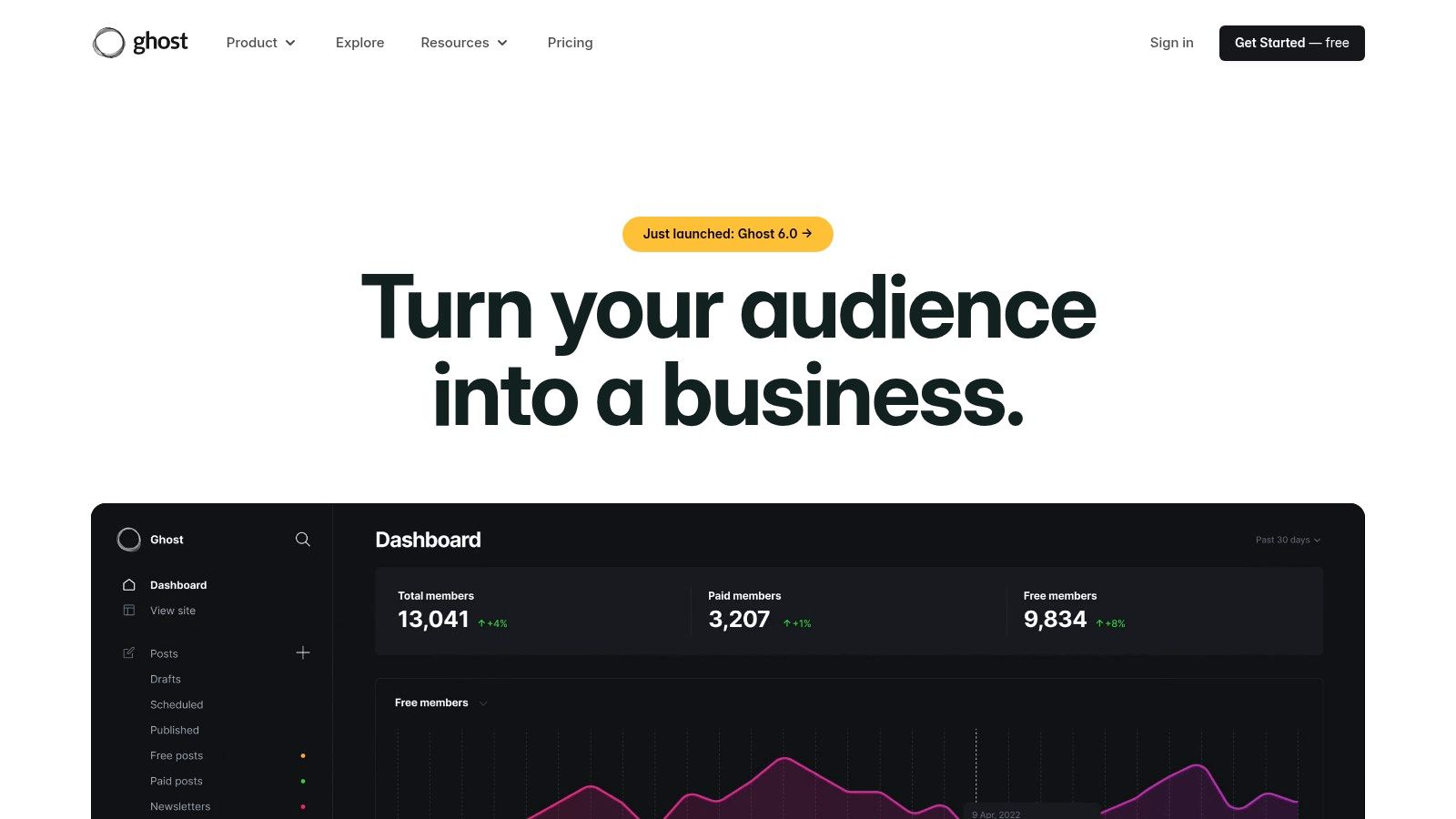
What truly distinguishes Ghost is its open-source nature and media-centric design. While turnkey platforms offer simplicity, Ghost provides unparalleled flexibility for creators who want to build a true media brand. You can customize your site's design extensively and integrate it with a vast ecosystem of tools. This makes it one of the best free newsletter platforms for those with the technical confidence to manage their own installation.
Key Features & Limitations
The Ghost software itself is completely free if you self-host it, meaning you only pay for your own server and any third-party email delivery service costs at scale. The paid Ghost(Pro) plan handles all the technical aspects for you.
- Pricing: Free and open-source software (self-hosting). The managed Ghost(Pro) hosting starts at $9/month for up to 500 members.
- Core Strengths:
- Total Ownership: You own your content, design, and audience data with no platform lock-in.
- Website & Newsletter in One: A powerful, unified system for publishing content on the web and via email.
- Extensive Customization: Offers deep control over design and functionality through themes and integrations.
- Limitations:
- Technical Overhead: Self-hosting requires technical knowledge of server management and setup. For example, you'll need to configure a web server, database, and email delivery service like Mailgun.
- Managed Hosting is Paid: The easy, non-technical option (Ghost(Pro)) comes with a monthly fee.
Best For: Technically-inclined writers, media brands, and publishers who want maximum control and a unified platform for their website and newsletter without platform fees on revenue.
9. HubSpot (Free Email Marketing)
HubSpot offers a powerful suite of free tools where email marketing is just one component of a much larger ecosystem. Instead of being a dedicated newsletter platform, it’s a free Customer Relationship Management (CRM) system at its core. This makes it an ideal choice for small businesses that need to manage customer data, track interactions, and send newsletters, all within a single, integrated environment. The platform is designed to scale with your business, providing a clear and logical upgrade path as your marketing needs become more complex.

What truly sets HubSpot apart is the context its CRM provides. Every email you send can be informed by data from your contact records, such as lifecycle stage or last interaction date. This integration allows for more personalized and effective communication right from the start, even on the free plan. While other tools focus solely on publishing, HubSpot focuses on building a full marketing and sales funnel, positioning it as one of the best free newsletter platforms for businesses with growth ambitions.
Key Features & Limitations
HubSpot’s free plan is incredibly generous for a business-focused tool, though it comes with some notable constraints designed to encourage upgrades. The free tier gives you a solid foundation for managing contacts and sending targeted emails.
- Pricing: Free plan includes up to 2,000 email sends per calendar month and allows you to store up to 1 million contacts. All free emails include HubSpot branding. Paid plans remove limits and branding.
- Core Strengths:
- Integrated Free CRM: Manage all your contacts and customer data in one place, providing deep context for your email campaigns. For example, you can segment your list to send a special offer only to contacts who have visited your pricing page.
- All-in-One Platform: Includes free tools for forms, landing pages, live chat, and ad management.
- Scalability: Provides a seamless upgrade path to advanced marketing automation, reporting, and sales tools as your business grows.
- Limitations:
- Branding & Send Limits: The 2,000 monthly send limit and mandatory HubSpot branding on the free plan can be restrictive for frequent publishers.
- Higher Learning Curve: More complex than simple newsletter tools due to its extensive CRM features.
Best For: Small businesses and startups that need an integrated CRM and email marketing solution and plan to scale their marketing efforts over time.
10. LinkedIn Newsletters
LinkedIn Newsletters is a native feature that allows individuals and company pages to publish articles directly on the platform, leveraging their existing professional network for instant distribution. It's not a traditional email service provider; instead, it's a powerful content tool designed for B2B professionals and thought leaders who want to engage their connections and followers in a familiar environment. When you publish, your network gets an automatic notification, driving immediate engagement.
This platform's primary advantage is its built-in distribution engine. Rather than building a subscriber list from scratch, you tap directly into your established LinkedIn audience. This frictionless approach is ideal for professionals aiming to build authority and share industry insights without managing a separate email marketing platform, making it one of the most accessible free newsletter platforms for B2B content.
Key Features & Limitations
The service is completely free to use for any individual with Creator Mode enabled or for any Company Page. There are no subscriber limits or hidden costs, as the goal is to drive engagement on the LinkedIn platform itself.
- Pricing: Completely free. There are no subscriber caps or paid tiers associated with the newsletter feature.
- Core Strengths:
- Built-in Audience: Instantly notify your existing connections and followers when you publish, eliminating the need to build a list from zero.
- Effortless Distribution: Subscribers receive both in-app and email notifications, maximizing visibility within the LinkedIn ecosystem.
- B2B Authority Building: Perfectly suited for industry experts, consultants, and companies looking to establish thought leadership.
- Limitations:
- Limited Ownership: You don't own the subscriber list or have direct access to their email addresses for use outside of LinkedIn. This is a critical drawback if you ever want to move to another platform.
- No Advanced Features: Lacks the automation, segmentation, and design customization found in dedicated email service providers.
Best For: B2B professionals, thought leaders, and companies who want to leverage their existing professional network for content distribution and brand building.
11. AWeber
AWeber is a long-standing email service provider that has adapted to the market by offering a robust free plan. It’s a solid choice for small businesses and creators who are looking for a traditional email marketing tool with reliable deliverability and strong support. The platform blends classic newsletter functionality with modern features like landing pages and basic automation, providing a comprehensive toolkit for those starting to build an email list.

What makes AWeber a dependable option among free newsletter platforms is its reputation for excellent customer support and deliverability, built over two decades in the industry. The free plan is not just a trial; it offers enough features to get a newsletter off the ground, including access to a vast library of email templates and a drag-and-drop editor. This makes it easy to create professional-looking emails without needing design skills.
Key Features & Limitations
AWeber's free plan is designed for new creators and small lists, providing essential tools to start growing an audience before needing to upgrade.
- Pricing: The AWeber Free plan supports up to 500 subscribers and allows you to send 3,000 emails per month. Paid plans unlock higher limits and advanced features like split testing and detailed analytics.
- Core Strengths:
- Reliable Deliverability: A mature platform known for its strong sending reputation and ISP relationships.
- User-Friendly: The interface is straightforward, making it easy for beginners to set up campaigns and automations.
- Comprehensive Free Tier: Includes landing pages, sign-up forms, and one automated email sequence. A user could, for example, create a landing page for their new ebook and set up an autoresponder to deliver it upon sign-up.
- Limitations:
- Subscriber and Send Caps: The 500-subscriber limit is lower than some competitors, requiring an upgrade as your list grows.
- Limited Automation: The free plan is restricted to a single welcome series or autoresponder.
Best For: Small businesses and solo entrepreneurs who want a traditional, reliable email marketing platform with excellent support and a clear path to scale.
12. SendPulse
SendPulse is a multichannel marketing platform that goes beyond email to include SMS, web push notifications, and chatbots. Its strength lies in offering an integrated suite of tools, making it one of the best free newsletter platforms for users who plan to expand their marketing efforts beyond a single channel. The free plan is notably generous with its email sending allowance, providing significant value for those just starting out.

What sets SendPulse apart is its "all-in-one" approach, even on its free tier. While many platforms focus solely on email, SendPulse allows you to build a more comprehensive communication strategy from day one without needing multiple tools. This is ideal for small businesses or creators who want to test different marketing channels to see what resonates with their audience, all from a single dashboard.
Key Features & Limitations
SendPulse's free offering is designed to give users a taste of its multichannel capabilities, with a very high email sending limit for small lists. It's a great starting point, but scaling often requires a paid plan.
- Pricing: Free for up to 500 subscribers and 15,000 emails per month. Paid plans start at $6.40/month (billed annually) for more subscribers and advanced features.
- Core Strengths:
- Generous Sending Limits: 15,000 monthly emails is one of the highest allowances for a list of 500 subscribers.
- Multichannel Marketing: Free access to email, chatbot, and web push notification tools.
- Drag-and-Drop Editor: Includes a user-friendly editor with over 130 templates to get started quickly.
- Limitations:
- Branding on Free Plan: Emails sent on the free plan will include SendPulse branding.
- Feature Restrictions: Advanced features like A/B testing and detailed segmentation are reserved for paid tiers.
Best For: Small businesses and marketers who need a high monthly email allowance for a small list and are interested in exploring multichannel marketing (email, SMS, chatbots) from a single platform.
Top 12 Free Newsletter Platforms Comparison
| Platform | Core features ✨ | UX / Quality ★ | Value / Price 💰 | Best for 👥 | Unique strength 🏆 |
|---|---|---|---|---|---|
| Substack | Free publishing, Stripe-paid subs, discovery, audio support | ★★★★ | 💰 Free newsletter; 10% platform fee on paid subs | 👥 Solo creators & writers | 🏆 Built-in discovery + payments |
| beehiiv | Unlimited sends, referral growth, ad marketplace, analytics | ★★★★ | 💰 Generous free (to 2.5k); paid growth features | 👥 Creators & media brands | 🏆 Native growth & monetization tools |
| MailerLite | Drag‑drop editor, automations, landing pages, free plan | ★★★★ | 💰 Forever free to 500 subs, 12k/mo sends | 👥 Small newsletters & SMBs | 🏆 Usability with solid deliverability |
| Mailchimp | Templates, automations, large integrations ecosystem | ★★★★ | 💰 Free to 500 contacts; 1k/mo sends (branding/limits) | 👥 SMBs needing many integrations | 🏆 Vast integrations & learning resources |
| Brevo (Sendinblue) | Drag editor, transactional email, SMS, big contact storage | ★★★★ | 💰 Free 300 emails/day; store up to 100k contacts | 👥 Transactional + multi‑channel teams | 🏆 Large contact storage & multi‑channel mix |
| EmailOctopus | Simple UI, automations, Connect via Amazon SES option | ★★★★ | 💰 Free to 2.5k; very low cost with SES Connect | 👥 Budget‑minded senders | 🏆 Ultra‑low sending costs via SES |
| Buttondown | Minimal Markdown editor, custom domains, paid subs | ★★★ | 💰 Free to 100 subs; low‑cost paid tiers | 👥 Writers who want simplicity & privacy | 🏆 Clean, distraction‑free writing workflow |
| Ghost | Native memberships, newsletters, integrated CMS & analytics | ★★★★ | 💰 Self‑host free; Ghost(Pro) paid managed hosting | 👥 Publishers & media brands | 🏆 Site + newsletter stack you own |
| HubSpot (Free) | Free CRM, email, forms, upgrade path to advanced tools | ★★★ | 💰 Free CRM; ~2k/mo sends (branding); paid tiers | 👥 Small businesses wanting CRM + email | 🏆 Tight CRM → marketing integration |
| LinkedIn Newsletters | In‑platform newsletters, notifications, basic analytics | ★★★ | 💰 Free (audience owned by LinkedIn) | 👥 B2B pros & thought leaders | 🏆 Instant professional reach & distribution |
| AWeber | Templates, landing pages, basic tagging & autoresponders | ★★★ | 💰 Free to 500 subs; 3k/mo emails | 👥 Beginners & small lists | 🏆 Mature deliverability & support |
| SendPulse | Email + SMS + chatbots, drag builder, SMTP service | ★★★ | 💰 Free to 500 subs; 15k/mo emails | 👥 Multichannel starters | 🏆 High free send allowance & multichannel tools |
Making Your Choice: How to Pick the Best Platform for You
Navigating the landscape of the best free newsletter platforms can feel overwhelming. The "perfect" choice depends entirely on your specific goals, audience size, and technical comfort level. The right platform for a solo writer building a community is very different from the one for a small business driving sales.
Here's a practical, step-by-step approach to help you decide.
Step 1: Define Your Primary Goal
First, what is the single most important thing you want to achieve in the next six months?
- Audience Growth: If your main goal is to get as many subscribers as possible, prioritize platforms with high free-tier limits and built-in growth tools. beehiiv (2,500 subscribers) and EmailOctopus (2,500 subscribers) are excellent choices.
- Direct Monetization: If you plan to launch a paid newsletter, you need a platform with integrated payment processing. Substack is the simplest option, while Ghost offers more control with zero platform fees on your revenue.
- Business Integration: If your newsletter is part of a larger business strategy (e.g., selling products or services), choose a platform with strong marketing and CRM features. HubSpot and MailerLite are designed for this.
Step 2: Assess Your Technical and Design Needs
Next, be honest about how much time you want to spend on setup and design.
- For total simplicity: If you just want to write and publish, choose Substack or Buttondown. Their minimalist editors remove all distractions.
- For professional design without coding: If you want visually appealing emails with an easy-to-use editor, MailerLite and Mailchimp offer excellent drag-and-drop builders and templates.
- For full control and customization: If you're technically confident and want to build a unique brand, self-hosting Ghost provides complete control over your website and newsletter.
Step 3: Plan for Growth
Finally, look at the paid plans. A generous free plan is great, but it's crucial to ensure the platform remains affordable as you grow. Check the pricing for your target subscriber count (e.g., 5,000 subscribers). A platform that is free today might become prohibitively expensive tomorrow.
By following these steps, you can move from analysis paralysis to a confident decision. For those seeking even more detailed comparisons, you might find valuable insights in this extensive experiment on 12 free newsletter platforms.
Summary & Next Step
Choosing the best free newsletter platform is about matching the tool to your ambition. If you're a writer focused on content and community, start with Substack. If you're a creator focused on growth, beehiiv is your best bet. And if you're a small business needing an all-in-one marketing tool, MailerLite or HubSpot offers the most value.
Your Recommended Next Step: Pick your top two choices from this list and sign up for a free account with both. Spend 30 minutes creating a draft newsletter in each. The platform that feels most intuitive and empowering is the right one for you. Get started today.
As you grow, ensuring your emails reliably reach the inbox becomes your top priority. That's where EmailGum comes in. Our deliverability and blocklist monitoring service helps you protect your sender reputation, so you can focus on creating great content while we ensure it gets delivered.