In the world of B2B marketing, it’s a hard truth that not all leads are created equal. A high-quality B2B email list is so much more than a spreadsheet of contacts; it's your direct line to the decision-makers who can actually say "yes" to your product or service. Master this, and you unlock the key to predictable revenue and sustainable growth.
Why Quality B2B Email Lists Are Your Greatest Asset
Think of your B2B email list as a master craftsman's specialized toolkit. Every single tool has a precise job, is kept in perfect condition, and guarantees a great result. Now, picture a generic toolbox from a discount store, crammed with random, mismatched parts. That’s a low-quality or purchased list. It might look full, but it won’t help you build anything of value.
Focusing on quality over quantity is the single most important rule in B2B email marketing. A clean, well-curated list of opted-in contacts fuels every single stage of your funnel, from that first welcome email to long-term customer loyalty. It becomes a core business asset that genuinely drives growth.

The Power of a Targeted Audience
The B2C marketing playbook often involves casting a massive net to catch as many individual consumers as possible. B2B is a completely different game. Your ideal audience isn't millions of people; it's a carefully selected group of professionals holding specific job titles at specific companies.
A high-quality list makes sure your message lands in the right inbox, every time. That precision brings some serious advantages:
- Higher Engagement: When you email people who actually want to hear from you, they’re far more likely to open, read, and click. This is the foundation of effective email marketing.
- Improved Deliverability: Clean lists mean fewer bounces and spam complaints. This protects your sender reputation and keeps your emails out of the dreaded spam folder.
- Stronger ROI: Every email sent to an engaged prospect has a much higher chance of converting, squeezing the maximum value from your marketing spend.
- Enhanced Brand Reputation: Sending valuable content to a receptive audience builds trust and cements your brand as an authority in your space.
B2B vs. B2C List Building: A Strategic Comparison
To really drive home the unique nature of B2B list building, it helps to see it side-by-side with its B2C counterpart. The goals, the audience, and the tactics are fundamentally different.
| Characteristic | B2B Email Lists | B2C Email Lists |
|---|---|---|
| Audience Focus | Specific job titles, industries, company size | Broad demographics, interests, purchase history |
| Buying Cycle | Long, multi-touch, involves multiple decision-makers | Short, often impulse-driven, individual decision |
| Content Strategy | Educational, value-driven (webinars, whitepapers) | Promotional, emotional (discounts, new arrivals) |
| Relationship Goal | Build long-term partnerships and trust | Drive immediate sales and brand loyalty |
| List Size | Smaller, highly targeted, and more valuable per contact | Larger, broader, focused on volume and segmentation |
This table shows why you can't just apply B2C tactics to a B2B strategy and expect results. The B2B approach is all about precision, patience, and providing professional value.
B2B Email Marketing by the Numbers
Email is still a dominant channel for a reason—it works. In the B2B space, the numbers are impressive. For instance, the average B2B email open rate hovers around a healthy 40%, which often outperforms the all-industry average of about 24%. This tells you that when you reach the right professional with a relevant message, they’re paying attention.
A great B2B email list isn't just a marketing tool; it's a strategic asset. It represents established trust and a direct line of communication with the people who can truly move the needle for your business.
Ultimately, building and maintaining a high-quality B2B email list is all about fostering real relationships. It takes a smart strategy, consistent effort, and an unwavering commitment to providing value. When you stick to B2B email marketing best practices, you turn your list into your most reliable source of leads and revenue—powering sustainable growth for years to come.
The Great Debate: Buying vs. Building Your List
Every B2B marketer eventually hits a fork in the road and asks the same question: Should I buy a list for a quick win, or should I put in the time to build one from scratch? The lure of a ready-made list is understandable. It promises instant scale, a shortcut to getting your message in front of thousands of potential customers.
But this path is riddled with potholes that can do way more harm than good. Think of it like trying to build a house with cheap, untested materials. Sure, it might go up fast, but the foundation is shaky, and it’s bound to crumble under the slightest pressure.
The Harsh Realities of a Purchased List
Buying B2B email lists might feel like a fast track, but the real costs often sneak up on you. These lists are usually scraped from public data or sold to dozens of other companies. That means the people on it have zero clue who you are or why you’re suddenly in their inbox. You're starting the conversation from a huge deficit.
This complete lack of consent and relevance triggers a domino effect of bad news:
- Sky-High Bounce Rates: Purchased lists are notoriously stale and inaccurate. A huge chunk of those emails will be invalid, leading to a high bounce rate that absolutely tanks your sender reputation.
- Spam Complaints: Since these folks never asked to hear from you, they’re far more likely to smash that spam button. Internet Service Providers (ISPs) take this very seriously. Too many complaints can get your entire domain blacklisted.
- Serious Compliance Risks: Firing off unsolicited commercial emails can land you in hot water with regulations like GDPR and the CAN-SPAM Act. We're talking hefty fines and legal headaches you just don't need.
- Brand Damage: Let's be honest—unsolicited emails are annoying. By showing up uninvited, you're immediately associating your brand with spammy, low-value tactics. Trust is eroded before you even have a chance to build it.
A purchased list is just a collection of contacts; a built list is a community of prospects. One is a gamble on rented attention, while the other is an investment in earned trust.
The Strategic Power of an Organic List
Now, let's flip the script and talk about building your list from the ground up. This approach is definitely a marathon, not a sprint, but the payoff is exponentially better. Every single person on your list has explicitly given you their permission to be there, which is a powerful signal of genuine interest.
This foundation of consent and intent is what turns a simple email list into a genuine, revenue-driving business asset.
The Long-Term ROI of Building
Crafting your own B2B email list creates a sustainable engine for growth. It takes patience and a real commitment to delivering value, but the return on that investment is massive and compounds over time. Here’s exactly why it’s the only way to go:
- Superior Lead Quality: Subscribers who willingly opt-in are already pre-qualified. They've essentially raised their hand and said, "Hey, I'm interested in what you do." That makes them vastly more likely to become customers.
- Higher Engagement: Because your audience actually expects to hear from you, your open rates, click-through rates, and replies will be in a different league entirely. This creates a positive feedback loop with email providers, boosting your deliverability across the board.
- Fosters Genuine Relationships: Email marketing, at its heart, is about building relationships. By consistently providing value, you nurture trust and establish your brand as a go-to authority. You're not just getting leads; you're turning subscribers into loyal customers and even brand advocates.
At the end of the day, buying a list is a short-term tactic with painful long-term consequences. Building a list is a long-term strategy that delivers predictable, sustainable results and creates a brand that people actually want to hear from.
Proven Methods for Building Your B2B Email List
Alright, we’ve established why growing your own B2B email list beats buying one every single time. Now, let’s get into the practical, step-by-step strategies that work. Building a quality list isn't about finding some secret hack; it's about consistently using smart, value-first tactics that draw the right people to you.
These methods are all about earning trust and giving professionals something genuinely useful. When you do that, you turn anonymous visitors into engaged subscribers who actually look forward to your emails. You’re not just collecting contacts; you’re building a lead generation engine that runs 24/7.
This image really drives home the difference between the two approaches.
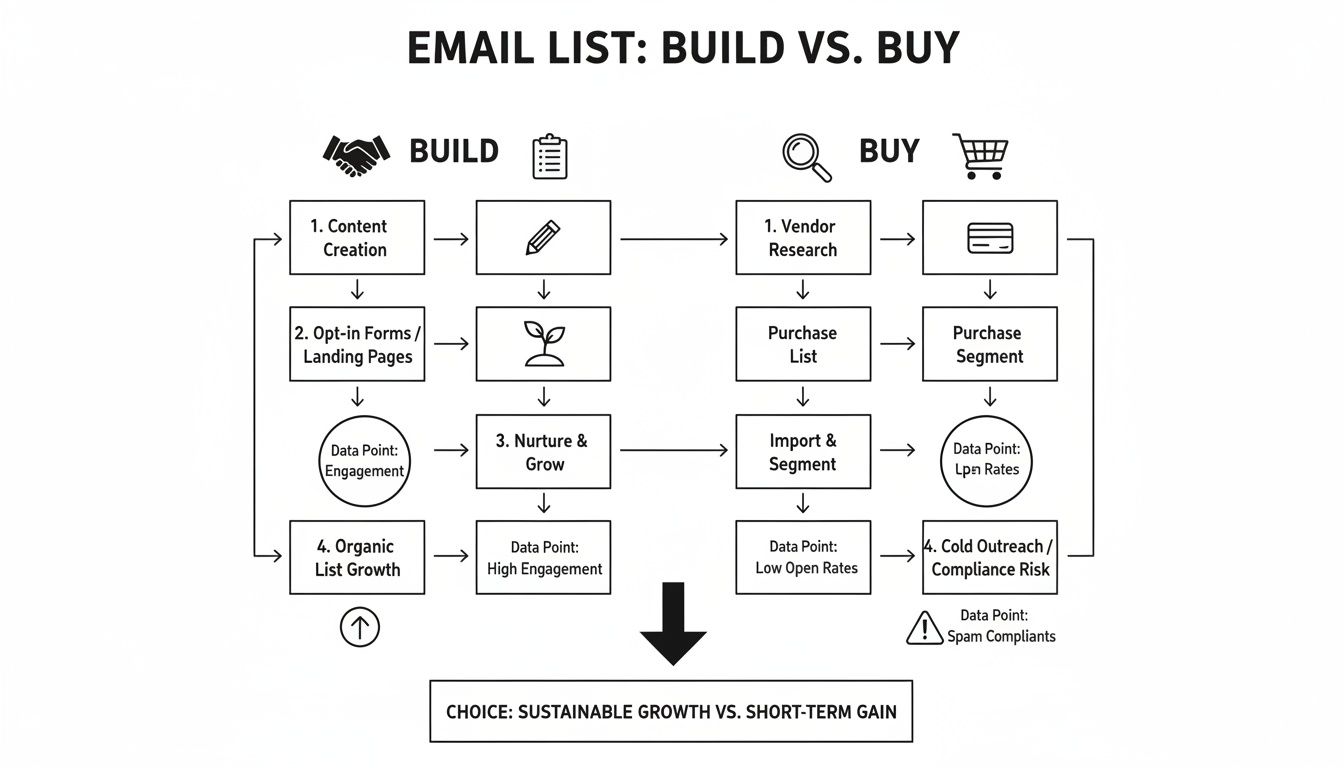
As you can see, building is a journey of nurturing relationships that creates sustainable growth. Buying is a shortcut with a cliff at the end.
Step 1: Create Irresistible Lead Magnets
A lead magnet is your opening offer—a valuable piece of content you give away in exchange for an email address. For a sharp B2B audience, this can't be fluff. It has to be substantial, insightful, and directly tied to the problems they’re trying to solve every day.
Think about the real-world pain points of your ideal customer. What checklist, dataset, or expert guide could you create that would make their job noticeably easier? That’s the heart of a great lead magnet.
High-Impact B2B Lead Magnet Ideas
A great B2B lead magnet isn't just about giving something away; it's about giving the right thing to the right person. It should feel like a valuable tool, not just another download. Here are a few ideas that consistently hit the mark with professional audiences.
| Lead Magnet Type | Best For Attracting | Real-World Example |
|---|---|---|
| In-Depth Whitepapers | C-suite, technical buyers | A cybersecurity firm offers a "CISO's Guide to AI-Driven Threat Detection." |
| Exclusive Industry Reports | Strategy & Marketing leaders | A marketing agency publishes a "State of B2B SaaS Content Marketing" report. |
| High-Value Webinar Replays | Mid-level managers, practitioners | Gated access to a live panel discussion with industry experts on a hot topic. |
| Practical Templates | Hands-on professionals | A project management software company creates a "Go-to-Market Launch Checklist." |
Each of these offers something tangible that helps a professional do their job better, making the decision to share their email address an easy one.
Step 2: Optimize Your Website for Conversions
Your website is ground zero for list-building, but only if you design it to capture leads. Every page, from your homepage to your blog, should have a clear, easy path for a visitor to subscribe. This isn't about being aggressive; it's about making the value clear and the sign-up process totally frictionless.
Don't just hide a form in your footer and call it a day. You need to be strategic. Here's how to start:
- On Your Blog: Offer a "content upgrade" directly within a relevant post. For example, if you write an article about project management, offer a free project plan template right in the middle of it.
- In the Website Header: A simple, clean "Get Our Weekly Insights" call-to-action in your header keeps the subscription option visible on every page.
- Use Exit-Intent Pop-ups: When a visitor’s cursor moves to leave the page, a pop-up offering one last valuable resource can be surprisingly effective at capturing their email.
A great website doesn't just display information; it invites a conversation. Your opt-in forms are the first step in that dialogue, offering a direct path for interested prospects to raise their hand and engage with your brand.
Step 3: Leverage Proactive Outreach and Networking
Your website will attract inbound leads, but you also need to go out and find the right people. Proactive outreach, especially on professional networks like LinkedIn, is a fantastic way to grow your list with highly targeted contacts. The key is to lead with value, not a sales pitch.
Here's a simple, step-by-step process:
- Identify: Pinpoint decision-makers at companies that fit your ideal customer profile using LinkedIn Sales Navigator or search filters.
- Engage: Don't just send a cold connection request. Engage with their posts, leave thoughtful comments, and become a familiar name.
- Connect: Once you’ve built a little rapport, send a personalized message. You could invite them to check out a resource you created or subscribe to your newsletter for more insights on a topic they’re clearly interested in.
This approach is central to any good guide on how to generate B2B leads for predictable growth because it focuses on relationship-building first.
Keeping Your B2B Email List Healthy and Engaged
Growing your list is a huge accomplishment, but the work doesn’t stop there. An unmanaged list is like an untended garden—it quickly gets overrun with weeds and stops producing results. To keep that list valuable, you need to master two key skills: segmentation and list hygiene.
Think of yourself as a librarian, carefully organizing a vast collection of books. Segmentation is how you make sure every person gets the right message at the right time. This simple act can make your emails feel less like a mass broadcast and more like a personal recommendation. It isn't just good practice; it drives real results.

The Power of Smart Segmentation
Blasting the same email to everyone on your list is a recipe for low engagement and a quick trip to the spam folder. After all, a CEO at a Fortune 500 tech company has completely different needs than a marketing manager at a small manufacturing firm. Segmentation is what lets you tailor your content to these specific groups, making your messaging far more relevant and impactful.
You can learn much more about the fundamentals in our complete guide explaining what is email segmentation. In short, this practice is the key to unlocking much higher engagement and conversions.
When managed well, B2B email lists are true revenue multipliers. For 2025, the gold standard for click-through rate (CTR) is around 3.2%, a figure that really depends on strong content and a clear call-to-action. Pair that with an average open rate of 39.5%, and you have a powerful combination where smart segmentation can lift your results dramatically.
Actionable Ways to Segment Your B2B List
Ready to start? Here are a few powerful ways to begin dividing your list for maximum impact:
- By Firmographics: This is all about grouping contacts using company-level data. Think about their industry (SaaS vs. healthcare), company size (startup vs. enterprise), or even geographic location.
- By Job Role or Title: A message crafted for a CFO should be worlds apart from one for a Head of HR. Segmenting by job function lets you speak directly to their specific responsibilities and pain points.
- By Engagement Behavior: This is a dynamic way to segment your audience based on their actions. You can create groups for your most engaged subscribers, people who haven't opened an email in 90 days, or contacts who clicked a link about a specific product.
Keeping Your List Clean with Good Hygiene
Just like segmentation, list hygiene is a non-negotiable part of maintaining a healthy B2B email list. Over time, contacts become inactive, emails go stale, and your data gets outdated. Regular clean-ups are absolutely essential to protect your sender reputation and ensure your emails actually make it to the inbox.
Think of it as routine maintenance for your most valuable marketing asset.
List hygiene isn't about shrinking your list; it's about strengthening it. Removing unengaged contacts makes room for subscribers who are genuinely interested, improving your metrics and ensuring your message reaches the right audience.
Here's a step-by-step plan for list hygiene:
- Regularly Remove Inactive Subscribers: Create a "sunset policy" for contacts who haven't engaged with your emails in a set period, like 90-180 days. First, send them a re-engagement campaign to try and win them back. If they still don't respond, it's time to let them go.
- Verify Email Addresses Periodically: Use an email verification service to scrub your list of invalid or risky addresses. This is especially crucial if you're collecting emails from various sources, as it dramatically reduces your bounce rate.
- Manage Bounces Immediately: Pay close attention to hard bounces (permanent delivery failures) and soft bounces (temporary issues). Most email service providers will automatically remove hard bounces, but it's always good practice to monitor this yourself.
To make sure your list stays healthy and provides accurate data for segmentation, it pays to adopt robust systems for effective subscriber data management. These practices stop your list from decaying and keep it a powerful engine for your marketing.
Staying Compliant and Hitting the Inbox
A brilliant email campaign is worthless if it lands in the spam folder—or worse, gets you in legal trouble. To run a healthy, high-performing B2B email list, you have to master two things: the legal rules and the tech that gets your emails delivered.
Think of it this way: compliance is the rules of the road, and deliverability is the engine in your car. You absolutely need both to get where you're going.
Getting this right isn’t just about dodging fines. It's about building trust and making sure the people you want to reach actually see your messages.
Understanding the Rules of the Road
Several major laws govern commercial email, and you can't afford to ignore them. They might seem complicated, but they all boil down to being transparent and respecting people’s inboxes.
Here’s a quick, no-nonsense look at the big ones:
- CAN-SPAM Act (U.S.): This law lays down the ground rules for commercial email in the States. You must include a valid physical postal address, give people a clear way to opt out, and honor those unsubscribe requests fast.
- GDPR (Europe): The General Data Protection Regulation is extremely strict. You need explicit, provable consent before you email anyone in the EU. You also have to be crystal clear about why you’re collecting their data and what you’ll do with it.
- CASL (Canada): Canada's Anti-Spam Legislation is similar, demanding express consent. While "implied consent" exists in some cases, the bar is high. Your safest bet is always to get a clear, explicit opt-in.
Actionable Takeaway: A simple rule of thumb for playing it safe globally is to follow the strictest law that applies to your audience. When you build your list on explicit, informed consent, you're pretty much covered everywhere.
The Mechanics of High Deliverability
Beyond the legal stuff, there's the technical puzzle of email deliverability—the art and science of actually getting your email into someone's main inbox. Email providers like Google and Microsoft are the gatekeepers here, and they're constantly scanning for signals to decide if you're a legitimate sender or just another spammer.
And the fight for inbox space is getting tougher. The sheer volume of email is staggering; projections show daily email traffic will jump from 319.6 billion in 2021 to 376.4 billion in 2025. That’s more than 4.3 million emails flying around every single second. If you want your B2B email lists to cut through that noise, you have to earn your spot. You can find more details in these amazing email marketing statistics.
Your Deliverability Checklist
To build a solid sender reputation and sail past the spam filters, you need to have your technical house in order. These are non-negotiable steps:
- Set Up Email Authentication: Ensure SPF (Sender Policy Framework) and DKIM (DomainKeys Identified Mail) are correctly configured for your domain. Think of them as digital signatures that prove to email providers that you are who you say you are. This one step can dramatically cut down on your emails being flagged as suspicious.
- Monitor Your Sender Reputation: Use tools like Google Postmaster Tools to see how inbox providers view your domain. If your reputation score is low, your emails are heading straight for the spam folder.
- Keep List Hygiene Impeccable: We’ve said it before, but it’s critical. Regularly cleaning your list to get rid of inactive subscribers and bad addresses is a must. A high bounce rate is a huge red flag for ISPs and will tank your reputation in a hurry.
When you nail both legal compliance and the technical fundamentals, you give your carefully written emails the best possible shot at being delivered, opened, and acted on.
Measuring Success: Metrics That Matter for B2B Lists
So, you’ve put in all this hard work building your B2B email list. How do you actually know if it's paying off? The answer isn't just about looking at numbers; it's about tracking the right numbers—the ones that connect directly to business growth.
Too many marketers get hung up on "vanity metrics" like open rates. Sure, they're interesting, but a high open rate doesn't mean a thing if nobody takes the next step. To really see what's working, you have to look deeper at the data that shows genuine interest and, ultimately, drives revenue.
Moving Beyond Vanity Metrics
The real story of your list's performance is told through metrics that measure action and quality. These are the figures that show how your emails are actually feeding the sales pipeline and turning subscribers into real, paying customers.
Focus your attention on these key performance indicators (KPIs):
- Conversion Rate: This is the ultimate measure of success. It tracks the percentage of subscribers who take a desired action—like downloading a whitepaper, booking a demo, or making a purchase. A healthy conversion rate tells you your message is hitting the mark.
- Lead Quality Score: Not all leads are created equal. Work with your sales team to define a "sales-qualified lead" (SQL). From there, you can score new subscribers based on their profile and engagement, letting you instantly spot your most promising prospects.
- Return on Investment (ROI): This is the metric your boss really cares about. It's a simple calculation: compare the total revenue generated from your email campaigns to what you spent to run them. This number proves the bottom-line value of your entire email effort.
Using A/B Testing to Systematically Improve
Guesswork has no place in a high-performing email strategy. The absolute best way to improve your results over time is through systematic A/B testing, sometimes called split testing. It's a straightforward process: you create two versions of a single email element, send each to a different slice of your audience, and see which one comes out on top.
A/B testing turns your marketing from an art into a science. It creates a powerful feedback loop, allowing you to make small, data-driven changes that lead to significant improvements over time.
The key is to test just one variable at a time so you get clean, understandable results. Not sure where to start? Here are three high-impact elements you can test right away:
- Subject Lines: Test a straightforward, benefit-focused subject line against one that sparks curiosity. For example, "New Report on AI in Marketing" vs. "Is Your Team Prepared for the AI Shift?"
- Calls-to-Action (CTAs): Play around with the wording, color, and placement of your CTA button. Does "Book a Free Consultation" pull in more clicks than "Learn More About Our Services"? Only a test will tell you for sure.
- Email Copy: Test the length and tone of your message. Is a short, punchy email more effective for your audience, or do they respond better to a more detailed, story-driven approach?
By consistently keeping an eye on the right metrics and running simple tests, you can refine your strategy piece by piece. This data-backed approach is what transforms a B2B email list from a simple communication channel into a predictable, revenue-generating machine that truly powers your business.
Your Next Steps
Building a high-quality B2B email list is a marathon, not a sprint. It's about consistently providing value, respecting your audience, and using data to guide your decisions. By focusing on organic growth over quick fixes, you create a powerful asset that will drive sustainable growth for years to come.
Recommended Next Step: Choose one lead magnet idea from this guide—like a checklist or a short industry report—and create a simple landing page for it this week. This single action is the first step toward building a valuable list.