Email targeted marketing isn't about fancy new software or complex theories. It’s the practical strategy of sending highly relevant messages to specific groups on your email list, instead of blasting the same generic email to everyone.
Think of it as delivering the right content to the right person at just the right moment. When you master that timing and relevance, you'll see your engagement and conversions climb dramatically. This guide will give you the step-by-step advice you need to make it happen.
Why Targeted Marketing Is Your Secret Weapon

Let's ditch the jargon and get straight to a real-world example. Imagine an online clothing store boosting its repeat purchases by 30%. How did they do it? They didn't reinvent their clothes or slash prices. They just stopped sending generic "20% off everything" emails.
Instead, they started sending promotions for women's shoes only to customers who had previously bought or browsed women's shoes. Simple, right?
That small but strategic shift is the very core of effective email targeted marketing. It’s the difference between shouting into a crowded room and having a quiet, meaningful one-on-one conversation that builds trust and drives sales.
The Problem with the "One-Size-Fits-All" Approach
The old-school "email blast" treats every subscriber exactly the same. It doesn't matter if they're a brand-new lead or a loyal customer of five years—they get the same message. This approach isn't just impersonal; it creates predictable problems:
- Low Engagement: Irrelevant offers get ignored, deleted, or worse, marked as spam. Your audience learns that your emails aren't for them.
- High Unsubscribe Rates: When your content consistently misses the mark, people hit "unsubscribe" just to clean up their inbox.
- Wasted Opportunities: You’re missing golden chances to nurture specific relationships, upsell perfectly matched products, or re-engage customers who are starting to drift away.
In short, generic emails train your audience to ignore you.
The Strategic Advantage of Targeting
A targeted strategy completely flips the script. Instead of starting with what you want to say, you focus on what your audience actually wants to hear. This pivot delivers real, tangible business results by aligning your marketing with your customers' needs and behaviors.
Actionable Takeaway: A person who bought hiking boots last month is far more likely to be interested in an offer on waterproof jackets than an email about a new line of dress shoes. Targeted marketing makes that connection for you, automatically.
For example, a software company can send detailed feature updates only to power users who will actually appreciate them, while sending friendly "getting started" guides to new trial sign-ups. This relevance is what builds trust and, ultimately, drives action.
Throughout this guide, we'll break down the exact steps to build, execute, and measure campaigns that feel personal and produce results you can take to the bank.
Building Your Foundation with Smart Audience Segmentation
Great email marketing starts long before you write a subject line. The real work happens when you turn your subscriber data into powerful marketing insights through smart audience segmentation. This isn't just splitting your list into random groups; it's about creating dynamic segments that reflect who your customers are and what they care about.
Think of it this way: instead of shouting the same message at a crowd, segmentation allows you to have countless mini-conversations. It’s the difference between a generic sales blast and a personalized heads-up about a new product you know a specific customer will love.
From Raw Data to Actionable Segments: A Step-by-Step Approach
The most effective segments come from blending different types of customer data. You're creating a detailed portrait of your subscriber, moving beyond a simple name and email. The real power comes from combining what you know about who they are with insights into what they do.
Here are the four main types of data you'll work with:
- Demographic Data (The "Who"): This is the basic profile information: age, gender, location, job title, or company size. A local restaurant, for example, would lean heavily on this, segmenting by city to send geo-targeted promotions.
- Psychographic Data (The "Why"): This digs into their interests, values, and lifestyle. A fitness brand could create segments based on interests like "yoga," "running," or "weightlifting" to send highly relevant workout tips and gear recommendations.
- Behavioral Data (The "What"): This is about the actions subscribers take—or don't take. Think purchase history, website pages visited, email engagement, and product usage. This is often the most powerful data for targeted marketing.
- Geographic Data (The "Where"): This focuses on a subscriber's physical location. This can be as broad as a country or as focused as a specific ZIP code, perfect for event promotions or store-specific deals.
The magic happens when you combine these. A software business, for instance, could create a "Churn Risk" segment by mixing behavioral data (low login frequency) with demographic data (small business clients). This gives them a hyper-specific group to target with a re-engagement campaign. For a deeper dive, check out this guide on what is email segmentation.
Putting Segmentation into Practice: A Real-World Example
Let's make this practical. Most modern email marketing tools like Mailchimp, ConvertKit, or Klaviyo have built-in features that make creating these groups surprisingly easy. You can set up rules that automatically add or remove subscribers from segments based on their activity.
Step-by-Step Scenario: An Ecommerce Coffee Store
An online store sells artisanal coffee and wants to boost repeat purchases. Instead of a generic "15% off" coupon, they build a few key segments:
- Segment 1: First-Time Buyers. This group gets a thoughtful welcome series. It tells the brand's story and offers tips for brewing the perfect cup. The goal is to build a relationship, not just push for another sale.
- Segment 2: Loyal Customers (3+ purchases). These are the VIPs. They get early access to new bean varieties and exclusive "subscriber-only" discounts as a thank you for their loyalty.
- Segment 3: Abandoned Carts. Anyone who adds a specific dark roast to their cart but doesn't check out gets a gentle reminder 24 hours later. The email features a stellar customer review of that exact coffee blend to build confidence.
Actionable Takeaway: By tailoring the message to where the customer is in their journey, the coffee shop makes each person feel seen. This relevance transforms a simple email list into a powerful revenue driver.
The opportunity here is massive. With 4.6 billion people projected to use email by 2025, it remains a dominant communication channel. A staggering 89% of marketers already call email their top channel for generating leads. Well-crafted segments are your secret weapon for cutting through the noise.
Effective Segmentation Strategies at a Glance
Here’s a quick-reference table of common segmentation models and how you can use them.
| Segmentation Type | What It Is | Example Use Case | Best For |
|---|---|---|---|
| Demographic | Grouping by age, gender, income, job title, etc. | A skincare brand sending anti-aging product info to subscribers aged 40+. | B2C brands, especially in fashion, beauty, and finance. |
| Geographic | Dividing the list by country, state, city, or ZIP code. | A concert venue announcing a new show to subscribers within a 50-mile radius. | Retail, events, restaurants, and any business with a physical presence. |
| Psychographic | Segmenting based on lifestyle, values, interests, or personality traits. | An outdoor gear company targeting a segment of "Adventure Seekers" with hiking content. | Niche brands, travel companies, and businesses with strong community values. |
| Behavioral | Using past actions like purchases, clicks, and website visits to create groups. | An ecommerce store sending a "we miss you" offer to customers who haven't purchased in 90 days. | Ecommerce, SaaS, and any business where user actions are a key indicator of intent. |
| Firmographic | B2B-focused segmentation based on company attributes like size, industry, or revenue. | A software company targeting "Marketing Managers at Mid-Sized Tech Companies." | B2B businesses, especially those with account-based marketing (ABM) strategies. |
Each strategy offers a unique lens through which to view your audience, allowing you to fine-tune your messaging for maximum impact.
How to Identify Your Most Profitable Segments
Where should you start? Trying to do everything at once is a recipe for frustration. To build a solid foundation, first master effective email list building strategies. Once your list is healthy, focus on creating the segments that will have the biggest impact on your bottom line.
Here’s a simple checklist to pinpoint your highest-value segments:
- Identify your VIPs: Who are your most frequent or highest-spending customers? Create a special segment for them and give them the royal treatment.
- Find your "window shoppers": Who browses specific product categories but never buys? Nudge them with targeted content or a special offer related to their interests.
- Welcome new subscribers: A dedicated segment for new sign-ups is non-negotiable. It lets you make a great first impression with a curated welcome series.
- Re-engage inactive users: Create a segment for subscribers who haven't opened an email in 90 days and send a targeted campaign designed to win them back.
Starting with just these four groups can dramatically improve the performance of your email marketing.
Crafting Hyper-Personalized Content That Converts
You’ve built your audience segments. Now comes the fun part: crafting content that feels like a genuine, one-on-one conversation. This is where the real power of email targeted marketing comes alive.
We’re talking about more than just dropping a [First Name] tag into a generic email. That’s the bare minimum today.
True personalization makes your subscribers feel understood. It’s the difference between a mass-produced flyer and a handwritten note from a friend. When you get this right, it does more than just boost metrics; it builds real loyalty by showing you’re paying attention.
Going Beyond a First-Name Basis with Dynamic Content
The [First Name] merge tag had its moment, but modern customers expect more. Hyper-personalization means using your rich behavioral and demographic data to tailor the entire message—from the subject line to the call-to-action (CTA). Your most powerful tool for this is dynamic content.
Dynamic content allows you to build a single email template that automatically swaps out content blocks for different audience segments. It’s like a "choose your own adventure" email where the adventure is perfectly matched to what each subscriber has shown interest in.
Real-World Example: A Travel Company
Imagine a travel agency sending its weekly newsletter. Instead of one generic email, they use dynamic content blocks based on user browsing history:
- Subscribers who browsed beach content: They see stunning photos of tropical getaways, an article on the best snorkeling spots, and a featured deal for a resort in Mexico.
- Subscribers who browsed hiking trips: Their version shows breathtaking mountain retreats, a guide to packing for a high-altitude trek, and an early-bird special for a trip to the Swiss Alps.
It's one campaign, but it delivers two completely different and incredibly relevant experiences. That’s the power of making your email targeted marketing feel personal.
Personalizing Subject Lines and CTAs for More Clicks
Your subscriber’s inbox is a crowded place. A personalized subject line is your best chance to get noticed. While adding a name can provide a small bump, tying the subject line to a subscriber's past behavior is far more effective.
The same applies to your call-to-action. It should feel like the obvious next step for that specific person, not a generic command.
Before and After Example:
Generic Email:
- Subject Line: Don't Miss Our Huge Spring Sale!
- CTA Button: Shop Now
Hyper-Personalized Email (for a customer who recently bought running shoes):
- Subject Line: Alex, Gear Up for Your Next Run with 20% Off Apparel
- CTA Button: Find My New Running Gear
The personalized version isn’t just an ad; it’s a relevant suggestion that speaks directly to Alex’s interests. It feels less like a sales pitch and more like a helpful heads-up.
The Art of Dynamic Recommendations
One of the most powerful personalization tactics is using dynamic product or content recommendations. By analyzing past purchases and browsing behavior, you can automatically populate your emails with suggestions that have a high chance of converting.
This is the secret sauce for giants like Amazon and Netflix, and it works because it removes friction and makes the path to purchase feel intuitive.
Here’s how different businesses can use this strategy:
- Ecommerce Store: An email can feature a "You Might Also Like" section with products that complement a recent purchase. Someone who bought a coffee grinder might see recommendations for artisanal coffee beans.
- SaaS Company: A newsletter could dynamically include links to tutorials related to the specific features a user engages with most, helping them get more value from the product.
- Content Publisher: A media site can send a weekly digest highlighting articles related to the topics a reader has shown the most interest in, ensuring the content is always relevant.
By weaving these advanced personalization strategies into your campaigns, you turn your email from a simple broadcast into a smart, data-driven tool that delivers real value to every person on your list.
Using Automation for Timely, Relevant Outreach
Once you have your segments and personalization strategy, it's time to put your outreach on autopilot. This is where targeted email marketing really shines—using automation to send the right message at the perfect moment, nurturing customers around the clock without you manually hitting "send."
Automation isn't about sending robotic messages. It's about using a customer's behavior as a trigger to start a helpful, one-on-one conversation. When someone subscribes, abandons a cart, or makes a purchase, their action is a signal—a critical point where a targeted email can make all the difference.
This simple flow shows how segmentation and personalization fuel effective automation.
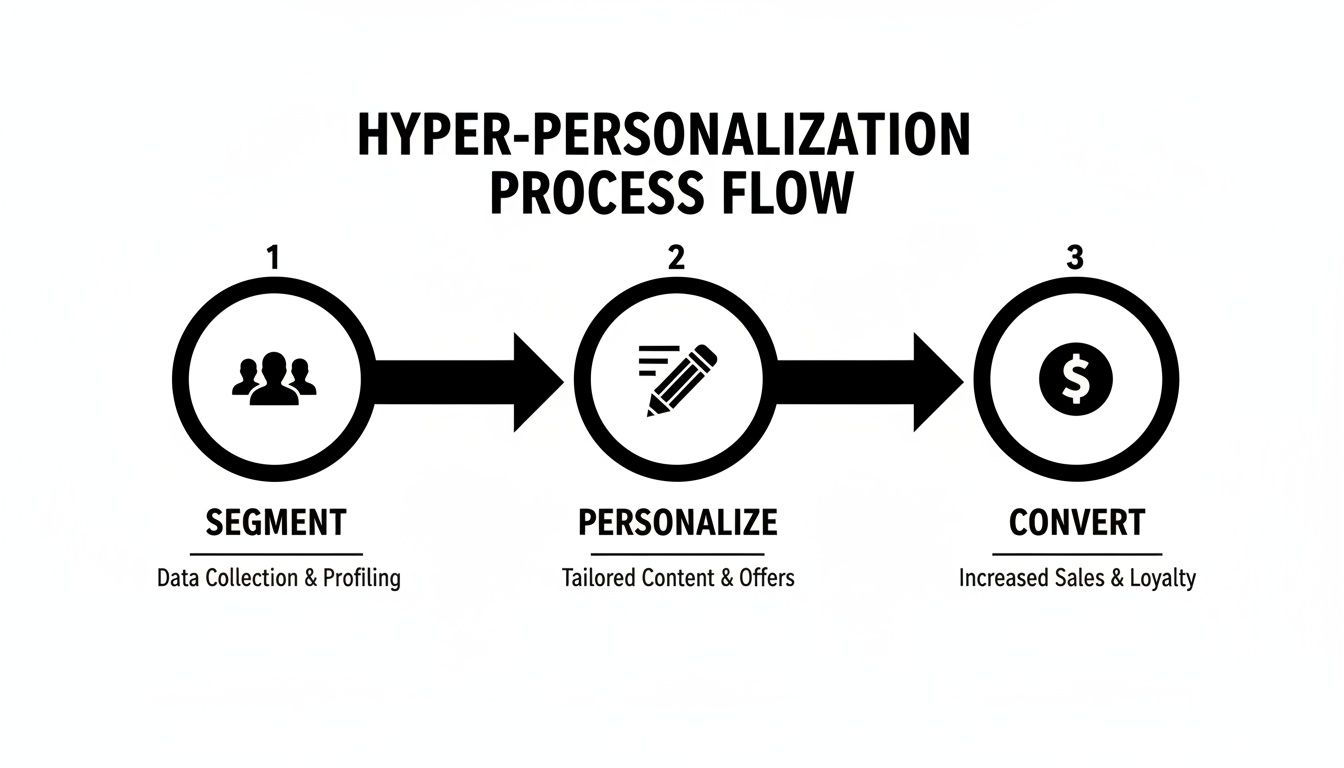
As you can see, great automation is built on a solid foundation of segmentation and personalization, leading directly to business growth.
Your Step-by-Step Blueprint for Essential Automated Campaigns
Let’s get practical and break down the three most effective triggered campaigns every business should have. For a deeper dive, check out this excellent guide on automated email marketing campaigns.
1. The Welcome Series
This is your one chance to make a killer first impression. A good welcome series can achieve open rates over 80%, making it one of the most powerful campaigns you'll ever send.
- Trigger: A user subscribes to your email list.
- Timing: The first email should go out immediately. Space subsequent emails 1-2 days apart.
- Step-by-Step Content Blueprint:
- Email 1 (Instant): Send a warm welcome and a thank you. Remind them why they subscribed and deliver any lead magnet you promised.
- Email 2 (1 Day Later): Introduce your brand and what makes you different. Share your mission or a behind-the-scenes look to build a human connection.
- Email 3 (3 Days Later): Guide them toward value. Showcase your best-selling products or most popular blog posts.
2. The Abandoned Cart Reminder
Did you know that nearly 70% of online shopping carts are abandoned? This single automation is your best tool for recovering that lost revenue.
- Trigger: A user adds an item to their cart but leaves without checking out.
- Timing: A sequence of 2-3 emails is ideal, starting within the first hour.
- Step-by-Step Content Blueprint:
- Email 1 (1 Hour Later): Send a gentle, helpful nudge. A subject line like "Did you forget something?" works well. Include a picture of the item and a clear link back to their cart.
- Email 2 (24 Hours Later): Add social proof. Include a customer testimonial or a 5-star review of the abandoned product to build trust.
- Email 3 (48 Hours Later): Create urgency with a time-sensitive offer. A small discount like "10% off your order, good for the next 24 hours" can be the final push they need.
Actionable Takeaway: Frame this sequence as a helpful reminder that becomes a valuable offer. You'll avoid being pushy and instead act as a helpful shopping assistant.
3. The Post-Purchase Follow-Up
The work isn't over when you make a sale. The post-purchase window is a golden opportunity to build loyalty, gather feedback, and set up the next purchase.
- Trigger: A customer completes a purchase.
- Timing: The first email should be instant, with follow-ups timed based on when they’d use your product.
- Step-by-Step Content Blueprint:
- Email 1 (Instant): Send the order confirmation and a thank-you note. Reaffirm their smart decision and get them excited for their order to arrive.
- Email 2 (7-14 Days Later): Ask for a review. Get their feedback while the purchase is still fresh in their mind to gather invaluable social proof.
- Email 3 (30 Days Later): Make a relevant cross-sell. Suggest a product that complements what they already bought. If they bought a coffee maker, now is the perfect time to recommend your best-selling espresso beans.
Building these core automations transforms your email marketing from a manual chore into a powerful, automated sales engine. For more inspiration, you can find fantastic drip marketing examples to spark new ideas.
Measuring Success and Optimizing Your Strategy
Getting your targeted email campaigns live is a huge step, but it's just the starting line. Real growth happens when you analyze the data, learn what resonates, and use those insights to make your next campaign even better.
The best email marketers look beyond vanity metrics. They ask: "Are my emails actually driving business results?" Answering that question means creating a continuous feedback loop where data drives every decision, constantly boosting your email marketing ROI.
Key Metrics That Actually Matter for Growth
Open rates are a decent starting point, but they don't tell the whole story. A high open rate means nothing if no one clicks or converts. To understand the real impact of your campaigns, you need to track metrics tied directly to your business goals.
Here are the metrics that should be on your dashboard:
- Conversion Rate: This is the most important one. It’s the percentage of people who took the action you wanted them to, whether that was making a purchase or booking a demo. It answers the question: "Did this email work?"
- Revenue Per Email (RPE): For e-commerce or SaaS, RPE is your best friend. Calculate it by dividing the total revenue from a campaign by the number of emails delivered. This tells you, in plain dollars, what each email is worth.
- Customer Lifetime Value (CLV): This is your long-term metric. By tracking CLV across different segments, you can see how your targeted campaigns affect what customers spend over their entire relationship with your brand.
Actionable Takeaway: A 25% open rate that produces a 5% conversion rate is infinitely better than a 40% open rate that barely scrapes a 0.5% conversion rate. Always focus on the actions that drive revenue.
While getting people to open your email is the first hurdle, if you’re struggling at this step, our guide on how to improve email open rates has plenty of practical advice.
A Practical Framework for A/B Testing
A/B testing (or split testing) is your secret weapon for continuous improvement. The concept is simple: you send two different versions of an email to small, random slices of your audience to see which one performs better. You then send the winning version to the rest of the segment.
Here’s a step-by-step guide to running effective A/B tests:
- Isolate One Variable: This is the golden rule. Test one thing at a time. If you change the subject line and the CTA button, you’ll have no idea which change made the difference.
- Choose What to Test: Start with elements that will have the biggest impact. Great candidates include the subject line, the call-to-action (CTA) text and color, or the offer itself (e.g., 15% off vs. free shipping).
- Run the Test and Analyze: Send your two variations to a small portion of your list (e.g., 10% for each version). Wait 24-48 hours to collect data. Then, look at your primary metric (like conversion rate or RPE) to declare a winner.
For example, an e-commerce brand could test two offers for their abandoned cart segment. Version A offers "15% Off Your Order," while Version B offers "Complete Your Order for Free Shipping." By seeing which email leads to more completed checkouts, they can confidently use the winning offer in all future abandoned cart automations.
Creating Your Monthly Campaign Review
To ensure you’re always improving, set aside time each month to review your campaign performance. This doesn't need to be a huge task. A simple dashboard or spreadsheet tracking your key metrics over time is all you need.
During this review, ask a few key questions:
- Which segments were most engaged this month?
- Which campaigns drove the most revenue?
- What did our A/B tests teach us?
- Are any segments becoming less active?
This simple monthly ritual keeps you accountable and ensures you're always learning. It transforms your email program from a series of disconnected sends into a smart, strategic system that gets better with every email.
Your Top Questions About Targeted Email Marketing, Answered
As you dive into targeted email marketing, a few practical questions are bound to come up. Getting clear answers is the difference between a strategy that feels overwhelming and one you can tackle with confidence. Let's clear up some of the most common hurdles marketers face.
How many segments should I create?
It's tempting to think more is always better, but that's a fast track to a tangled, unmanageable mess.
The practical advice: Start with 3-5 core segments built around your most valuable customer data. Focus on behaviors that signal intent or define a clear relationship with your brand. Good starting points include:
- Purchase History: Grouping customers by what they've bought is simple and incredibly powerful.
- Engagement Level: Create separate segments for your superfans and for those who are starting to drift away.
- Signup Source: Where did they come from? A pop-up for a 10% discount? A webinar registration? That context is gold for your messaging.
It's far more effective to have a handful of well-managed segments with truly distinct, tailored content than dozens of groups getting slightly tweaked versions of the same email.
Actionable Takeaway: The goal isn't to have the most segments; it's to have the most meaningful segments. Each group should serve a clear purpose in helping you have a more relevant conversation.
Personalization vs. Segmentation: What’s the Difference?
This is a common point of confusion. They are deeply connected, but they are not the same thing.
Here’s an easy way to remember it:
Segmentation is the who. It’s the act of sorting your large audience into smaller, distinct buckets based on shared traits (e.g., "first-time customers in the last 30 days").
Personalization is the what. This is where you tailor the message inside the email to make it feel individual. For your "first-time customers" segment, you could use a dynamic content block to recommend products that pair perfectly with the exact item they just bought.
In short, segmentation creates the right audience. Personalization delivers the right message to that audience. You need both to make a real impact.
Can I do this with a small email list?
Yes, absolutely! In fact, starting your segmentation efforts with a small list is one of the smartest things you can do.
It forces you to build good habits from the ground up. It ensures that your earliest subscribers—often your most loyal advocates—have an incredible, relevant experience with your brand right from the start.
Even with just a few hundred subscribers, you can create meaningful segments based on how they signed up or what links they clicked in your welcome series. This early focus on relevance builds a rock-solid foundation of loyalty that will pay massive dividends as your list grows.
Summary and Your Next Step
Targeted email marketing is a powerful strategy that revolves around a simple idea: sending the right message to the right person at the right time. By moving beyond generic "email blasts" and embracing segmentation, personalization, and automation, you can build stronger customer relationships and drive significant business growth. You don't need a huge list or a complex system to start—just a commitment to understanding and serving your audience better.
Recommended Next Step: Choose just one of the high-impact segments we discussed (like "First-Time Buyers" or "Inactive Subscribers") and create a simple, automated two-email campaign for them this week.
Ready to turn these insights into action? EmailGum provides in-depth guides and practical tutorials to help you master every aspect of email marketing. Build, manage, and optimize your campaigns with expert advice. Get started at https://emailgum.com.