Building a successful email list boils down to three core steps: creating an irresistible offer, setting up a system to capture emails, and promoting it effectively. The secret? Offer genuine value in exchange for an email address. This approach builds a relationship based on trust from the very first interaction.
Why an Email List Is Your Best Business Asset
Forget social media algorithms and unpredictable search engine traffic. Your email list is the one marketing channel you truly own. You have a direct, reliable line to people who have explicitly asked to hear from you, without a third-party platform controlling your reach.
That direct connection is a powerful engine for growth.
Consider this: a social media post might be seen by only 5% of your followers. An email, however, lands directly in every subscriber's inbox. This reliability is how an e-commerce store can announce a flash sale and see immediate revenue, or how a consultant can share a case study and book new client calls.
The Financial Power of a Direct Connection
The financial payoff from this direct relationship is staggering. In 2025, email marketing is on track to generate almost $11.3 billion in global revenue, and that number is expected to jump to $18.9 billion by 2028. That explosive growth comes from an absolutely killer return on investment (ROI). For every $1 you put into it, businesses are consistently seeing returns between $36 and $42. You can read more about email marketing's ROI to really grasp its financial muscle.
This simple graphic illustrates the essential flow of building a healthy, profitable email list.
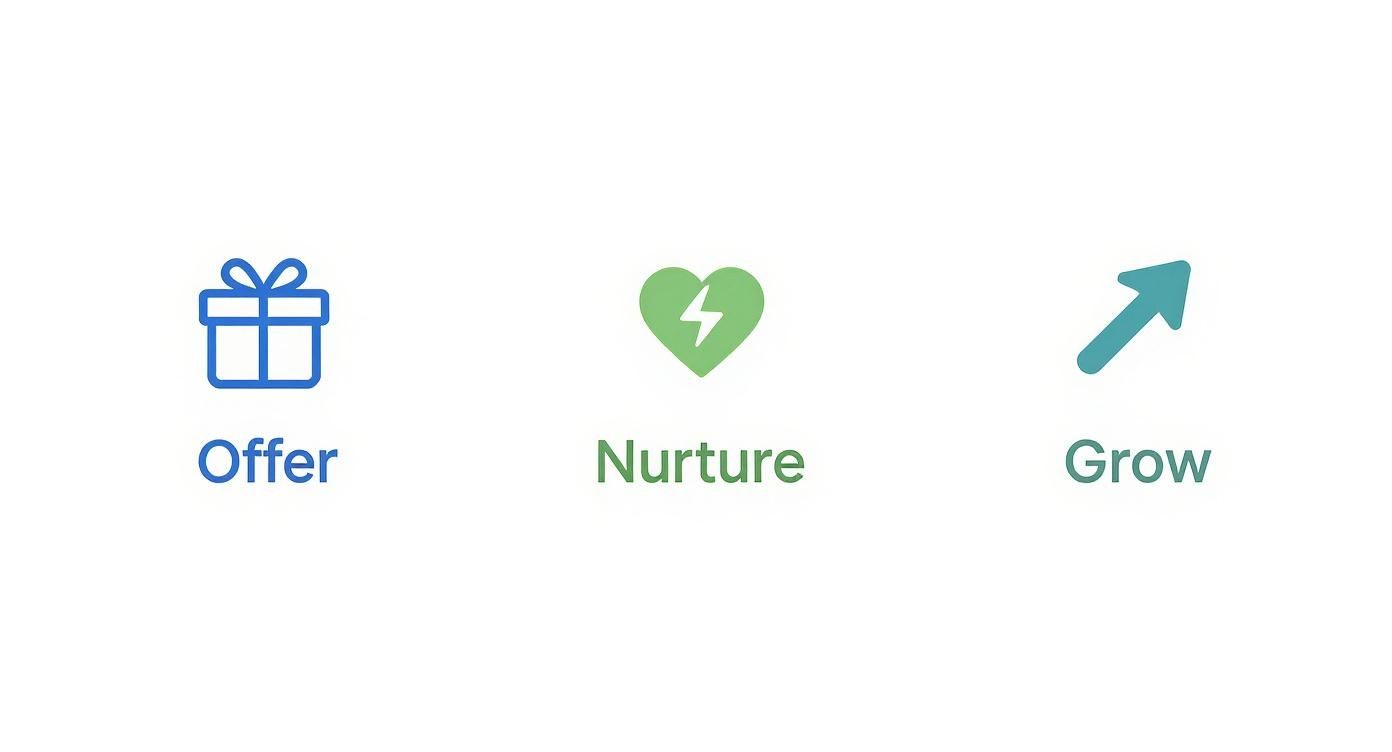
As you can see, it all starts with a compelling offer, which allows you to nurture that new relationship and ultimately fuel sustainable growth for your business.
What to Expect in This Guide
Building an effective email list isn't just about collecting contacts. It's about creating a system that consistently attracts the right people and turns them into loyal customers and fans. In this guide, we'll walk through the entire playbook with practical, step-by-step advice.
Here’s a sneak peek at what we'll cover:
- Step 1: Crafting irresistible lead magnets that solve a real problem for your audience.
- Step 2: Designing opt-in forms that convert visitors into subscribers.
- Step 3: Building automated welcome sequences that start building trust from day one.
- Step 4: Promoting your list using simple strategies that actually work.
Step 1: Creating Lead Magnets People Actually Want
Building an email list is a simple trade: you offer something valuable, and in return, a visitor trusts you with their email address. That valuable item is your lead magnet—the handshake that starts the relationship.
A great lead magnet isn't a generic ebook. It’s a targeted solution to a specific problem your ideal customer is facing right now. The goal is to provide a quick, tangible win that makes them think, "If their free content is this good, imagine their paid offerings."
Identifying Your Audience’s Pain Points
Before creating anything, you must understand your audience's challenges. What problems are they trying to solve? What questions do they type into Google? If your lead magnet misses this, it will fail.
Here’s a simple, step-by-step process for finding these insights:
- Review Your Comments: Look at your blog and social media comments. Recurring questions and the exact language people use are pure gold.
- Ask Your Audience Directly: Run a simple survey asking, "What's the #1 thing you're struggling with when it comes to [your topic]?"
- Analyze Your Traffic: Check your website analytics to see which articles get the most traffic and engagement. These topics are clear indicators of audience interest.
This research is what separates a lead magnet people download out of mild curiosity from one they feel they absolutely need. For a deeper dive, check out this ultimate guide to creating lead magnets.
Choosing a High-Impact Format
Once you know the problem you're solving, pick a format that delivers the solution quickly. The best lead magnets are easy to consume and provide immediate value. No one has time for a dense, 50-page PDF to find a simple answer.
Here are a few modern, high-impact ideas:
- Interactive Quizzes or Calculators: Perfect for service providers. A quiz like "What's Your Marketing Blind Spot?" offers personalized insights and positions you as an expert. Example: A financial advisor offers a "Retirement Savings Calculator."
- Exclusive Checklists or Templates: Instantly usable and practical. Example: An e-commerce store offers a "Capsule Wardrobe Checklist," while a project manager provides a downloadable Trello board template.
- Video Mini-Courses or Workshops: A great way to showcase your teaching style. Example: A course creator offers a free 3-part video series on "Mastering the Basics of Photoshop."
- Resource Guides or Toolkits: A curated list of the best tools for a specific task saves your audience hours of research. Example: A digital marketing agency creates a "Top 10 SEO Tools for Small Businesses" guide.
Actionable Takeaway: Prioritize immediate utility. The best format is the one that delivers the solution in the quickest, most efficient way for your audience.
High-Impact Lead Magnet Ideas for Different Industries
This table breaks down some of the most effective lead magnet types, showing where they fit best and the effort required.
| Lead Magnet Type | Best For (Industry) | Effort to Create | Potential Impact |
|---|---|---|---|
| Interactive Quiz | Coaches, Consultants, SaaS | Medium-High | Very High |
| Checklist/Template | E-commerce, B2B, Bloggers | Low | High |
| Video Mini-Course | Creators, Educators | High | Very High |
| Resource Guide | Agencies, Affiliates | Low-Medium | High |
A low-effort, high-impact checklist can easily outperform a time-consuming ebook if it solves the right problem. Focus on providing a specific, valuable outcome for your new subscriber.
Step 2: Designing Opt-In Forms That Convert Visitors
You've created an incredible lead magnet. Now, you need to give people a seamless way to sign up for it. This is where your opt-in form comes in—it’s the bridge between a curious visitor and your newest subscriber.
A great opt-in form is more than a box for an email address. It combines psychology, design, and clear communication to make signing up an easy decision.

The best forms are designed to reduce friction. Every extra field or confusing word adds resistance that can cause a visitor to leave. Simplicity is key.
The Anatomy of a High-Converting Form
Your opt-in form has seconds to answer the visitor's question: "What's in it for me?" Here are the essential components of a form that works.
- A Killer Headline: Your hook must be benefit-driven and directly related to your lead magnet. Instead of "Join Our Newsletter," try "Get Your Free 5-Day Productivity Plan."
- Minimal Form Fields: Only ask for what you absolutely need. For most lead magnets, a first name and email are enough. Research shows that reducing fields from four to three can boost conversions by 50%.
- A Compelling Call-to-Action (CTA): The button text matters. "Submit" is boring. Use action-oriented language that reinforces the benefit, like "Send Me the Checklist!" or "Get Instant Access."
- Clear, Concise Copy: Use a short sentence or a few bullet points to describe the core benefit and the transformation your lead magnet provides.
Actionable Takeaway: Design your form to match your website's branding (colors, fonts). A form that looks out of place can feel spammy and reduce your sign-up rate.
Choosing the Right Form Type and Placement
Where and how your form appears is as important as what it says. Use different form types strategically to maximize sign-ups.
Common Opt-In Form Types
Here are the most effective options and when to use them.
| Form Type | Best For | Strengths | Potential Drawbacks |
|---|---|---|---|
| Embedded Form | Blog posts, sidebars, footers | Non-intrusive, always visible | Can be ignored (banner blindness) |
| Pop-Up Form | High-traffic pages, exit-intent | Grabs attention, high conversion | Can be annoying if poorly timed |
| Slide-In Form | Content-heavy pages, blog posts | Less disruptive than a pop-up | Less visible than a full pop-up |
| Landing Page | Paid ads, social media links | Zero distractions, highly focused | Requires a dedicated click from another source |
For example, an embedded form works perfectly within a related blog post. Someone reading about productivity hacks is already primed to download your productivity checklist. An exit-intent pop-up offers one last chance to capture an email before a visitor leaves, without interrupting their reading experience.
Mobile Optimization and Legal Compliance
In 2024, over half of all web traffic is mobile. If your opt-in form is difficult to use on a small screen, you're losing subscribers. Always test your forms on a real phone to ensure a smooth experience.
Finally, be transparent. Many marketers use a two-step confirmation process to ensure list quality. You can learn more by reading our guide on what is double opt-in and why it's crucial for deliverability. This practice helps build a list of people who are genuinely interested.
Step 3: Crafting a Welcome Sequence That Builds Trust
Getting a new subscriber is just the beginning. The real work is turning that sign-up into a lasting relationship. Your welcome sequence is your automated first impression and your best chance to prove that subscribing was a smart decision.
A great welcome series does more than deliver your lead magnet. It showcases your brand's personality, sets expectations, and guides new subscribers toward their next step with you. Nailing this transforms a cold lead into an engaged member of your community.

The Proven 3-Email Welcome Framework
A simple, strategic 3-email sequence is all you need to build immediate momentum. Here's a step-by-step framework:
- Email 1: The Instant Delivery (Day 1). Send this immediately. Its sole purpose is to deliver what you promised. Keep it short and make the download link impossible to miss.
- Email 2: The Personal Connection (Day 2). Shift the focus from the freebie to you and your brand. Share a quick story about why you started your business or a core belief that drives you. This makes you relatable.
- Email 3: The Next Step (Day 3). Set expectations and deliver more value. Tell them what kind of emails to expect (e.g., "Every Tuesday, I share one actionable marketing tip"). Then, point them to your best content, like a popular blog post or video.
This structure fulfills your promise, builds a personal connection, and establishes a pattern of providing value. For more detailed guidance, our guide on how to write a welcome email offers more templates and real-world examples.
Making a Powerful First Impression
The words you use in these first emails set the tone for your relationship. Ditch the corporate jargon and write like you're talking to a friend.
Here is a real-world example for that first "Instant Delivery" email:
Subject: Here’s your free productivity checklist!
Body:
Hey [First Name],
Thanks so much for signing up! I’m excited to have you here.
As promised, here is your copy of the 5-Minute Productivity Checklist.
[Download Your Checklist Now]
Keep an eye out for another email from me tomorrow—I’m going to share the single biggest mistake people make when trying to manage their time.
Talk soon,
[Your Name]
Notice how it's friendly, direct, and teases what's coming next? This simple detail dramatically increases the open rate on your second email.
Actionable Takeaway: Your welcome sequence is your best opportunity to train subscribers to open your emails. Deliver high value and set clear expectations in the first few days to create a powerful habit.
Smart Segmentation from Day One
As your list grows, you'll offer different lead magnets. This is where simple segmentation becomes your secret weapon for personalization.
Modern email service providers (ESPs) like ConvertKit or ActiveCampaign let you apply a tag to subscribers based on which opt-in form they used.
For instance:
- Someone who downloaded your "Beginner's Guide to SEO" gets tagged with
interest-seo-beginner. - Someone who grabbed your "Advanced Link Building Checklist" gets tagged with
interest-seo-advanced.
This allows you to send targeted content later, ensuring everyone receives relevant information. Marketers who segment their campaigns see open rates jump by 30% and click-throughs increase by 50%. Personalization is no longer a "nice-to-have"; it's essential for standing out in a crowded inbox.
Step 4: Actionable Strategies to Promote Your Email List
You've built a great lead magnet and welcome sequence. Now it's time to drive the right traffic to your offers. Promotion is about strategically showing up where your ideal subscribers already are.
The goal is to build a marketing flywheel—a self-sustaining system where your efforts create a steady flow of new, qualified subscribers. This involves blending organic tactics with targeted paid methods.

Squeeze More Value From Your Existing Digital Assets
Before spending money, optimize the assets you already own. Here’s a step-by-step plan:
- Add Content Upgrades to Popular Blog Posts: Identify your top-performing articles. Create a hyper-relevant bonus (e.g., a checklist, template, or PDF version) and offer it within the post. This converts at a much higher rate than a generic offer.
- Optimize Your Social Media Profiles:
- Bio Link: Use a tool like Linktree to feature your best lead magnet prominently.
- Pinned Posts: On platforms like X or Facebook, pin a post that highlights the value of your lead magnet and links to the sign-up page.
- Cover Photos: Design your Facebook or LinkedIn cover photo to visually promote your primary freebie with a clear call-to-action.
These small tweaks ensure that anyone who discovers your brand sees a compelling reason to subscribe.
Collaborate With Complementary Businesses
One of the fastest ways to grow your list is by tapping into someone else’s audience. Partner with businesses that serve a similar audience but aren't direct competitors.
A great strategy is to co-host a webinar. You and your partner promote the event to both audiences, and everyone who registers joins both email lists (with their explicit consent).
Real-World Example: A graphic designer specializing in branding could team up with a copywriter to co-host a webinar titled "The Founder's Guide to Building a Brand That Sells." Attendees get immense value, and each business gains access to a pool of warm leads who need their services.
Another powerful collaboration is a content swap. Write a guest post for their blog that includes a call-to-action for one of your lead magnets, and they can do the same for your site.
Run Targeted, Cost-Effective Ad Campaigns
Organic growth is essential, but paid advertising can accelerate your progress. Platforms like Facebook and Instagram offer powerful targeting capabilities. You can run ads that send people directly to a landing page for your lead magnet, showing it only to a specific audience.
For example, a business coach could target users interested in entrepreneurship who follow thought leaders like Tony Robbins. This precision ensures your ad budget is spent effectively. You can explore proven lead generation solutions to enhance your campaigns. The key to success with paid ads is to start small, test your creative and copy, and monitor your cost per lead. Once you find a winning combination, you can scale your spending to drive predictable list growth.
Keeping Your Email List Healthy and Engaged
Growing your list is just the first step. The long-term value comes from keeping it clean and full of engaged subscribers.
An unengaged list hurts your deliverability, wastes money, and lowers your ROI. Routine list hygiene—the practice of keeping your list clean and active—is one of the most important things you can do. Think of it like tending a garden: you must weed, water, and prune to keep it healthy.
Monitoring Your List’s Vital Signs
The first step to a healthy list is knowing what to monitor. These key metrics provide a real-time view of your audience's engagement.
- Open Rate: The percentage of subscribers who open a specific email. This is your primary signal for subject line effectiveness.
- Click-Through Rate (CTR): The percentage of subscribers who clicked a link in your email. This measures how compelling your content is.
- Unsubscribe Rate: The percentage of people who opt out. A high rate can be a red flag that your content or frequency is off.
Industry benchmarks show an average open rate around 42-43%, yet 59% of users say most marketing emails are unhelpful. You can explore this data further on Inboxally.com. This highlights the importance of regular list cleaning.
Winning Back Inactive Subscribers
Before removing subscribers, try to win them back with a re-engagement campaign. This is a short, automated email series sent to subscribers who haven't opened or clicked your emails in a set period (e.g., 90 days).
The goal is to remind them why they signed up and give them a reason to stay. You could offer a discount, highlight your value, or simply ask if they still want to receive your emails. Segmenting these users first is a great strategy, which you can learn about in our guide to what is email segmentation.
Actionable Takeaway: Your re-engagement email's subject line is critical. Try something direct like, "Is this goodbye?" or benefit-focused like, "A special gift to welcome you back."
Knowing When to Say Goodbye
If a subscriber ignores your re-engagement campaign, it's time to remove them. It feels counterintuitive, but it's one of the healthiest things you can do for your email program.
Here’s why: Internet Service Providers (ISPs) like Gmail track engagement. Sending emails to a list of people who never open them damages your sender reputation. A poor reputation means more of your emails land in spam, even for your most loyal fans.
Regularly cleaning your list ensures you're communicating with people who want to hear from you, which improves deliverability and gives you a more accurate picture of your marketing performance.
A Few Common Email List Building Questions
Here are answers to some of the most common questions about building an email list.
How Long Does It Take to Build a Good Email List?
The honest answer is: it depends. There is no magic timeline.
Your growth rate is influenced by your website traffic, niche competitiveness, and the quality of your lead magnet. A site with steady traffic might gain hundreds of subscribers in the first month, while a new site will start slower.
Instead of fixating on a number, focus on consistent effort. By applying the strategies in this guide, you should see steady, meaningful growth within the first three to six months.
Which Email Marketing Tool Is Best for Beginners?
For beginners, platforms like MailerLite or Mailchimp are excellent choices. They offer generous free plans with intuitive drag-and-drop builders, making it easy to create forms and emails.
These tools provide all the core features you need without a large budget. You can start with a simple tool and upgrade as your list and needs grow.
Industry Insight: The best tool is the one you'll actually use. Start simple, master the fundamentals of list building, and only add complexity when necessary.
Is It Okay to Buy an Email List?
In one word: never. Buying an email list is the fastest way to destroy your sender reputation and get your email account shut down.
Those individuals never gave you permission to contact them. When your email arrives, they will mark it as spam. This signals to providers like Gmail that you're a bad actor, causing your deliverability to plummet.
The only sustainable path is to earn every subscriber. It takes more effort, but it's the only way to build a list that drives real results.
At EmailGum, we live and breathe email marketing. For more deep dives on everything from deliverability to automation, check out all our resources at https://emailgum.com.
Summary & Your Next Step
Building a quality email list is a systematic process. It starts with understanding your audience's needs to create a valuable lead magnet. From there, you design frictionless opt-in forms, nurture new subscribers with a welcome sequence, and consistently promote your list across your digital assets. Remember, a healthy, engaged list is more valuable than a large, inactive one.
Your Recommended Next Step: Identify the single biggest challenge your audience faces right now. Brainstorm one simple lead magnet—like a checklist or a template—that you could create this week to solve that problem.
