Trying to build an email list without a solid plan is like setting off on a road trip with no map. You might get somewhere, but it probably won't be where you intended to go. You can't just throw up a sign-up form and hope for the best; that's a surefire way to build a list that just gathers digital dust.
A list that actually drives your business forward—one that generates revenue, nurtures real relationships, and builds a loyal following—starts with a strong foundation. This guide will walk you through, step-by-step, how to build that foundation and create a list that becomes your most valuable marketing asset.
Why Your Business Needs a Strong Email List Foundation
Before you even think about what color your pop-up form should be or what freebie to offer, you need to pause and ask one simple question: Why?
Why are you building this list in the first place? Your answer to that question will dictate every single decision you make. It’s the difference between a list that works for you and a list that you just work on.
Step 1: Define Your Primary Business Goals
Let’s get specific. "Growing my audience" isn't a goal; it's a wish. A real goal is tied to a business outcome you can actually measure.
What do you really want your emails to accomplish? Here are a few real-world examples:
- Drive Direct Sales: This is common for e-commerce brands. Your goal might be to use email to launch new products, announce promotions, and directly convert subscribers into paying customers. Actionable Goal: Achieve a 20% increase in revenue from email campaigns this quarter.
- Nurture Leads: If you're a B2B company or sell high-ticket services, your sales cycle is longer. Here, the goal isn't an immediate purchase. It's about educating prospects, building trust, and positioning your brand as the go-to expert. Actionable Goal: Generate 50 sales-qualified leads from our welcome email sequence each month.
- Increase Repeat Traffic: For content creators, bloggers, or media sites, the main objective is often getting people to come back. More clicks on your latest articles mean more ad revenue and a more engaged community. Actionable Goal: Increase click-through rates to our blog by 15% from our weekly newsletter.
This initial thinking process—moving from high-level goals to a deep understanding of your audience and then crafting a strategy—is the bedrock of your entire email marketing effort.
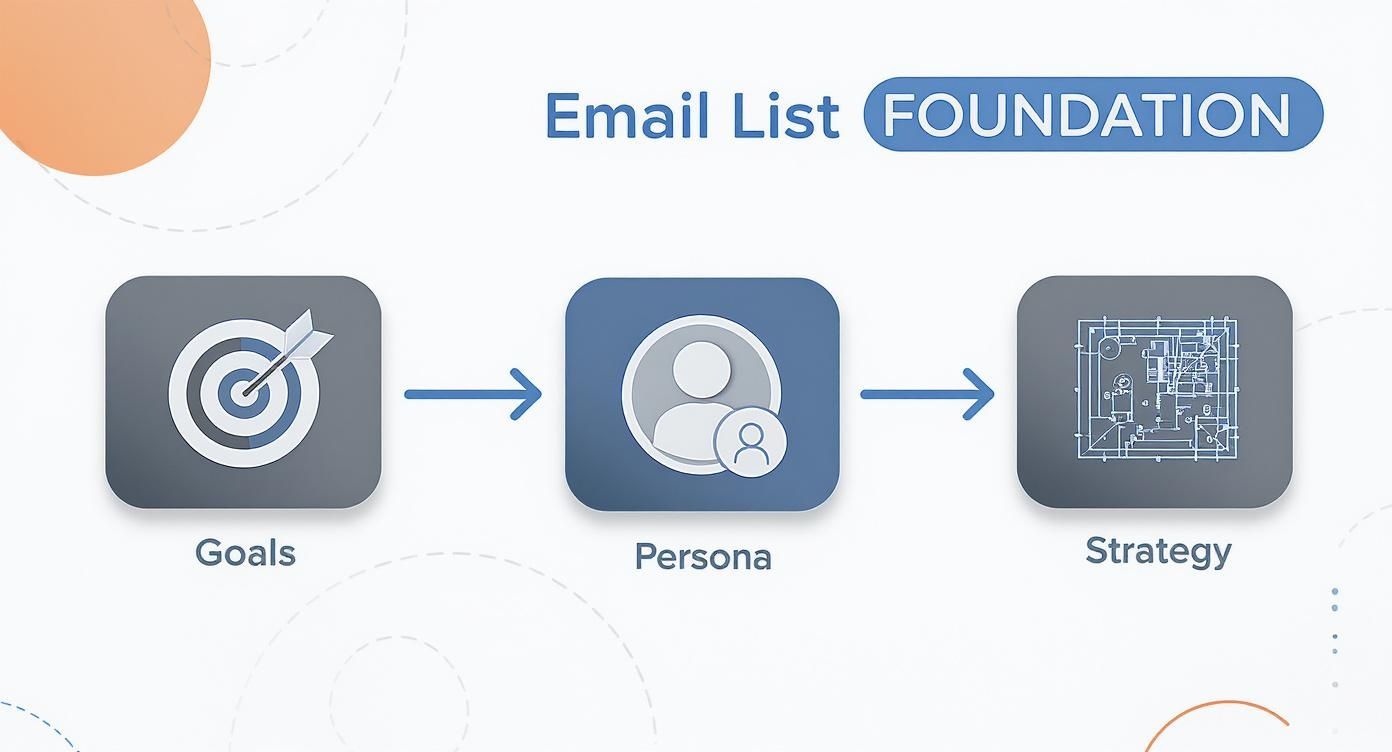
A successful list isn't just a collection of contacts. It’s a strategic asset you build with a clear purpose from day one.
Step 2: Craft Your Ideal Subscriber Persona
Okay, you know what you want to achieve. Now, who are you talking to?
You need to get crystal clear on your ideal subscriber. A persona is more than just basic demographics like age and job title. It's about understanding their world. What are their biggest challenges? What keeps them up at night? What are they secretly hoping to achieve?
A well-defined persona helps you answer the single most important question from a subscriber's perspective: "What's in it for me?"
When you truly understand their pain points, you can frame your emails—and your sign-up incentives—as the solution they've been searching for.
For example, a financial advisor isn't targeting "people with money." That’s way too broad. They’re targeting someone like "Ambitious Anna," a 35-year-old tech manager who’s earning a great salary but feels completely overwhelmed by investing and just wants a straightforward plan to build long-term wealth.
See the difference? Now every email can be written directly to Anna. This level of detail is what makes your content feel personal and incredibly relevant. Without it, your messages are just noise, destined to be ignored. There’s a reason email marketing consistently delivers an average return of $42 for every $1 spent. It’s a powerful channel, especially when you start with a strong foundation. If you're looking for innovative ways to attract subscribers, you might even explore strategies for growing your mailing list with interactive video.
Creating Lead Magnets People Genuinely Want
A powerful lead magnet is the single most effective tool you have for growing your email list. It’s the handshake, the welcome gift, the value you offer upfront that makes someone say, "Yes, this is worth my email address."
Forget generic "newsletter updates"—that promise is no longer enough to build an email list of engaged fans. The goal is to create an incentive so perfectly aligned with your audience's needs that signing up feels like an obvious win for them.
Step 1: Brainstorm Your High-Value Offer
Your best lead magnet idea sits right at the intersection of your expertise and your audience's most urgent problem. Don't try to solve everything at once. Instead, pinpoint one specific, nagging issue and offer a quick, high-impact solution.
Start by thinking about the questions your ideal subscribers are actually asking. What are they searching for online? What hurdles are stopping them from reaching their goals?
- For a fitness coach targeting busy professionals: The problem isn't just "getting in shape." It’s "how do I fit a workout into my packed schedule?" A perfect lead magnet would be a "15-Minute Home Workout Plan for Busy Execs." It's specific, promises a quick win, and speaks directly to their pain point.
- For a freelance graphic designer: Their audience struggles with creating professional-looking visuals on a budget. A great lead magnet? A "Canva Template Pack for Stunning Social Media Graphics." This gives them an immediate tool they can use to solve their problem right now.
This approach ensures you're providing a genuine solution, not just more content.
Step 2: Choose a Compelling Format
The format of your lead magnet should match how your audience prefers to consume information. A simple PDF isn't your only option.
Consider these modern, engaging formats:
- Interactive Quizzes: These are fantastic for engagement and segmentation (grouping subscribers by interest). A quiz like "What's Your Personal Decorating Style?" for an interior design blog not only captures an email but also tells you about the subscriber's preferences.
- Exclusive Video Workshops: A short, pre-recorded training on a specific topic can feel incredibly high-value. For example, a 10-minute video on "How to Write a Welcome Email That Converts" offers actionable advice in a dynamic format.
- Curated Resource Libraries: Instead of one download, you can offer access to a password-protected page on your site with a collection of your best tools, links, and checklists. This becomes a living resource that people will bookmark and come back to.
For a ton of other options and inspiration, check out these 23 Lead Magnet Ideas For Instagram.
Choosing the Right Lead Magnet for Your Audience
| Lead Magnet Type | Best For | Audience Type | Effort Level |
|---|---|---|---|
| Checklists & Cheatsheets | Quick wins, simplifying complex processes. | Beginners, busy professionals needing fast answers. | Low |
| Ebooks & Guides | In-depth exploration of a core topic. | Learners who want to dive deep and understand the "why." | Medium-High |
| Webinars & Workshops | Demonstrating expertise, live Q&A. | Engaged audiences ready for a high-value commitment. | High |
| Templates & Swipe Files | Providing an immediate, usable tool. | Action-takers who need a shortcut to results. | Medium |
| Quizzes & Assessments | Personalization and audience segmentation. | Those looking for tailored advice or self-discovery. | Medium |
| Resource Libraries | Offering ongoing, curated value. | Loyal followers who trust your recommendations. | Medium (ongoing) |
Ultimately, the best lead magnet is one that solves a real problem in a format your audience will actually use.
Step 3: Write Copy That Converts
Once you have a fantastic offer, you need to describe it in a way that’s impossible to ignore. Your copy should focus entirely on the benefit and transformation the subscriber will get.
Use a clear, benefit-driven headline. Instead of "Download Our Ebook," try "Get Your Free Guide to Planning a Week of Healthy Meals in Under 30 Minutes." See the difference?
Your opt-in copy isn't just describing a file; it's selling a solution to a problem. Focus on the outcome, not the features.
Use bullet points to quickly lay out the value. List the key takeaways or results they can expect after consuming your lead magnet. Keep the language simple, direct, and focused on what they will gain by signing up.
Designing and Placing High-Converting Opt-In Forms
You've got a killer lead magnet ready to go. Now comes the critical part: building a seamless bridge for people to actually get it. This is where your opt-in form comes into play. A well-designed form isn't just a box for an email address; it’s the invitation that makes signing up an easy, almost reflexive, decision.
A fantastic offer hidden behind a clunky, hard-to-find form is a wasted opportunity. Your job is to make the sign-up process completely frictionless.

Step 1: Build an Effective Form
The forms that convert the best almost always share a few key ingredients.
- A Headline That Grabs Attention: Ditch the generic "Subscribe" and go for something specific that screams value, like, "Get Your Free 5-Day Meal Prep Plan."
- Benefit-Driven Copy: In just a few words, tell them what they're getting and why it's great. Bullet points are your best friend here. Think: "Learn to cook healthy meals in under 20 minutes."
- Minimal Form Fields: The more you ask for, the fewer sign-ups you'll get. Research shows that cutting form fields from four to three can boost conversions by 50%. For most lead magnets, an email address is all you need. You can ask for a first name for personalization, but stop there.
- A Clear Call-to-Action (CTA) Button: Your button copy should be an action. Instead of "Submit," try "Download Your Guide," "Get the Checklist," or "Send My Free Template." Make the button pop with a contrasting color so it’s impossible to miss.
Your opt-in form should feel like a natural next step in your visitor’s journey, not an interruption. Every element should reinforce the value of what they're about to receive.
Step 2: Place Your Forms Strategically
Where you put your forms can make or break your list-building efforts. You need to meet people where they are, right when they’re most engaged.
Here are the highest-impact placements:
- Embedded Forms within Content: Place a sign-up form right inside your most popular blog posts. If you have an article on "10 Tips for Better Sleep," an embedded form offering a "Bedtime Routine Checklist" feels helpful, not salesy.
- Exit-Intent Pop-ups: Just as a visitor's cursor heads for the 'back' button, this form appears. It's your last chance to grab their attention with your most valuable, no-brainer lead magnet.
- Header Bar or "Smart Bar": This is a thin, sticky banner at the top of a website. It’s always visible but doesn't get in the way, making it a perfect spot for a site-wide offer like a free webinar.
- Dedicated Landing Pages: For your most important lead magnets, give them their own page with no distractions—no navigation, no sidebar, just a laser-focused explanation of the offer and a sign-up form. This is the best practice for traffic from paid ads or social media campaigns.
Step 3: Prioritize Mobile and Test Everything
More than half of all web traffic now comes from mobile devices. Your forms must work flawlessly on a smartphone. A frustrating mobile experience is a guaranteed way to lose subscribers.
Finally, don't just "set it and forget it." A/B testing is your secret weapon. This simply means creating two versions of your form (e.g., with different headlines) and showing each to 50% of your audience to see which one performs better. Test your headlines, button colors, and copy. Small changes can lead to significant lifts in your sign-up rate over time.
Your First Impression: The Automated Welcome Sequence
The moment someone gives you their email address is the peak of their interest. They've raised their hand and said, "I want to hear from you." This is your golden opportunity to make a brilliant first impression.
Neglecting this moment is one of the biggest mistakes you can make. An automated welcome sequence ensures every new subscriber gets a warm, strategic introduction to your brand, moving them from a curious visitor to an engaged fan right from day one.

Crafting a Simple 3-Part Welcome Series
You don't need a complex, 10-email sequence to make an impact. This simple three-part series is a powerful and practical place to start.
Email 1: The Instant Delivery (Send Immediately)
This email needs to land in their inbox within minutes of signing up. Its main job is to deliver what you promised, reinforcing that they made a great decision.
- Objective: Deliver the goods and say thank you.
- Key Elements:
- A clear subject line: "Your Free [Lead Magnet Name] is Here!"
- A warm, personal greeting.
- A prominent link or button to download the lead magnet.
- A brief, genuine "thank you."
Keep this email short, focused, and valuable. The goal is immediate gratification.
Email 2: The Brand Introduction (Send Day 2)
Now it's time to introduce yourself and show off your brand's personality. This is where you start building a human connection.
- Objective: Share your story and provide more value.
- Key Elements:
- Tell them who you are and why you're passionate about what you do.
- Briefly explain what makes your brand unique.
- Share a link to one of your most valuable pieces of content—a popular blog post or a helpful video—to provide even more value upfront.
This isn't a sales pitch. It's about revealing the person behind the brand. For a deeper dive, check out our guide on how to write a welcome email that really resonates.
Email 3: Setting Expectations (Send Day 4)
The final email in this core sequence is all about the future. Clearly communicate what subscribers can expect from you moving forward.
- Objective: Set the stage for your ongoing relationship.
- Key Elements:
- Tell them how often you'll be emailing (e.g., "expect to hear from me every Tuesday morning").
- Remind them of the kind of content they'll get (tips, case studies, special offers).
- Ask a simple question to encourage a reply, like "What's the biggest challenge you're facing with [your topic] right now?" This one trick can massively boost engagement and teach you a ton about your audience.
This three-part series creates a structured, welcoming journey for every new subscriber.
The Power of Early Segmentation
Your welcome series is also the perfect place to start segmenting your list. Segmentation is simply grouping subscribers based on their interests, and it allows you to send more relevant, personalized content.
Modern email marketers know that personalization is key. Personalized emails generate 30% more opens and 50% more click-throughs compared to generic campaigns.
Here's a simple, actionable step: add a P.S. to your second or third email with a question like: "Are you more interested in A, B, or C? Click the topic you care most about, and I'll make sure to send you the most relevant content." When they click a link, your email platform can automatically "tag" them, allowing you to send far more targeted messages down the road.
Driving Consistent Traffic to Your Opt-In Offers
Your lead magnet is compelling, your forms are optimized, and your welcome sequence is ready. The entire system is built. Now it's time to fuel the engine. Attracting the right eyeballs, consistently, is how you turn a trickle of sign-ups into a steady stream.
Let's walk through the most effective ways to drive traffic.
Step 1: Leverage Your Existing Content
Your best list-building assets are likely hiding in plain sight on your website. I'm talking about your highest-performing blog posts. These pages are already proven winners, attracting your ideal audience.
First, check your analytics and identify your top 5-10 most popular articles. For each one, ask: "What is the next logical step for a reader of this post?"
Then, strategically insert a call-to-action (CTA) for a lead magnet that offers that next step. For example, if you have a popular post on "A Beginner's Guide to Photography," embed a sign-up form for a "Camera Settings Cheatsheet." This approach feels genuinely helpful, not intrusive, and it works wonders for conversion rates.
Don't just slap a generic "subscribe to my newsletter" form on your best content. Match a specific lead magnet to the topic of that page to maximize sign-ups.
Step 2: Turn Social Media Into a Growth Engine
Your social media profiles are powerful tools for promoting your opt-in offers to an engaged audience.
- Optimize Your Bio: Your bio is the most valuable real estate on any social platform. Use a tool like Linktree or a dedicated "links" page on your site to feature your most important lead magnet.
- Create Shareable Graphics: Design simple, eye-catching graphics for Instagram Stories, Pinterest, or Facebook that highlight the main benefit of your lead magnet. Use clear text overlays and a direct CTA like "Swipe up to download!"
- Pin Your Best Offer: On platforms like X (Twitter) and Facebook, you can "pin" a post to the top of your profile. Use this feature to promote your most effective lead magnet, guaranteeing every profile visitor sees a compelling reason to subscribe.
The key is to treat your lead magnet like a core piece of content that deserves consistent promotion.
Step 3: Explore Paid and Collaborative Channels
Once your organic channels are humming along, you can accelerate growth by strategically investing in paid traffic or partnerships.
A small, hyper-targeted ad campaign on Facebook or Instagram can be incredibly effective. A great place to start is by targeting a "lookalike" audience based on your existing website visitors. Promote your best lead magnet directly in the ad, sending that traffic to a dedicated landing page built for one thing: converting visitors into subscribers.
Another powerful strategy is collaboration:
- Guest Posting: Write an article for another blog in your niche. In your author bio, instead of just linking to your homepage, link directly to a relevant lead magnet landing page. This taps you into an established, perfectly-aligned audience.
- Co-host a Webinar: Find a complementary (not competitive) brand and partner up to host a joint webinar. You both promote the event to your respective audiences, and everyone who registers can be added to both of your email lists (with their permission).
Keeping Your Email List Healthy and Engaged
Getting someone to sign up for your email list is a huge win, but the real work has just begun. An email list is like a living community that needs consistent care to stay valuable.
Think of it like tending a garden. If you ignore it, weeds creep in and the good stuff withers. People change jobs, abandon old email addresses, or simply lose interest over time. This is called list decay.
The Inevitable Problem of List Decay
Email list decay is a frustrating reality. On average, you can expect at least 28% of an email list to go stale within a single year. That means over a quarter of your hard-won contacts could become invalid or unresponsive. For more on this, check out these insights on how list decay impacts businesses.
A "dirty" list full of bounced emails and unengaged subscribers actively harms your sender reputation. When email providers see you sending to bad addresses, they start thinking you might be a spammer, which makes it harder for your emails to reach the people who actually want them.
This is where list hygiene comes in. It's the non-negotiable practice of cleaning house to make sure you're only sending to valid, engaged email addresses.
Proactive list hygiene isn't about shrinking your list—it's about increasing its quality. A smaller, highly engaged list is always more valuable than a massive, inactive one.
A Practical Guide to List Cleaning
Keeping your list in top shape boils down to a few key habits.
First, set yourself up for success by using a double opt-in process. This means new subscribers have to click a confirmation link in their first email to officially join your list. It’s a simple step that filters out typos and fake sign-ups, ensuring you build a high-quality list from day one. If you want a deeper dive, we have a whole guide on what is double opt-in.
Next, have a plan for dealing with inactive subscribers—those who haven't opened or clicked an email in 90-120 days.
- Step 1: Launch a Re-Engagement Campaign: Create a targeted 2-3 email series just for your inactive segment. Use a punchy subject line like "Is this goodbye?" or "Do you still want to hear from us?"
- Step 2: Offer a Special Incentive: In the email, remind them why they signed up. You could offer a unique discount or a valuable piece of content to spark their interest again.
- Step 3: Respectfully Prune Your List: If someone doesn't engage with your re-engagement campaign, it's time to let them go. Removing them from your active list is a crucial step. It might feel counterintuitive, but it's essential for maintaining a healthy, high-performing list.
Unpacking Common Questions About Building an Email List
Getting clear, straightforward answers to common questions can help you sidestep mistakes and build your list with confidence.
Let's tackle the most frequent questions I hear.
How Long Does It Take to Build a Substantial Email List?
The honest answer is: it depends. A high-traffic e-commerce site might get hundreds of new subscribers in a month, while a brand-new blog could celebrate its first 100 subscribers after a few months. Both are great!
The key is to shift your focus from raw speed to consistent effort. Your goal should be steady, sustainable growth of engaged subscribers—not just chasing a big number.
Should I Use Single or Double Opt-In?
I am a strong advocate for double opt-in, where a new subscriber must click a confirmation link in their email. It builds a much higher quality list filled with people who are genuinely interested, which directly boosts your email deliverability and long-term engagement.
Sure, a single opt-in process might grow your list slightly faster. But it’s a recipe for typos, fake emails, and high bounce rates that will damage your sender reputation.
For a healthy, high-performing list, always choose double opt-in. It's your quality control, ensuring every subscriber is real, confirmed, and actually wants to hear from you.
What Are the Most Common Mistakes to Avoid?
Building a great list is often less about finding a secret trick and more about avoiding the big mistakes that sabotage your efforts.
Watch out for these classic missteps:
- Offering a Weak Lead Magnet: Nobody wants generic "updates." Your offer must solve a specific, nagging problem for your ideal customer.
- Burying Your Sign-up Forms: If people can't easily find your opt-in forms, they can't subscribe. Place them strategically in your blog posts, header, sidebar, and footer.
- Going Silent After Subscription: The welcome email sequence is crucial. It's your first conversation. Don't leave new subscribers hanging.
But the absolute worst mistake? Buying an email list. Just don't. It will tank your sender reputation, often violates anti-spam laws, and guarantees terrible engagement because no one on that list actually asked to hear from you. It's the ultimate shortcut to failure.
Summary and Your Next Step
Building a powerful email list comes down to a clear, repeatable process:
- Foundation: Define your goals and understand your audience.
- Incentive: Create a high-value lead magnet that solves a real problem.
- Capture: Use optimized, strategically placed forms to make signing up easy.
- Nurture: Welcome new subscribers with an automated sequence to build trust.
- Promote: Consistently drive traffic to your offers through organic and paid channels.
- Maintain: Keep your list healthy with regular cleaning and hygiene practices.
Your Recommended Next Step: Before you do anything else, take 15 minutes to define your ideal subscriber persona. Write down their biggest challenge related to your industry. This single insight will become the foundation for your first successful lead magnet.
At EmailGum, we provide the actionable advice you need to master every aspect of email marketing. From list building to deliverability, our in-depth guides are designed to help you grow your business. Explore more expert email strategies at EmailGum.