Growing an email list comes down to a simple trade: you offer something of genuine value in exchange for a direct line to someone's inbox. Unlike social media, where algorithms decide who sees your content, your email list is an audience you truly own. It's a stable, reliable asset for your business that you control.
Why Your Email List is a Core Business Asset
If social media is like renting an apartment, building an email list is like owning your home. You’re in full control. You have a direct connection to your audience, making you immune to the sudden platform meltdowns or algorithm shifts that can tank your reach overnight. Learning how to grow your email list isn't just another marketing task—it's a foundational investment in your business's future.
This direct line lets you build genuine relationships with people who have actively chosen to hear from you. That's a powerful position to be in.

The Unmatched ROI of Email Marketing
The numbers don't lie. The return on investment for email marketing is staggering. On average, for every $1 you spend on email, you can expect a return of around $36. In fields like retail and e-commerce, that number often climbs even higher. It's one of the most efficient marketing channels available today.
This incredible return happens because you're communicating with a warm audience—people who already know your brand and are interested in what you offer.
Your email list is more than just a collection of contacts; it's a curated audience of your most engaged potential customers, loyal fans, and future brand advocates. Nurturing this asset is one of the highest-impact activities you can undertake.
Ownership in an Unpredictable Digital World
Picture this: a creator with 100,000 social media followers versus another with a dedicated email list of 5,000 subscribers. While the first might seem more impressive, their entire business is built on rented land. One algorithm update or an unexpected account suspension could erase their reach.
The creator with the email list, however, has a reliable, direct channel. They can:
- Drive targeted traffic to new products or content without paying for ads.
- Get direct feedback by simply asking subscribers to reply to an email, helping them create better offers.
- Build a true community that feels connected and valued.
This level of control is what turns a contact list into a powerful business engine. For a deeper look at specific tactics, check out this excellent resource on how to grow your email list with Divi.
Now, let's dive into the practical strategies for building this vital asset.
Step 1: Create Lead Magnets People Actually Want
Let's be practical: an email address is personal. People don't hand it over without a good reason. To earn that spot in their inbox, you need to offer something genuinely valuable in return. This is where a lead magnet comes in—it's the compelling incentive that makes someone want to subscribe.
Forget the generic, low-effort checklists that everyone has seen a million times. Today's audiences are savvy and demand real solutions. The best lead magnets solve a very specific problem for a very specific person, delivering a quick win or a tangible shortcut that makes your new subscriber’s life easier right away. This first interaction is critical; it immediately positions you as a helpful expert and sets a positive tone for your entire relationship.
Uncover Your Audience's Core Problem
Before creating anything, you must identify a significant pain point. What is the one nagging problem, burning question, or frustrating roadblock your ideal subscriber constantly faces? The goal is to create a resource so perfectly targeted it feels like you've read their mind.
Here’s a simple, step-by-step process to uncover these high-value problems:
- Listen Actively: Dive into social media comments, Reddit threads, or Quora forums in your niche. What questions appear repeatedly? These are your clues.
- Analyze Your Hits: Look at your blog and social media analytics. Which posts or topics get the most traffic, shares, and comments? These are proven areas of interest you can expand upon.
- Ask Directly: Run a poll on Instagram or send a simple survey to existing customers. A straightforward question like, "What's your single biggest challenge with [your topic] right now?" can provide pure gold.
A killer lead magnet doesn't try to solve everything. It focuses on one pressing issue and delivers a high-impact solution.
Your lead magnet should be the "aspirin" to your audience's "headache." It provides immediate relief for a specific pain point, demonstrating your value instantly and making them eager to hear more from you.
Modern Lead Magnet Ideas That Convert
Once you’ve identified the problem, it’s time to choose the right format for your solution. The best choice depends on your audience and the value you’re delivering.
For example, a business consultant could create an interactive quiz that helps potential clients diagnose their biggest operational bottleneck. It's far more engaging than a static PDF and provides immediate, personalized value. A content creator might offer an exclusive video workshop teaching a specific, in-demand skill. This format not only showcases their teaching style but also builds a stronger personal connection. And for busy B2B professionals? Time-saving templates or a curated swipe file of proven examples are incredibly effective because they offer immediate, practical utility.
Choosing the Right Lead Magnet for Your Audience
Matching the format to your audience is key for maximizing sign-ups. What works for a freelance designer’s audience will likely fall flat for an e-commerce brand’s customers. To help you choose, here's a quick comparison of some of the most effective lead magnets today.
| Lead Magnet Type | Best For | Audience Persona | Conversion Potential |
|---|---|---|---|
| Interactive Quiz/Assessment | Service providers, coaches, consultants | Analytical users looking for self-discovery and personalized feedback. | Very High |
| Exclusive Video Workshop | Creators, educators, course sellers | Visual learners who want to see a process in action and build a connection. | High |
| Templates/Swipe Files | B2B professionals, marketers, designers | Busy professionals seeking efficiency and proven frameworks to save time. | High |
| Resource Library/Toolkit | Bloggers, community builders | Action-takers who want a curated collection of the best tools and resources. | Medium-High |
| Free Mini-Course (Email) | Anyone teaching a complex skill | Methodical learners who prefer information delivered in bite-sized, actionable steps. | Very High |
Selecting the right incentive is the first and most important step. With global email use expected to hit 4.89 billion users by 2027, the opportunity is massive. Data shows that over 63% of emails are sent for engagement purposes, meaning your subscribers expect value, not just promotions. You can find more insights in Hostinger's detailed report on email marketing statistics.
Ultimately, your goal is simple: deliver something so genuinely useful that people would have happily paid for it. That kind of generosity builds instant trust and makes subscribers excited to see your name in their inbox.
Step 2: Design Opt-In Forms That Convert Visitors
You've created the perfect lead magnet. That’s the hard part, right? Not quite. Your opt-in form is the gateway to that value, and if it’s clunky, confusing, or poorly designed, no one will use it.
Think of it this way: a great form should feel like a natural next step for your visitor, not an annoying interruption. It needs to appear at the exact moment they're most engaged and hungry for what you have to offer.

This is about balancing visibility with a smooth user experience. The best forms blend seamlessly into the user's journey, making the decision to sign up an easy "yes."
The Anatomy of a High-Converting Form
Every effective opt-in form shares a few core components. Get these right, and you're golden. Miss one, and you'll see your sign-up rates plummet. It's a recipe where every ingredient counts.
Here’s the step-by-step breakdown of what every successful form needs:
- A Magnetic Headline: This is your hook. Its one job is to grab attention and state the main benefit. Ditch "Join Our Newsletter" for something like, "Get 5 Actionable Marketing Tips in Your Inbox Every Tuesday."
- Benefit-Driven Copy: Be quick and clear about what’s in it for them. Bullet points are your best friend here—they make the value easy to scan. Focus on the outcome ("Save 10 hours a month") not the feature ("Get our productivity planner").
- A Crystal-Clear Call-to-Action (CTA): Your button text needs to be specific and action-oriented. "Download the Free Guide" is far more compelling than a boring "Submit." Pro tip: make the button a contrasting color so it pops off the page.
- Trust-Building Social Proof: A simple line like, "Join 15,000+ other smart marketers" works wonders. It shows that other people have already found value, making the decision to subscribe feel much less risky.
Your opt-in form isn't just a data collection tool; it's your first direct conversation with a potential subscriber. Make it clear, compelling, and centered entirely on the value they are about to receive.
Strategic Placement for Maximum Impact
Where you put your form is just as critical as what it says. You have to meet your visitors where they are, right at their moment of highest intent.
An embedded form is perfect for content upgrades. For example, if you wrote a detailed blog post on Pinterest marketing, you could offer a "Pinterest Pin Template Pack" right in the middle of that article. It's contextually relevant and highly effective.
Then there's the exit-intent pop-up. This appears only when a visitor is about to leave your site. It’s your last-ditch effort to capture their attention without interrupting their initial reading experience. When done well, these can recover 10-15% of visitors who would have otherwise been lost for good.
You can also use a modern tool like a powerful lead generation chatbot to engage visitors 24/7. These can start a conversation, qualify leads, and guide people straight to your opt-in.
Fine-Tuning Your Forms with A/B Testing
Never assume your first draft is the best one. The only way to truly know what works for your audience is to test it. A/B testing (or split testing) involves creating two versions of your form and showing them to different groups of people to see which performs better.
You don't have to get complicated. Start with these simple tests:
- Headline Variations: Test a question ("Ready to Double Your Traffic?") against a bold statement ("Get the Free Guide to Doubling Your Traffic").
- Button Color and Text: Does a green button work better than a red one? How about "Get Instant Access" versus "Download Now"? You’d be surprised what a difference these small tweaks can make.
- Image vs. No Image: See if a simple graphic or a mockup of your lead magnet boosts sign-ups. Sometimes it helps, sometimes it distracts.
- Number of Fields: Test a form asking for just an email against one that also asks for a first name. While personalization is valuable, fewer fields almost always lead to higher conversion rates.
Constantly testing and refining your forms is how you turn a decent opt-in rate into a fantastic one. As you set things up, it's also a good time to consider your confirmation process. You can learn more in our guide explaining what is double opt-in and whether it’s the right move for your list.
Step 3: Drive Targeted Traffic to Your Sign-Up Forms
You’ve built a killer lead magnet and a high-converting sign-up form. But here’s the reality: if nobody sees them, your list growth will stall. All that effort is wasted without a steady stream of the right people finding your offer.
Getting those eyeballs isn't about spamming your link into the void. It’s about being deliberate and showing up where your ideal subscribers are already spending their time.
Let's walk through a practical plan to get your opt-in forms the traffic they deserve.
Leverage Your Existing Website Traffic
Before you spend a single dollar on ads, optimize the real estate you already own. Your website and blog are goldmines for capturing leads who are already curious about what you do.
Real-World Example: A blogger had an article about Instagram Reels that was getting consistent daily traffic from Pinterest. People would read it and leave. She made one simple change: she added a PDF guide with creative call-to-action ideas—something directly related to the post—and within 45 days, she had 50 new subscribers, all from traffic that was already there.
Here’s a step-by-step approach to do the same:
- Find Your Winners: Dive into your website analytics and identify your top 5-10 most popular pages or blog posts. These are your proven traffic magnets.
- Add Relevant CTAs: Go into each of these top posts and sprinkle in clear, compelling calls-to-action. Don't just slap a generic button at the bottom. Weave in a text link, add a graphical banner, or embed the form right in the content where it makes sense.
- Build a Dedicated Landing Page: Give your lead magnet its own home. A dedicated landing page has one job: to get the sign-up. By removing all other distractions, these pages almost always convert better.
Promote Your Offer on Social Media Channels
Your social media profiles can be powerful traffic drivers, but you have to be smart. Just posting "sign up for my newsletter" is ineffective. The key is to make your lead magnet a natural part of your content.
Here are a few actionable ways to turn followers into subscribers:
- Optimize Your Bio Link: Your bio is the most valuable real estate on any social platform. Use a tool like Linktree or Beacons to create a simple hub page that puts your lead magnet right at the very top.
- Create Promotional Content: Don't just tell them, show them. Design posts, Reels, or Stories that highlight the specific benefit of your freebie. You could show a sneak peek, share a testimonial from someone who used it, or talk about the frustrating problem it solves.
- Pin Your Best Offer: On platforms like X (formerly Twitter) and Pinterest, you can pin a post so it's the first thing people see on your profile. Pin a post that sends people straight to your lead magnet's landing page for maximum, ongoing visibility.
Your social media should act as a bridge, guiding interested followers from a platform you don't control to an asset you do—your email list. Make that journey as smooth and compelling as possible.
Expand Your Reach with Paid Ads and Partnerships
Once you’ve optimized your owned channels, it's time to branch out. Paid ads and collaborations are how you get your offer in front of entirely new, highly-targeted audiences.
Running ads on platforms like Facebook or Instagram can be a game-changer once you have an offer that you know converts well. You can get incredibly specific, targeting users based on their interests, online behaviors, or even by creating a "lookalike audience" based on your best existing customers. Just start with a small budget to test what works before scaling up.
Partnerships are another potent, and often cheaper, strategy. Team up with a creator or a non-competing business that serves the same audience. You could co-host a webinar, write guest posts for each other's blogs, or do a simple cross-promotion of your lead magnets to each other's audiences. It’s a powerful shortcut that leverages the trust your partner has already built.
Step 4: Welcome New Subscribers to Build Loyalty
Getting someone to sign up is a huge win, but it’s just the starting line. The real work begins now: turning that new lead into a loyal, engaged member of your community. Those first few interactions are incredibly important, and a well-crafted welcome email sequence is your best tool for the job.
This isn't just about sending a link to the lead magnet they requested. A great welcome series makes a powerful first impression by setting expectations, sharing your brand's unique story, and delivering immediate—and often unexpected—value. It’s your chance to prove they made the right choice in trusting you with their email address.
More Than Just a "Hello"
The moment someone subscribes is when they are most engaged with your brand. Your welcome email will likely be one of the most-opened emails you ever send them, so you have to make it count. Don't just deliver the goods and disappear.
Instead, use this first email to kick off a genuine conversation. A simple yet effective welcome email should accomplish these key things:
- Deliver the Promise: Immediately provide the lead magnet they signed up for. No delays.
- Set Expectations: Let them know what kind of emails you'll send and how often you'll be in touch.
- Share Your Story: Briefly introduce yourself or your brand. What do you stand for? Why should they listen to you?
- Provide a Quick Win: Offer an extra tip or a small piece of actionable advice related to their download to provide instant value.
For a deeper dive into the nuts and bolts, our complete guide on how to write a welcome email offers templates and real-world examples you can adapt for your own sequence.
The Power of Simple Segmentation
Thinking about segmentation from day one is one of the smartest moves you can make. Segmentation simply means dividing your list into smaller groups based on specific criteria. This allows you to send more relevant, personalized content that truly connects with your audience.
You don't need a complex system to get started. A simple and powerful technique is to tag subscribers based on the specific lead magnet they signed up for.
For instance:
- Someone who downloaded a "Beginner's Guide to SEO" gets tagged with
Interest-SEO-Beginner. - A subscriber who grabbed a "Social Media Content Calendar" is tagged
Interest-Social-Media.
This small action lets you send targeted follow-up content that speaks directly to their interests, which can dramatically improve your engagement rates down the line.
The goal of a welcome sequence isn't just to onboard a subscriber; it's to validate their decision. By providing immediate value and a clear sense of what's to come, you transform a transactional sign-up into the beginning of a meaningful relationship.
This tailored approach pays off. Marketers who segment their email lists report 30% higher open rates and 50% higher click-through rates. The data is clear: personalized content drives far more engagement than generic blasts. You can discover more insights from these powerful email marketing statistics and see why it's a tactic worth implementing from the very beginning.
By focusing on a strong welcome and smart, simple segmentation, you stop churn before it can start. You’re not just collecting emails; you’re building a foundation of trust and loyalty that will pay dividends for years.
Your Path to 1,000 Loyal Subscribers
We've covered a complete playbook for how to grow your email list sustainably. We've walked through the core pillars: creating value with lead magnets, optimizing your website for conversions, promoting your offers across channels, and nurturing subscribers from the moment they join.
These aren't just one-off tactics; they are interconnected parts of a system built to attract and keep an audience that wants to hear from you. Your welcome sequence, for instance, is the single most critical step in turning a new subscriber into a long-term, loyal fan.
This visual shows the simple yet incredibly powerful flow of a great welcome sequence.
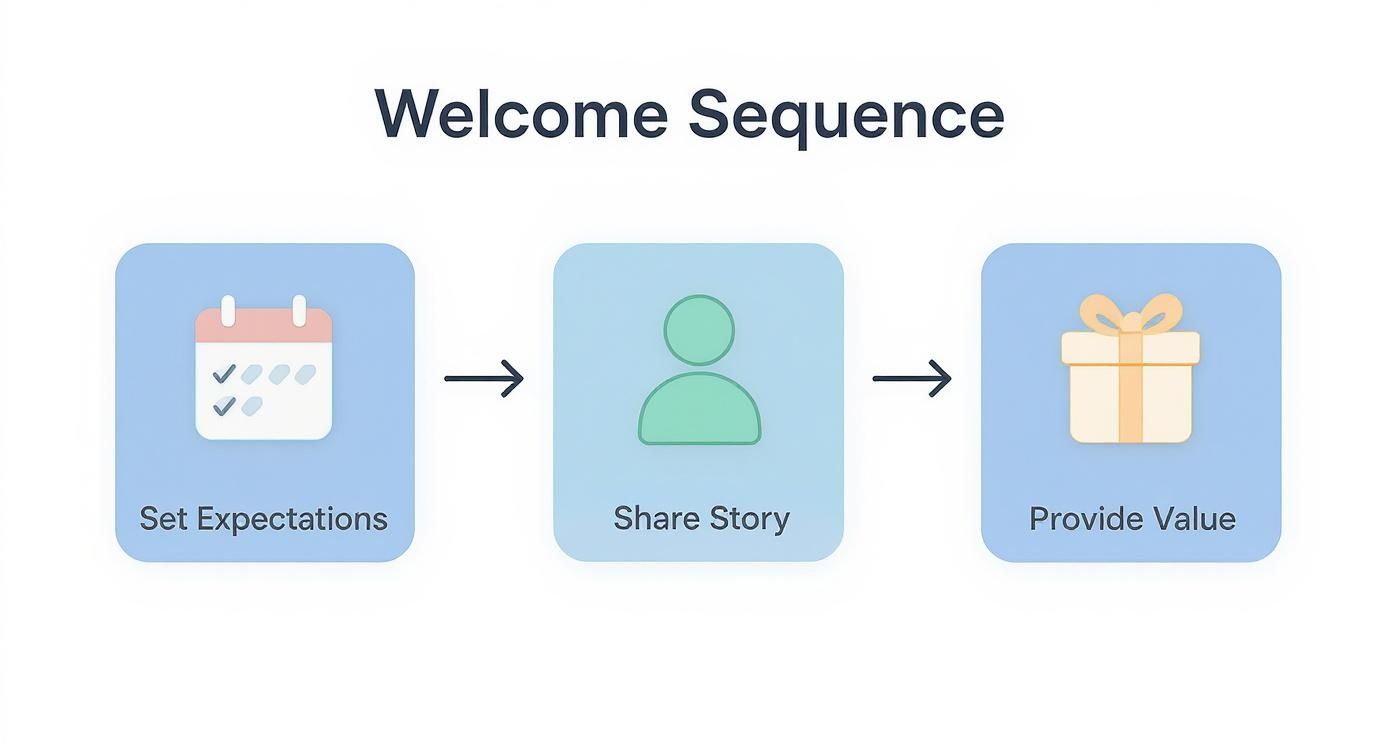
The main takeaway is that a strong welcome is so much more than a delivery mechanism for your freebie—it’s a relationship-building tool. For more inspiration, you can find a ton of proven email list building strategies that build on these foundational ideas.
Summary and Your Next Step
Growing a quality email list is a marathon, not a sprint. It’s about consistently providing value and building trust. By creating a compelling lead magnet, designing high-converting forms, driving targeted traffic, and welcoming new subscribers effectively, you build a powerful asset that will fuel your business for years to come.
Your Recommended Next Step: Take 15 minutes to analyze your website traffic. Identify your single most popular blog post or page and brainstorm one simple, relevant lead magnet you could create specifically for that audience.
Common Questions About Growing Your Email List
Even with a solid strategy, questions are bound to come up. Let's clear up some of the most common ones so you can keep your momentum going.
How Often Should I Email My List?
There’s no single right answer, but a great starting point is once a week. This rhythm keeps you on your audience's radar without overwhelming their inboxes.
The most important factor is consistency. Whether you choose weekly, bi-weekly, or monthly, stick to it so your subscribers know when to expect to hear from you. Always make sure every email is valuable—if people know you deliver quality content, they'll look forward to your emails. Finally, watch your numbers. Your open rates and unsubscribe stats are direct feedback from your audience about your sending frequency.
What Is a Good Email List Growth Rate?
A healthy and sustainable organic growth rate is typically between 1-5% per month. So, if you have a list of 1,000 subscribers, that’s about 10-50 new, genuinely interested people joining you monthly. Of course, this number can spike significantly during a promotion, partnership, or if a piece of content goes viral.
My advice? Don't get fixated on a specific percentage. The quality of your new subscribers is infinitely more important than the quantity. It's far better to add 20 highly-engaged people than 100 who are a poor fit and will never open your emails.
Steady growth with the right audience is always the goal.
Should I Ever Buy an Email List?
Let me make this simple: No. Never. Buying an email list is one of the fastest ways to sabotage your marketing efforts. You're paying for a list of cold contacts who never gave you permission to email them, which leads to a host of problems.
Here’s what happens when you use a purchased list:
- Your spam complaints will skyrocket. People won't know who you are and will rightly mark you as spam.
- You'll destroy your sender reputation. High complaint rates are a massive red flag for email providers like Gmail. They'll start sending all your emails—even to your real subscribers—straight to the spam folder.
- Engagement will be abysmal. You can expect rock-bottom open and click-through rates because the audience has zero interest in what you have to say.
Building your list organically by offering real value is the only path to creating an asset that actually grows your business.
At EmailGum, we're all about giving you the strategies and insights to build an email list that drives real results. Check out our resources and start growing your audience the right way. You can find out more at https://emailgum.com.