Growing your email list boils down to a simple value exchange: you offer something your ideal audience actually wants in return for their email address. The whole game is about defining your target subscriber, creating a compelling value proposition they can't refuse, and consistently attracting high-quality leads who are genuinely excited to hear from you.
This guide provides a step-by-step playbook to do just that, moving from foundational strategy to advanced tactics you can apply immediately.
Building Your Foundation for Sustainable List Growth
Before you even think about chasing subscriber numbers, you must build a solid foundation. Many marketers jump straight to flashy tactics—pop-ups, giveaways, you name it—but those efforts will fall flat without a crystal-clear understanding of who you're trying to attract and why they should care. Rushing this stage is like building a house on sand.
The goal isn't just to bloat your subscriber count. It’s to build an engaged community of people who will eventually become loyal readers and customers. Getting this foundation right from day one sets you up for better open rates, higher engagement, and a real return on your effort.
Step 1: Define Your Ideal Subscriber
You can't attract the right people if you don't know who they are. Go beyond basic demographics and sketch out a detailed profile of your ideal subscriber. What are their biggest headaches? What are they trying to accomplish? What kind of content would make their life or work noticeably easier?
Think about it this way: a newsletter for brand-new freelance writers needs a totally different hook than one for seasoned agency owners.
Real-World Example:
- New Freelance Writers: They're likely looking for step-by-step advice on landing their first clients, figuring out what to charge, or writing a proposal that doesn't get ignored.
- Agency Owners: They're more likely interested in strategies for scaling their business, hiring top talent, or improving client retention for the long haul.
Nailing these details helps you craft content and offers that truly resonate, making the decision to subscribe a no-brainer. If you're just getting your feet wet, our guide on how to start an email newsletter is a great place to get this part right.
Step 2: Craft a Compelling Value Proposition
Once you know your audience inside and out, you need to answer their unspoken question: "What's in it for me?" Your value proposition is the clear, concise promise of the value they'll get by signing up. This needs to be front and center on every sign-up form and landing page you create.
A weak value proposition is generic and forgettable, like "Subscribe to our newsletter." A strong one is specific and screams benefits.
Actionable Takeaway: A powerful value proposition shifts the focus from what you send (e.g., a newsletter) to what the subscriber gets (e.g., actionable insights to double their revenue).
This simple process flow breaks it down perfectly. You have to nail these core pillars—Audience, Value, and Quality—to build a list that’s actually worth having.
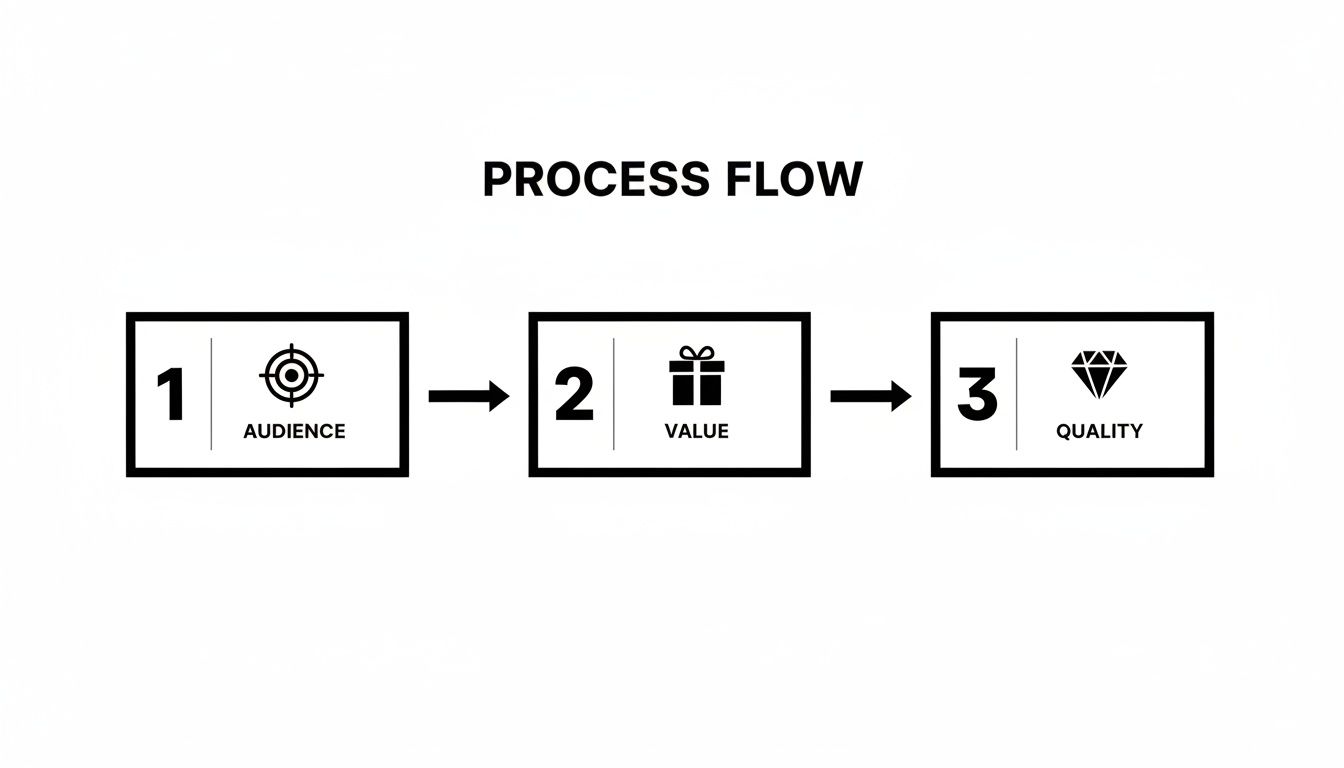
This visual hammers home the point that sustainable growth is a sequence. If you don't have a clear audience, your value proposition will be weak, and the quality of your list will inevitably suffer. To lay a solid groundwork for growth, it helps to understand the broader strategies for how to generate leads online and grow your business.
Creating Lead Magnets That Actually Convert
A killer lead magnet is your single best weapon for turning casual visitors into engaged subscribers. This is where you offer something so valuable, people are happy to give you their email address for it.
The psychology here is simple: you’re not just asking for their contact info; you’re offering an immediate solution to a problem that’s been bugging them. Forget about writing another generic, 50-page ebook that collects digital dust. Today's best lead magnets are concise, super actionable, and deliver a quick win.
Step 1: Pinpoint Your Audience's Most Pressing Problem
The success of your lead magnet boils down to one word: relevance. To create something people are desperate for, you have to find a specific, urgent pain point they're dealing with right now. What’s the one question they keep typing into Google? What’s the roadblock stopping them from hitting their goals?
Once you’ve nailed that core problem, your lead magnet becomes the most direct solution.
Real-World Examples:
- For E-commerce Store Owners: Their biggest headache is probably abandoned carts. A perfect lead magnet would be a "5-Part Email Sequence Template to Recover Lost Sales."
- For SaaS Founders: They might be struggling with getting new users to stick around. A high-value offer could be a "New User Onboarding Checklist" that helps customers find that "aha!" moment fast.
- For Content Creators: The constant grind of coming up with new ideas is a real challenge. The ideal lead magnet? "100 Viral Content Prompts for Your Niche."
Each example offers a tangible fix for a specific issue. This targeted approach works. In fact, modern industry insights show that businesses using tailored lead magnets can boost their signup rates by up to 20-30% compared to generic popups. This makes sense, especially when you consider that recent email marketing statistics show that 78% of consumers actually prefer brands to use email during their buying journey.
Step 2: Choose a High-Impact Format
The way you package your lead magnet is just as important as what's inside. People are busy, so they’re drawn to resources they can consume and apply in minutes, not hours. High-impact formats are all about action.
The goal of a lead magnet isn't to teach someone everything you know. It’s to solve one problem so well that they trust you to solve the next one.
This means you should lean into formats that are practical and deliver that instant hit of value. Some are perfect for professionals who need a shortcut, while others are better suited for beginners who need a step-by-step guide.
Lead Magnet Ideas for Different Audiences
| Lead Magnet Type | Best For (Audience) | Example | Potential Conversion Lift |
|---|---|---|---|
| Templates & Swipe Files | Professionals looking for shortcuts and proven formulas. | A social media manager gets a pre-built content calendar template. | 15-25% |
| Checklists | Overwhelmed individuals who need a clear, step-by-step process. | A new homeowner downloads a "First 30 Days Moving Checklist." | 10-20% |
| Interactive Quizzes | Audiences seeking personalized insights or recommendations. | A fitness enthusiast takes a "What's Your Ideal Workout Style?" quiz. | 20-35% |
| Free Mini-Course | Learners who want a structured introduction to a complex topic. | A beginner coder signs up for a "5-Day Python Basics" email course. | 18-30% |
| Resource Library | Power users who want access to a curated collection of tools. | A marketer gets access to a library of high-converting ad templates. | 25-40% |
Choosing the right format depends entirely on who you're trying to reach and what problem you're solving. Don't be afraid to test a couple of different ideas to see what resonates most.
Step 3: Design and Deliver for Maximum Impact
Finally, even the world's greatest resource won't perform if it's a pain to get. The presentation and delivery of your lead magnet can make or break its success.
Here’s a simple step-by-step plan to ensure your offer lands perfectly:
- Design with Your Brand in Mind: Your lead magnet is often the first real interaction someone has with your brand. Make it look professional! Use clear fonts, plenty of white space, and your brand colors to create a polished, trustworthy resource.
- Create a Dedicated Landing Page: Don't just throw a link to a PDF on your homepage. Build a simple landing page that sells the benefit of your lead magnet. Use a punchy headline, a few bullet points explaining the value inside, and a big, obvious call-to-action button.
- Automate the Delivery: The second someone signs up, they should get an email with their resource. This immediate delivery is crucial—it builds trust and starts the relationship off on the right foot. Use your email service provider to set up a simple automated welcome email that delivers the goods instantly.
Designing Opt-In Forms That Drive Action
Your opt-in form is the gatekeeper to your email list. You could have the most incredible lead magnet in the world, but if your form is clunky, confusing, or buried on a forgotten page, your list growth will flatline.
The best forms are designed with a single purpose: to make subscribing a quick, frictionless, and compelling decision. This isn't just about picking pretty colors; it's a careful balance of psychology, copywriting, and strategic placement. Every element, from the headline to the button text, has a job to do.

Anatomy of a High-Converting Form
Think of your opt-in form as a micro-landing page. It has just a few seconds to sell the value of subscribing. Here are the essential ingredients for a form that gets results:
- A Benefit-Driven Headline: Your headline must immediately answer "What's in it for me?" Forget generic phrases like "Join Our Newsletter." Instead, try something like, "Get 5 Actionable Marketing Tips in 5 Minutes."
- Concise and Persuasive Copy: Use a short sentence or a couple of bullet points to hammer home the value. Briefly explain what they'll get and how it will help them.
- A Clear and Actionable Call-to-Action (CTA): The button text is crucial. Ditch boring words like "Submit." Swap them for something that implies immediate value, like "Send Me the Cheatsheet" or "Get Instant Access."
When you focus on these core elements, you turn a passive data-collection tool into an active conversion machine.
The Sweet Spot for Form Fields
One of the biggest debates in list building is how many form fields to use. The rule of thumb is simple: the fewer fields you ask for, the higher your conversion rate will be.
Every extra field creates friction and gives someone another reason to leave. For most lead magnets and newsletter signups, all you really need is an email address. Asking for a first name can be great for personalization, but you have to test it. If adding that one field causes your conversion rate to drop by 20%, is the personalization worth the lost subscribers?
Asking for just an email address can boost conversion rates by over 50% in some cases. You can always gather more info later in the relationship, once you've earned their trust.
If you're worried about the quality of leads from a single-field form, you can always use a two-step confirmation process. You can learn more about how what is double opt-in works to ensure you're building a list of engaged, verified subscribers.
Strategic Placement for Maximum Visibility
Where you put your forms is just as important as how they look. You want to maximize visibility without being annoying. Get it right, and you’ll capture leads from every corner of your website.
Here’s a step-by-step breakdown of the most effective form types and where to use them:
- Embedded Forms (In-Content): Placing a form directly within a relevant blog post is a fantastic, non-intrusive strategy. If someone is reading an article about social media, a form offering a "Free Content Calendar Template" feels like a natural next step, not an interruption.
- Slide-In Forms: These forms slide into view from a bottom corner as a user scrolls. They're less aggressive than a full-screen popup but still highly visible, making them a great middle-ground option.
- Exit-Intent Popups: This tech detects when a user's cursor is heading for the "back" button and triggers a popup with a final offer. It's your last chance to convert a visitor and can save subscribers who would have otherwise been lost for good.
- The "Hello Bar": A thin banner that sticks to the top of your website is a persistent, site-wide call to action. It’s perfect for promoting your main newsletter or a high-value lead magnet without disrupting the user experience.
Driving Targeted Traffic to Your Subscription Forms
You've created an irresistible lead magnet and designed a high-converting form. Now for the most critical part—getting eyeballs on it. An amazing offer is useless if no one ever sees it.
This is where you build a repeatable system for funneling the right people to your subscription forms. The key is promoting your email list across your entire digital presence, turning every channel into a potential source of new, engaged subscribers.

Strategy 1: Leverage Your Owned Media Channels
Your own website and social media profiles are your most valuable assets. This is your home turf, where you have complete control over the messaging. Start by optimizing these properties to make subscribing feel like the natural next step for every visitor.
High-traffic pages like your homepage, blog, and "About" page are perfect spots for a prominent call to action. Over on social media, your bio is your billboard.
Actionable Steps:
- Instagram & X (Twitter): Use a clear call to action in your bio, like "Get my weekly marketing cheat sheet 👇" and point it to a dedicated landing page.
- LinkedIn: Add your newsletter link directly to your headline, header image, and the "Featured" section to capture professional connections.
- YouTube: Every video description should have a link to your newsletter. Even better, mention it verbally in your intros or outros for maximum impact.
The goal is to make it impossible for an interested visitor to leave your digital properties without seeing an invitation to subscribe. Treat every piece of content as an opportunity to grow your list.
Strategy 2: Tap into New Audiences with Content Marketing
Content marketing is your engine for getting offers in front of fresh, relevant audiences. The strategy is to provide immense value on other platforms to build authority and drive targeted traffic back to your sign-up forms.
One of the most effective methods is guest blogging. By writing for a publication your ideal subscribers already read, you borrow their audience and credibility. When you write a guest post, create a specific content upgrade that’s directly related to the article.
Real-World Example:
Imagine you write a guest post for a popular finance blog about "5 Common Budgeting Mistakes." Instead of a generic bio link, you offer a "Free Budgeting Template Spreadsheet" that readers can download. This contextual offer converts at a much higher rate because it directly solves the problem the reader is already thinking about.
Other powerful content marketing tactics include:
- Podcast Interviews: Appear as a guest on relevant podcasts and direct listeners to a special landing page built just for them.
- Collaborative Webinars: Partner with a complementary brand to host a joint webinar. Both parties promote the event, and you share the leads generated.
- Content Swaps: Team up with another newsletter creator in your niche and agree to promote each other for an endorsed introduction.
Strategy 3: Scale Your Growth with Paid Acquisition
Once you have a system that reliably converts organic traffic, it’s time to pour fuel on the fire with paid acquisition. Paid ads offer a predictable, scalable way to get your lead magnets in front of a highly targeted audience.
Success with paid ads boils down to precision targeting. Platforms like Facebook, Instagram, and LinkedIn allow you to zero in on users based on demographics, interests, and online behaviors.
Actionable First Step:
Run a simple campaign promoting your best-performing lead magnet, sending users directly to its landing page with a modest budget. Keep a close eye on your cost per lead (CPL)—the amount you pay for each new subscriber—to ensure you’re acquiring them profitably. Once you find a winning combination of audience, offer, and ad creative, you can confidently increase your spend to drive consistent, scalable growth.
Crafting a Welcome Sequence That Builds Real Connection
Getting a new subscriber isn't the finish line—it's the starting gun. That first interaction is your golden window of opportunity. Their interest is at its peak, and the first few emails you send will set the tone for the entire relationship.
A well-thought-out welcome sequence does more than just deliver a lead magnet. It makes a killer first impression, slashes immediate unsubscribes, and starts turning a fresh lead into a loyal fan.
The Anatomy of the Perfect First Email
Your very first email is the most important one you'll send. It has the highest open rates you'll ever see, often soaring past 50%. This is your one shot to confirm their subscription, deliver on your promise, and kickstart a real connection.
Here’s a step-by-step checklist for that first email:
- Deliver the Goods Immediately: If they signed up for a guide or a checklist, the link to download it should be front and center. This instant gratification builds trust.
- Set Clear Expectations: Briefly remind them what they signed up for and what's coming next. Will you email them weekly? Monthly? What kind of content can they expect?
- Introduce Your Brand's Personality: This is your chance to show them who you are. Are you funny, serious, or data-driven? Let your brand's voice shine through to make the interaction feel human.
For a deeper dive, our guide on how to write a welcome email offers detailed templates and examples.
From Welcome Mat to Personalized Journey
An effective welcome sequence doesn't stop after one email. The best ones are a carefully planned series of 3-5 emails sent over the first week, designed to systematically nurture that new relationship.
Actionable Takeaway: Your welcome series is the perfect place to showcase your greatest hits. Link out to your most popular blog posts, a valuable case study, or a helpful video tutorial. This gives new subscribers a curated look at your very best content right away.
This multi-step approach gives you the space to introduce different facets of your brand without cramming everything into one massive, overwhelming email.
The Power of Asking Questions
One of the most powerful and overlooked strategies is to simply ask new subscribers what they're interested in. This simple action is the first step toward effective email segmentation (sending tailored content to different groups).
You can pull this off by including a simple question in your first or second email.
Real-World Example:
A marketing blog could ask:
"To make sure I only send you the most relevant stuff, what are you most interested in learning about right now?
- Growing my audience
- Improving email conversions
- Mastering paid ads"
When a subscriber clicks one of those links, you can automatically tag them in your email tool. Someone who clicked "Mastering paid ads" might get a case study on a successful campaign, while the "Growing my audience" group gets a guide on organic traffic. This simple act of segmentation shows you're listening and is a crucial step in turning a new subscriber into a loyal fan.
Measuring and Refining Your List Growth Engine
You can't just set up opt-in forms and hope for the best. To accelerate your list growth, you have to treat your strategy like an engine—one that needs constant measuring, tuning, and refining. This data-driven mindset is what separates a stagnant list from one that sees consistent, sustainable growth.

The Metrics That Matter Most
Forget vanity metrics like total subscribers for a moment and zero in on the key performance indicators (KPIs) that actually tell you what’s working.
Here are the three most important metrics to track:
- Opt-in Conversion Rate: The percentage of people who see your form and actually subscribe. A low number here is a red flag that your offer, copy, or form placement may need work.
- Cost Per Lead (CPL): If you're running paid advertising, this metric is your north star. It tells you exactly how much you're spending to get one new subscriber.
- List Growth Rate: Calculated monthly, this is the net growth of your list after factoring in unsubscribes. A healthy rate means you're bringing in new people faster than you're losing them.
Once you start tracking these numbers, you'll have a clear baseline for improvement.
Running Simple, Effective A/B Tests
The single best way to tune your growth engine is through A/B testing (also called split testing). The concept is simple: you create two versions of something—say, a landing page headline or a signup button—and show each version to a different segment of your audience to see which one performs better.
The point of A/B testing is to stop guessing and start knowing. Even tiny, incremental improvements compound over time, leading to impressive growth.
You don't need a complicated setup. Focus on simple, high-impact tests that can give you clear answers.
Actionable A/B Test Ideas:
- Your Headline: Pit a benefit-driven headline ("Get the 5-Step Plan to Double Your Traffic") against one that sparks curiosity ("The SEO Mistake 90% of Blogs Make").
- Your Call-to-Action (CTA): Try different button copy. Does "Get the Guide" work better than "Send It to Me!"?
- Your Form Design: Test a simple, single-column layout against a two-column design.
Getting serious about split testing landing pages is non-negotiable for understanding what truly resonates with your audience. By methodically testing one variable at a time, you can make data-backed decisions that consistently lift your signup rates.
Got Questions About Growing Your Email List? We've Got Answers.
As you start putting these list-building strategies into practice, you're bound to have some questions. Let's tackle some of the most common ones.
How Many Emails Should I Actually Send Per Week?
There's no magic number, but a great starting point is one email per week. That’s frequent enough to stay on your audience's radar without flooding their inbox.
The real key? Consistency. It's far better to send one email every Tuesday like clockwork than to send three this week and none for the next month. Pick a schedule you can genuinely stick to, then watch your open rates and unsubscribe numbers. Your audience will tell you if you're sending too much or too little.
List Quality vs. List Size: What Really Matters?
Quality. Every single time. No contest.
A highly-engaged list of 1,000 subscribers who love your content and buy your products is infinitely more valuable than a list of 10,000 people who never open your emails. The second group is just dead weight, hurting your deliverability and costing you money.
Pour your energy into attracting the right people—those who are a perfect fit for what you offer. A smaller, highly targeted list will always deliver better engagement, higher conversions, and a much stronger return on your effort.
What's the Best Tool for Managing an Email List?
The "best" tool is the one that fits your specific needs, goals, and budget. Here's a quick breakdown of popular tools:
- For Beginners: Platforms like Mailchimp or ConvertKit are fantastic. They’re built for creators and small businesses, with easy-to-use interfaces.
- For E-commerce: If you're running an online store, Klaviyo is a powerhouse, offering deep integration with platforms like Shopify.
- For Advanced Automation: A tool like ActiveCampaign is excellent for more complex automation and segmentation strategies.
Start simple, and don't be afraid to migrate to a more powerful tool once you outgrow your first one.
Summary and Your Next Step
Growing your email list is a systematic process, not a secret trick. It starts with deeply understanding your audience, creating a valuable lead magnet to solve their problems, and strategically promoting it across multiple channels. By focusing on quality over quantity and continuously testing your approach, you can build a thriving community of engaged subscribers who are eager to hear from you.
Your Recommended Next Step: Take 15 minutes to define your ideal subscriber. Write down their single biggest challenge right now. This one exercise will provide the clarity you need to create your next high-converting lead magnet.