To consistently improve your email open rates, you must master three key areas. First, write compelling, personalized subject lines that spark curiosity and demand attention. Second, maintain a clean and segmented email list to ensure every message is relevant to the recipient. Third, build a strong sender reputation with proper email authentication to make sure you land in the primary inbox, not the spam folder. Get these fundamentals right, and you'll be well on your way to earning the click every time.
Why Your Emails Aren't Getting Opened

Before testing a dozen different subject line formulas, it's crucial to understand what’s actually broken. When subscribers ignore your emails, they’re sending a clear signal. The problem almost always comes down to a breakdown in trust, a lack of relevance, or a simple failure to stand out in a crowded inbox.
Think of an email open as a small transaction. Your subscriber "pays" with their time and attention. In return, they expect the value you promised. If your past emails didn't deliver, they’ll stop making that investment. This is a common trap for marketers—obsessing over the "send" button instead of nurturing the relationship that earns the open in the first place.
Step 1: Pinpoint the Core Problems
Understanding why your emails are getting the cold shoulder is the first step toward a real solution. It's rarely a mystery. The reasons typically fall into a few key categories that directly influence a subscriber's split-second decision to open or delete.
Your diagnosis should start with these foundational pillars:
- Sender Reputation and Trust: Does your "From" name look familiar and credible? An email from "Sarah at Company XYZ" often feels more personal and trustworthy than one from "Company XYZ Marketing." If people don't recognize or trust the sender, they'll delete it without reading another word.
- Inbox Appearance: This is the one-two punch of your subject line and preheader text. A generic, uninspired subject line like "Our Weekly Newsletter" is an immediate turn-off. It’s competing against dozens of other messages, and if it doesn't create urgency or curiosity, it will get lost in the noise.
- Audience Relevance: Are you sending the right message to the right person at the right time? Blasting a promotion for a product a subscriber just bought is a classic mistake. It shows you aren't paying attention to their journey with your brand.
Before we dive into specific tactics, this table breaks down the core pillars you need to focus on to start seeing improvements.
Core Factors That Influence Email Open Rates
| Pillar | Primary Goal | First Actionable Step |
|---|---|---|
| Inbox Presence | Capture immediate attention and create curiosity before the open. | A/B test a question-based subject line against a statement-based one. |
| Audience Relevance | Send targeted content that aligns with the subscriber's interests and history. | Create one simple segment based on a past purchase or site visit and send them a tailored email. |
| Sender Reputation | Build trust with both subscribers and inbox providers (like Gmail and Outlook). | Check your "From" name to ensure it's recognizable and feels personal, not robotic. |
| Technical Deliverability | Ensure your emails are authenticated and avoid the spam folder. | Use a free tool to verify your SPF and DKIM records are set up correctly. |
The most effective way to improve email open rates is to shift your mindset from chasing opens to earning them. Every email is an opportunity to build trust and prove your value, making the next open an easier decision for the subscriber.
This framework is about building a relationship, not just blasting out campaigns. When you focus on being a trustworthy, relevant, and interesting presence in the inbox, you create an environment where subscribers want to open your emails. The strategies that follow are all built on this essential principle of earning attention.
Writing Subject Lines That Earn the Click
Think of your subject line as the gatekeeper to your email. You could have brilliant, valuable content waiting inside, but a weak subject line guarantees it never sees the light of day. Research consistently shows that nearly 50% of recipients open an email based on the subject line alone, making it your single biggest lever for boosting open rates.
The secret isn’t a magic formula. It’s about understanding the psychological triggers that make someone pause in their crowded inbox, feel a spark of curiosity, and decide your message is worth their time. You're competing with meeting reminders, texts from family, and the endless scroll of social media.
Step 2: Leverage Psychology in Your Subject Lines
The best subject lines don't just describe what's inside; they tap into fundamental human drivers to create an emotional response or a compelling reason to act now. It’s the difference between a boring sign that says "Sale Today" and one that whispers, "Did you forget something?"
Here are a few of the most reliable angles that work time and again:
- Curiosity: We are hardwired to want answers. A subject line that opens a loop or poses an intriguing question is almost impossible to ignore. Instead of "Our New Features Are Here," try something like, "The one feature you’ve been waiting for."
- Urgency and Scarcity: This is a classic for a reason—it works. Deadlines and limited availability kickstart our fear of missing out (FOMO). Simple phrases like "Last chance," "24 hours left," or "Only 3 spots left" force a decision.
- Personalization: Seeing your name in a subject line is a powerful pattern interrupt. But modern personalization goes deeper, referencing past purchases, browsing history, or location to make the email feel like it was written just for them.
- Benefit-Oriented: Your subscribers are always subconsciously asking, "What's in it for me?" Subject lines that clearly state a benefit—saving time, learning a skill, solving a nagging problem—give them an immediate reason to click.
Your preheader text is not an afterthought—it’s the subtitle to your subject line’s headline. Use it to add context, build on the curiosity, or reveal a secondary benefit. A great preheader can be the final nudge a subscriber needs to open your email.
Real-World Examples of Effective Subject Lines
The right approach depends entirely on your goal and audience. A subject line for a B2B software update should feel different from one for a flash sale at a clothing store.
Let's look at a few practical examples:
E-commerce Flash Sale:
- Generic: "50% Off Everything!"
- Better: "⚠️ Last Call: Your cart expires in 3 hours" (Urgency + Personalization)
- Why it works: The emoji grabs attention, "Last Call" creates urgency, and mentioning their cart makes it personal.
SaaS Company Content:
- Generic: "Our New Blog Post"
- Better: "Steal our top-performing email template" (Benefit + Curiosity)
- Why it works: It promises a direct benefit (a proven template) and uses an active word ("Steal") to create intrigue.
Local Service Business:
- Generic: "Book Your Appointment"
- Better: "Is your [service area] ready for the season, [Name]?" (Personalization + Question)
- Why it works: It’s personalized with their name, timely (mentions the season), and asks a question that prompts a thought.
The "better" versions are more specific, create an emotional pull, and speak directly to a subscriber's needs. They turn a generic broadcast into a personal invitation.
Step 3: A/B Test Your Subject Lines
How do you know if a curiosity-driven subject line works better than an urgent one for your audience? You test it. A/B testing is how you stop guessing and start making data-driven decisions.
Follow this simple, step-by-step framework:
- Form a Hypothesis: Start with a clear question. For example: "I believe a subject line phrased as a question will get a higher open rate than one that's a statement."
- Create Two Versions (A and B): Write two distinct subject lines based on your hypothesis. Crucially, keep every other part of the email identical.
- Version A (Control): "Our Summer Lookbook Is Here"
- Version B (Variant): "Ready for a summer style refresh?"
- Send to a Small Segment: Send each version to a small, equal portion of your list. Sending to 10% for A and 10% for B is a common starting point.
- Analyze and Send to the Winner: Wait a few hours, then check which version has the higher open rate. Send that winning version to the remaining 80% of your list.
This process takes the guesswork out of the equation and lets your audience guide your strategy. For more advanced techniques, explore these 8 Email Subject Line Best Practices. Consistent testing is the surest path to steadily improving open rates over time.
Using List Segmentation to Boost Relevance
Sending the same generic email to your entire list is the fastest way to teach subscribers to ignore you. In a world overflowing with content, relevance is everything. If you want your emails to feel essential, you must master email list segmentation—the practice of dividing your audience into smaller, more focused groups.
This isn't about creating dozens of complex workflows overnight. It’s about taking logical steps to send the right message to the right people at the right time. When a subscriber gets an email that feels like it was written just for them, they don't just open it; they start looking forward to the next one. This shift from broadcasting to narrowcasting is how you truly move the needle on your open rates.
Step 4: Start with High-Impact Segments
You can get big wins right away by focusing on one thing: engagement. Your most dedicated fans behave very differently from people who haven't opened an email in six months, and treating them the same is a massive missed opportunity.
Start by creating these two foundational segments:
- Engaged Subscribers: This is your fan club—people who have opened or clicked an email in the last 90 days. Send them your regular newsletters, special offers, and new content. They're already listening.
- Inactive Subscribers: This group includes everyone who hasn't engaged in the last 90 days (or whatever timeframe fits your business). Blasting them with daily emails will only hurt your deliverability. Instead, target them with a specific re-engagement campaign designed to win them back.
This simple split protects your sender reputation and ensures your best content is seen by your most valuable audience. For a deeper dive, our guide on what email segmentation is is a great place to start.
Advanced Segmentation Strategies in Action
Once you have engagement segments dialed in, you can get more sophisticated with behavioral and demographic data. This is where you create emails that feel incredibly personal and timely, directly leading to more opens. The data proves it: according to recent email marketing statistics, segmented campaigns can see open rates that are 14% higher than non-segmented ones.
Let's look at how this plays out in the real world.
Scenario 1: The E-commerce Brand
An online store selling running gear can use purchase history to create hyper-relevant campaigns.
- Segment: "Recent Marathon Shoe Buyers"
- Criteria: Customers who bought a specific brand of long-distance running shoes in the last 60 days.
- Targeted Email: Instead of a generic "New Arrivals" email, they get a message with the subject line, "Recover right: nutrition tips for marathon runners." The email offers helpful content about recovery products like foam rollers and supplements.
By segmenting based on a high-intent purchase, the store solves the customer's next problem. The email feels like a helpful tip, not just another sales pitch.
Scenario 2: The SaaS Company
A project management software company wants to drive adoption for a key feature.
- Segment: "Users Who Haven't Tried 'Gantt Charts'"
- Criteria: Active users who have logged in within the last 30 days but have never clicked on or created a Gantt chart.
- Targeted Email: They send a super-focused email with the subject line, "A simpler way to visualize your project timeline." Inside is a short GIF showing the feature in action and a link to a 2-minute tutorial.
This approach avoids annoying power users with basic tips while giving helpful, context-aware education to those who need it, boosting both open rates and product engagement.
Scenario 3: The Content Creator
A personal finance blogger is launching a new online course on investing.
- Segment: "Aspiring Investors"
- Criteria: Subscribers who have previously clicked on blog posts or downloaded guides about the stock market, but not those who have only engaged with debt-reduction content.
- Targeted Email: This segment gets an exclusive "early bird" announcement for the course with a subject line like, "You asked for it: Our new investing course is here."
This ensures the promotion only hits the warmest leads—people who have already shown interest. By respecting the different needs within their audience, the creator drives more opens and conversions.
Getting Your Emails to Actually Land in the Inbox
You can write the world's greatest subject line, but it’s useless if your email never arrives. Before anyone can open your email, it must pass the gatekeepers: spam filters. This is the world of email deliverability, and getting it right is non-negotiable.
Think of it like this: your domain has a sender reputation, much like a credit score. Internet Service Providers (ISPs) like Gmail and Outlook are always watching. Every time someone marks you as spam or your emails bounce, your score takes a hit. A low score tells them your emails are likely unwanted junk.
Step 5: Master Technical Email Authentication
To even get a seat at the table, you must prove you are who you say you are. This is where a few crucial technical records come into play. Their job is to stop spammers from hijacking your domain, which protects your reputation.
Setting these up is the first step to building trust with inbox providers.
- SPF (Sender Policy Framework): An approved senders list for your domain. It tells ISPs which servers have permission to send emails on your behalf.
- DKIM (DomainKeys Identified Mail): Adds a digital signature to your emails, like a tamper-proof seal on an envelope, proving the message hasn't been altered.
- DMARC (Domain-based Message Authentication, Reporting & Conformance): Tells ISPs what to do with emails that fail SPF and DKIM checks (like reject or quarantine them).
Getting these records in place is a massive signal to Gmail and Outlook that you're a legitimate sender. For a step-by-step walkthrough, check out this guide on how to improve email deliverability.
Step 6: Practice Consistent List Hygiene
Your sender reputation isn't just about technical setups; it's heavily tied to the quality of your email list. Continuously sending emails to dead, invalid, or unengaged addresses is a huge red flag for ISPs. This is where list hygiene—the act of cleaning your list—is essential.
One of the best things you can do for your deliverability is to regularly remove subscribers who haven't opened or clicked your emails in the last 90-180 days. I know, shrinking your list feels wrong. But trust me, you're better off sending to 1,000 people who care than 10,000 who don't.
Keeping a clean list is a powerful signal to inbox providers. It shows you're a responsible sender who pays attention to engagement. This boosts your sender score and dramatically increases the odds of landing in the primary inbox.
Think of it like moving from a noisy crowd to focused groups. You want to send the right message to the right people, and that starts with having the right people on your list.
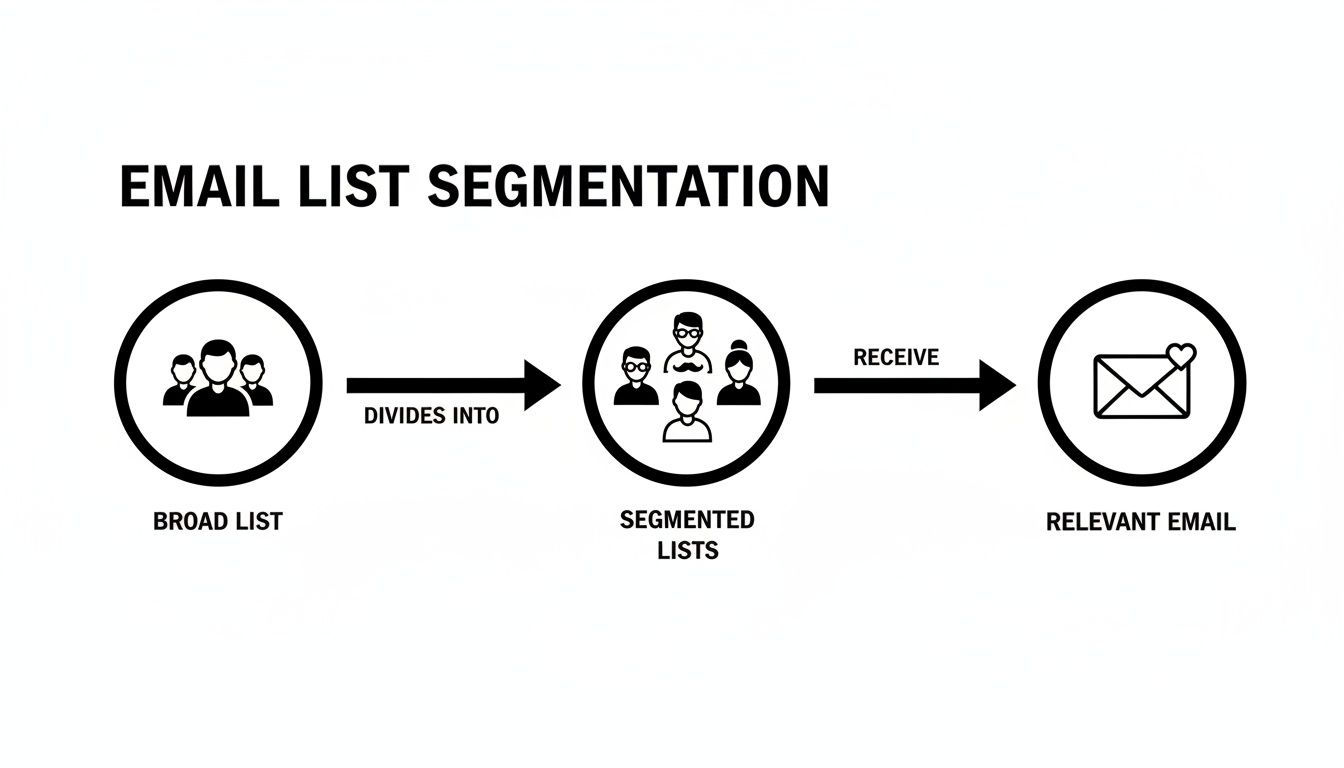
This process of refining your audience is key. A clean, segmented list means your content is more relevant, which directly leads to better deliverability and higher open rates.
A Simple Workflow for Keeping Your List Clean
Maintaining list health doesn't need to be a huge project. Just build this simple, repeatable process into your routine:
- Find the Unengaged: Create a segment of subscribers who haven't opened or clicked an email in the last 90 days.
- Run a Win-Back Campaign: Send this specific group a re-engagement campaign. Use a punchy, direct subject line like, "Is this goodbye?" or "Still want to hear from us?" to get their attention one last time.
- Say a Graceful Goodbye: If they still don't engage with that win-back email, it's time to let them go. Remove them from your active sending list to protect your sender reputation.
By prioritizing authentication and list hygiene, you build a rock-solid foundation of trust with inbox providers. For a deeper look into the technical side, explore this resource on email content delivery. Get this right, and your beautifully crafted emails will actually get the chance to be seen.
Automating Engagement with Triggered Emails
Some of the best-performing emails you’ll ever have are the ones you set up once and let run automatically. While your regular newsletters and promo campaigns are important, the real magic often happens with triggered emails. These are automated messages that go out based on a specific action a subscriber takes.
What makes them so powerful? They’re timely, hyper-relevant, and directly connected to something that person just did. This context makes the email feel less like a marketing blast and more like a genuinely helpful, one-to-one interaction.
The performance gap is staggering. Triggered messages almost always blow standard newsletters out of the water. Welcome emails, for instance, frequently hit open rates in the 60%+ range. Compare that to your typical newsletter, which usually lands in the mid-20s. That’s a massive opportunity waiting to be tapped.
Step 7: Implement High-Performing Automations
Here are three powerful automated campaigns you can set up today to drive engagement and sales on autopilot.
Blueprint for a High-Performing Welcome Series
Your welcome email is arguably the most important email you send. It lands in the inbox right when a new subscriber’s interest is at its peak. A multi-part welcome series is your chance to build a relationship from day one.
Here’s a simple but incredibly effective three-part flow:
- Email 1 (Send Immediately): Deliver the goods. Whether it’s a discount code or a PDF guide, get that lead magnet to them right away. Use a crystal-clear subject line like, "Here's your 15% off code!"
- Email 2 (Send 1 Day Later): Tell your story. Build a connection beyond the initial transaction. Share your brand's origin, a popular blog post, or a customer success story to give them a reason to care.
- Email 3 (Send 3 Days Later): Start a conversation. End the series by asking a simple question like, "What's the biggest challenge you're facing with [your topic]?" to encourage a reply and gain valuable insights.
A great welcome series doesn't just deliver a freebie; it onboards a new subscriber into your world. It's your best chance to turn a casual sign-up into an engaged fan.
Winning Back Sales with Abandoned Cart Reminders
If you run an e-commerce store, abandoned cart emails are pure gold. The shopper has already shown high intent. All they often need is a gentle nudge to come back and finish the job.
Try this automated sequence:
- Email 1 (Send 1-3 hours after abandonment): The simple, helpful check-in. A subject line like, "Did you forget something?" works perfectly.
- Email 2 (Send 24 hours later): Add social proof or urgency. Try a subject line like, "Your items are selling fast!" or "See what others are saying."
- Email 3 (Send 48-72 hours later): If they’re still on the fence, it’s time for an incentive. An offer like, "Take 10% off your order—today only!" can be the final push they need.
Reigniting Interest with Re-Engagement Campaigns
Over time, some subscribers will go quiet. A re-engagement campaign, or win-back flow, is an automated series designed to wake up these dormant contacts. This is a critical part of list hygiene.
Here’s a proven re-engagement flow:
- Trigger: Subscriber has not opened or clicked an email in 90 days.
- Email 1: Send an email with a subject line that’s impossible to ignore, like "Is this goodbye?" or "We miss you." Remind them of the value you offer.
- Email 2 (Send 1 week later): If you get silence, send one last direct but friendly message: "We haven't heard from you, so we'll be removing you from our list soon to respect your inbox."
- Action: If they don’t engage, your automation should unsubscribe them. It’s tough, but it’s essential for a healthy list.
By setting up these core automated flows, you build a system that works for you 24/7, delivering the right message at the right time to earn opens and drive results.
Summary & Your Next Step
We've covered a ton of ground, from writing subject lines that get clicked to cleaning your lists so you're only talking to people who want to hear from you. The big secret? There isn't one. The best email programs are built by nailing the fundamentals over and over again.
Improving your open rates comes down to earning your subscribers' trust. Every email is a chance to prove you're worth their time. When you consistently send them relevant and valuable content, they start looking forward to your emails. You’re no longer just another message in their inbox; you're building a relationship that makes them want to click.
Your Quick-Win Checklist
Feeling a little overwhelmed? Don't be. Use this checklist to spot the easiest place to make a difference right now.
- Subject Line & Preheader: Are you A/B testing? Try pitting a curiosity-based subject line against one that uses urgency.
- List Segmentation: Have you created an "Engaged vs. Inactive" segment? It's a massive first step.
- Deliverability Check: Are your SPF and DKIM records set up correctly? If not, you're asking to land in the spam folder.
- Automation Audit: Is your welcome series running? It’s your best chance to train new subscribers to open your emails from day one.
If you take away only one thing from this guide, make it this: relevance is the single biggest lever you can pull to improve your open rates. Send the right message to the right person, and opening your email becomes an easy decision for them.
You don’t need to tear down your whole program. This is about making small, smart improvements that add up over time.
Recommended Next Step
Pick one item from the checklist above and implement it this week. Start with the lowest-hanging fruit—the one that feels like the easiest win. Gaining a little momentum now is what builds into huge, lasting results down the road.
Frequently Asked Questions
Even the sharpest email marketers have questions. Here are quick, practical answers to some of the most common head-scratchers about email open rates.
What is a "good" email open rate?
There’s no single magic number. While industry benchmarks often float around the 21-27% mark, a "good" open rate is entirely relative to your industry, audience, and the type of email you're sending. A local charity might see open rates over 35%, while an e-commerce brand sending a promotional blast might be thrilled with 25%.
Actionable Takeaway: Forget universal benchmarks. Your most important competitor is your past self. Focus on consistently beating your own baseline, month over month. That’s the real measure of success.
How often should I clean my email list?
Think of it as essential maintenance for your sender reputation. Regular list hygiene is non-negotiable if you want to land in the inbox.
A great rule of thumb is to do a major list cleanup every 3 to 6 months. This involves creating a segment of subscribers who haven't engaged in the last 90-180 days, sending them a final win-back campaign, and then removing those who still don't respond. Sending to a smaller, more engaged audience is infinitely better for your deliverability and results.
Do emojis in subject lines help open rates?
They can be a fantastic way to stand out in a crowded inbox, but their effectiveness depends on your brand and audience. For many B2C brands, a well-placed emoji adds personality and can lift opens. In more formal B2B communications, it might feel out of place or even trigger spam filters.
Actionable Takeaway: The only way to know for sure is to test it. Run a simple A/B test: send one version of your subject line with an emoji and one without. Let your data tell you what your audience prefers. Use emojis to enhance your message, not just for decoration.
Ready to turn these insights into action? EmailGum provides in-depth guides, practical tutorials, and expert strategies to help you master every aspect of email marketing. Start building more effective campaigns today.