You’ve been there. You spend time crafting the perfect email, hit send, and then… nothing. It’s a common frustration, but the real magic often happens in the follow-up. The secret to writing a follow-up that actually gets a response is to be valuable, concise, and human. A great follow-up really boils down to three things: perfect timing, genuine personalization, and a clear call to action. This guide will walk you through a step-by-step process, complete with real-world examples and actionable takeaways you can use today.
Why Your First Email Is Just the Beginning

It’s easy to get discouraged when a well-thought-out email goes unanswered. Your first instinct might be to assume they’re just not interested, but the reality is usually much simpler. People are busy. Inboxes are chaotic. Your initial email might have landed at a bad time or just got buried under an avalanche of other messages.
This is exactly why mastering the follow-up is a non-negotiable skill for anyone in sales, marketing, or business development. It’s not about being pushy; it’s about polite persistence and acknowledging that one email is rarely enough to cut through the noise.
Before we get into the nuts and bolts, let's break down the key elements that make or break a follow-up email. Think of this as your cheat sheet for every follow-up you write from now on.
The Anatomy of a High-Impact Follow-Up Email
| Component | What It Is | Why It Matters |
|---|---|---|
| Clear Subject Line | A brief, compelling line that provides context and stands out in a crowded inbox. | It's the first thing your recipient sees. A good subject line gets your email opened; a bad one gets it deleted. |
| Polite Opener | A gentle reminder of your previous email without sounding demanding or accusatory. | Sets a positive, professional tone and jogs their memory about who you are and why you're reaching out. |
| Value Proposition | A quick restatement of the core benefit or a new piece of valuable information. | Reminds them why they should care and gives them another reason to engage with your message. |
| Simple CTA | A single, low-effort action you want the recipient to take next. | A clear and easy CTA removes friction and makes it simple for them to respond, even when they're busy. |
This table gives you the high-level view. Now, let's explore why this persistence is so critical and what makes it work in the real world.
The Power of Polite Persistence
Think of your follow-up as a gentle nudge. It’s a professional reminder that adds a little extra value and keeps the conversation from going cold. When done right, a follow-up can turn radio silence into a real dialogue.
The numbers don't lie. A startling 70% of cold emails never get a follow-up, which means most people are giving up way too soon. Here's a game-changer: sending a follow-up just three days after your initial email can boost replies by 31%. If you're not following up, you're leaving opportunities on the table. You can explore more eye-opening cold email statistics to see just how much persistence pays off.
What Makes a Follow-Up Successful
A winning follow-up strategy isn't complicated, but it does require a bit of thought. It's built on a few core ideas that we'll dive into throughout this guide.
- Strategic Timing: Sending a follow-up too soon feels aggressive. Waiting too long means they’ve already forgotten your first message. Finding that sweet spot is key.
- Added Value: Never, ever just say, “Did you see my last email?” Instead, offer something new—a relevant article, a fresh insight, or a link to a helpful resource.
- Crystal-Clear CTA: Make it ridiculously easy for them to respond. A simple question or a low-commitment next step is almost always your best bet.
The goal of a follow-up isn’t to pester; it’s to serve. By providing continued value and making it easy to engage, you transform a simple "check-in" into a meaningful touchpoint that builds relationships and drives results.
Crafting Subject Lines and Openers That Get Noticed

Let's be real: your email's fate is decided in a matter of seconds. The subject line is the gatekeeper, and with the average professional juggling over 120 emails a day, anything generic is a one-way ticket to the trash folder.
The goal here isn’t just to get an open. It’s to instantly re-engage your recipient and remind them why they should give you their time. A powerful subject line does three things: provides context, sparks curiosity, and feels like it was written just for them. So, ditch the tired old "Following up" or "Checking in" phrases. It's time to be direct, clear, and respectful of their packed schedule.
Writing Subject Lines That Demand Attention
The best subject lines are short, specific, and hint at the value inside. In fact, research consistently shows that subject lines with just 3 to 5 words get the most attention. Personalization is another game-changer. Simply weaving in their name or company can give your open rates a serious lift.
Here are a few simple approaches you can start using right away:
Reference Your Last Chat: The easiest way to jog someone's memory is to connect back to your last interaction. This is perfect after a meeting or a product demo.
- Example:
Recap of our chat about [Project Name] - Example:
Next steps for the [Company Name] proposal
- Example:
Spark Some Curiosity: A well-placed question or a hint at a solution to their problem can be irresistible. They’ll have to click to find out more.
- Example:
A quick question about your Q4 goals - Example:
An idea for improving [Specific Pain Point]
- Example:
Offer Something New: Instead of just asking for a response, frame your follow-up as a chance to give them something valuable.
- Example:
Found that article we discussed, [First Name] - Example:
A resource to help with your [Specific Goal]
- Example:
Think of your subject line as the headline for your email. It needs to be compelling enough that the person feels like they'd be missing out if they didn't open it. It’s less of a label and more of a hook.
If you're looking for more inspiration, you can find a whole host of powerful email subject line examples to get your creative juices flowing.
The Art of the Perfect Opening Line
Okay, they opened your email. Great! Now you have about three seconds to convince them to keep reading. The first sentence is your next critical hurdle, and its job is to immediately bridge the gap between your last conversation and this one.
Whatever you do, don't start with a weak, apologetic phrase like, "Sorry to bother you again." Lead with confidence and a clear reminder of your connection.
Here’s how you can craft an opener that actually works:
Be Direct and Give Context: Get straight to the point.
- Example: "It was great connecting at the [Event Name] last week. I really enjoyed our conversation about..."
Show You Were Listening: Bringing up a specific detail from your last conversation is pure gold. It proves you paid attention and makes the follow-up feel genuine, not automated.
- Example: "I was thinking more about your comments on [Specific Topic] and wanted to share a thought."
Lead with Value: If you have something helpful to offer, put it right at the top.
- Example: "Following our call, I found a case study that directly addresses the challenge you mentioned with..."
These core strategies for hooking a reader aren't just for email; they apply across all forms of communication. You can explore a proven framework for writing engaging content that dives deeper into these same principles.
When you pair a compelling subject line with a sharp, contextual opener, you drastically improve your chances. Your follow-up won't just be seen—it will be read and, most importantly, acted upon.
Structuring a Body and Call to Action That Drive Replies

So, your killer subject line worked and they've opened the email. Now what? This is where the body copy and your call to action (CTA) have to do the heavy lifting. Your mission is to build on that initial message, re-establish why you’re in their inbox, and make it ridiculously easy for them to hit "reply."
The single biggest mistake I see people make is sending a follow-up that’s just a lazy rehash of the first email. The dreaded "just checking in" message is a complete waste of an opportunity. The goal is to add new value with every single touchpoint, proving your message is worth their attention.
Designing a Scannable and Valuable Email Body
Let's be real: busy people don't read emails. They scan them. Your follow-up has to be built for this reality. Think short paragraphs, smart formatting, and a message that cuts straight to the chase.
Here is a simple, three-step formula for writing the body of your follow-up:
- Context: A quick, friendly reminder of who you are and why you're reaching out.
- Value: Something new and genuinely helpful. This could be a relevant article, a fresh data point, or a quick insight they can actually use.
- Action: A crystal-clear, simple CTA telling them what to do next.
Instead of hitting them with a wall of text, break your message into bite-sized pieces. Use bullet points to list out key benefits or potential next steps. Throw some bold text on the most important bits, like a specific date or a key question. It makes your email feel less like homework and more like a helpful note from a real person.
The most effective follow-up emails feel less like a sales pitch and more like a helpful continuation of a conversation. By adding fresh value, you shift the dynamic from asking for something to giving something.
This approach is never more important than on that very first follow-up. The data is clear: sending just one follow-up can boost reply rates by nearly 50% compared to sending none at all. That initial nudge has the most impact, as responses naturally drop off with each subsequent email. Nailing that first, value-packed follow-up is one of the smartest things you can do for your outreach. Check out the latest email response rate benchmarks to see just how powerful this can be.
Crafting a Low-Friction Call to Action
The final piece of the puzzle—and honestly, the most critical—is your call to action. A vague or high-effort CTA is the number one killer of follow-up emails. You have to make replying feel absolutely effortless.
The psychology behind this is straightforward: you need to lower the cognitive load. Asking someone to "hop on a 30-minute call" is a big ask. It forces them to open their calendar, hunt for a free slot, and mentally commit to a meeting. That’s a ton of friction.
Contrast that with asking a simple, low-stakes question. It’s so much easier to answer. That’s the secret to getting a response and starting a real conversation.
Comparing High-Friction vs. Low-Friction CTAs
Let's see what this looks like in the wild.
High-Friction CTAs (Use with caution):
- "When are you free for a call next week?"
- "I'd love to schedule a demo to walk you through our platform."
- "Let me know your thoughts on the attached proposal."
These requests demand time, brainpower, and commitment. Save them for when you’ve already built some rapport and the person is clearly engaged.
Low-Friction CTAs (Your new best friend):
- "Would this be the best email to share a couple of ideas?"
- "Are you the right person to speak with about this?" (A simple yes/no)
- "Would you be open to a quick 15-minute chat to see if this is a fit?"
These CTAs can be answered in a single word. They aren't designed to close the deal; they're designed to open a door. By making it easy to say "yes," you dramatically increase your chances of getting that first reply and moving the conversation forward.
Proven Follow-Up Email Templates for Any Situation
Knowing the theory is great, but let's be honest—what you really need are some solid templates you can grab and adapt on the fly. After all, the follow-up you send to a new connection is worlds away from the one you send about a late invoice.
The key is to think of these less as rigid scripts and more as flexible starting points. I've pulled together a few of my most-used templates for common situations. Each one is built around a specific goal, whether it's building a relationship, getting paid, or re-engaging a quiet lead.
Following Up After a Networking Event
You've got a pocket full of business cards. Now what? The goal is to turn that brief handshake and chat into a genuine professional connection before you become just another name in their inbox.
The Strategy: Speed and context are everything here. You have a 24-hour window to make an impression. When you write, mention something specific you talked about. It's the simplest way to prove you were actually listening and separates you from everyone else sending a generic blast.
The Template:
Subject: Great connecting at [Event Name]
Hi [First Name],
It was a pleasure meeting you at [Event Name] yesterday. I really enjoyed our conversation about [Specific Topic You Discussed].
I was thinking more about what you said regarding [Challenge or Goal They Mentioned], and I wanted to share an article that I think you'll find helpful: [Link to Resource].
Would you be open to a brief chat next week to continue our conversation?
Best,
[Your Name]
Nudging a Gentle Reminder for an Unpaid Invoice
This is always a tricky one. You need to be firm but professional, polite yet direct. The best approach is to assume it was a simple oversight, not a deliberate refusal to pay.
The Strategy: Make it as easy as possible for them to pay you. Don't beat around the bush—state the invoice number and due date right up front. Always re-attach the invoice to the email; it removes the "I can't find it" excuse and clears the path for immediate payment.
The Template:
Subject: Following up on Invoice #[Invoice Number]
Hi [Client Name],
I hope you're having a productive week.
This is just a friendly reminder that Invoice #[Invoice Number] for [Amount] was due on [Due Date]. I’ve attached a copy for your convenience.
Could you please let me know when we can expect payment? If you've already sent it, please disregard this message.
Thanks,
[Your Name]
For those moments when you need to whip up a message quickly, an AI Follow-Up Generator can be a real time-saver.
Re-Engaging a Cold Lead After a Proposal
Silence. It's the response every salesperson dreads after sending a proposal. Your follow-up here isn’t about poking them with a stick ("Did you see my email??") but about gently reopening the door.
The Strategy: Ask a simple, low-effort question. Instead of asking for a big decision like, "So, what did you think of the proposal?", try something that requires a simple yes/no answer. This makes replying feel less like a commitment and gets the conversation going again.
The Template:
Subject: A quick question about the proposal
Hi [First Name],
I'm writing to follow up on the proposal I sent over last week regarding [Project Name]. I wanted to make sure you had everything you needed from my end.
I know things can get busy. Is this still a priority for you right now?
Let me know if you have any questions at all.
Best,
[Your Name]
The "Before and After" Makeover
To see these principles in action, let's take a common—and painfully weak—follow-up and give it a serious upgrade.
The Weak "Before" Version:
Subject: Following Up
Hi Jane,
I am just checking in on the email I sent last week. Did you get a chance to look at it?
Let me know if you are interested.
Thanks,
Bob
This email is a classic. It’s lazy, offers zero value, and puts all the work on Jane. It's practically begging to be deleted.
The Powerful "After" Version:
Subject: A resource for [Company Name]'s Q4 goals
Hi Jane,
I hope your week is off to a great start.
When we last spoke, you mentioned your team is focused on improving lead generation this quarter. I came across this case study on how a similar company boosted their leads by 35% and thought of you.
Here’s the link: [Relevant Link]
Does a quick 15-minute call next Tuesday sound good to discuss if a similar strategy could work for [Company Name]?
Best,
Bob
See the difference? This version works because it's personalized ("you mentioned..."), adds value (the case study), and has a clear, low-friction CTA. It flips the script from a selfish "checking in" to a helpful "I thought of you," which is infinitely more likely to get a response.
Building a Winning Follow-Up Sequence
A single follow-up is a decent start, but a thoughtful sequence is what really moves the needle. You need to shift your mindset from sending one-off reminders to building a multi-touch system that turns radio silence into a real conversation. This isn't about spamming someone's inbox; it's about crafting a narrative that adds value at every step.
The goal is to get away from the lazy "just checking in" approach. Every single email in your sequence needs a distinct purpose and should offer something new. This kind of thoughtful persistence shows you respect their time while keeping your initial message top-of-mind.
Mapping Out Your Follow-Up Cadence
Figuring out when and how often to follow up is a delicate dance. Follow up too soon, and you come off as pushy. Wait too long, and you lose all momentum. While the sweet spot can vary by industry, a few universal principles always apply.
The key is to start by spacing your emails out intentionally. A common—and effective—cadence might look something like this:
- Email 1: Initial Outreach
- Email 2: Day 3 (A gentle nudge with a new piece of value)
- Email 3: Day 7 (Come at it from a different angle or share a relevant case study)
- Email 4: Day 14 (Ask a simple, low-effort question)
- Email 5: Day 21 (The "breakup" email)
This structure creates consistent touchpoints without ever feeling overwhelming. Notice how the time between each message gradually increases? That gives them space to think and respond. A well-planned sequence is non-negotiable, especially when you consider that 80% of sales require at least five follow-up attempts. Yet a staggering 48% of salespeople never follow up even once, leaving a massive opportunity on the table for those willing to be persistent.
A great follow-up sequence is like a story with multiple chapters. Each email should move the plot forward by offering a new piece of information, a different perspective, or a helpful resource that makes your contact's life easier.
This flowchart gives you a visual guide for structuring your follow-ups across different scenarios, from networking events to chasing down an invoice.
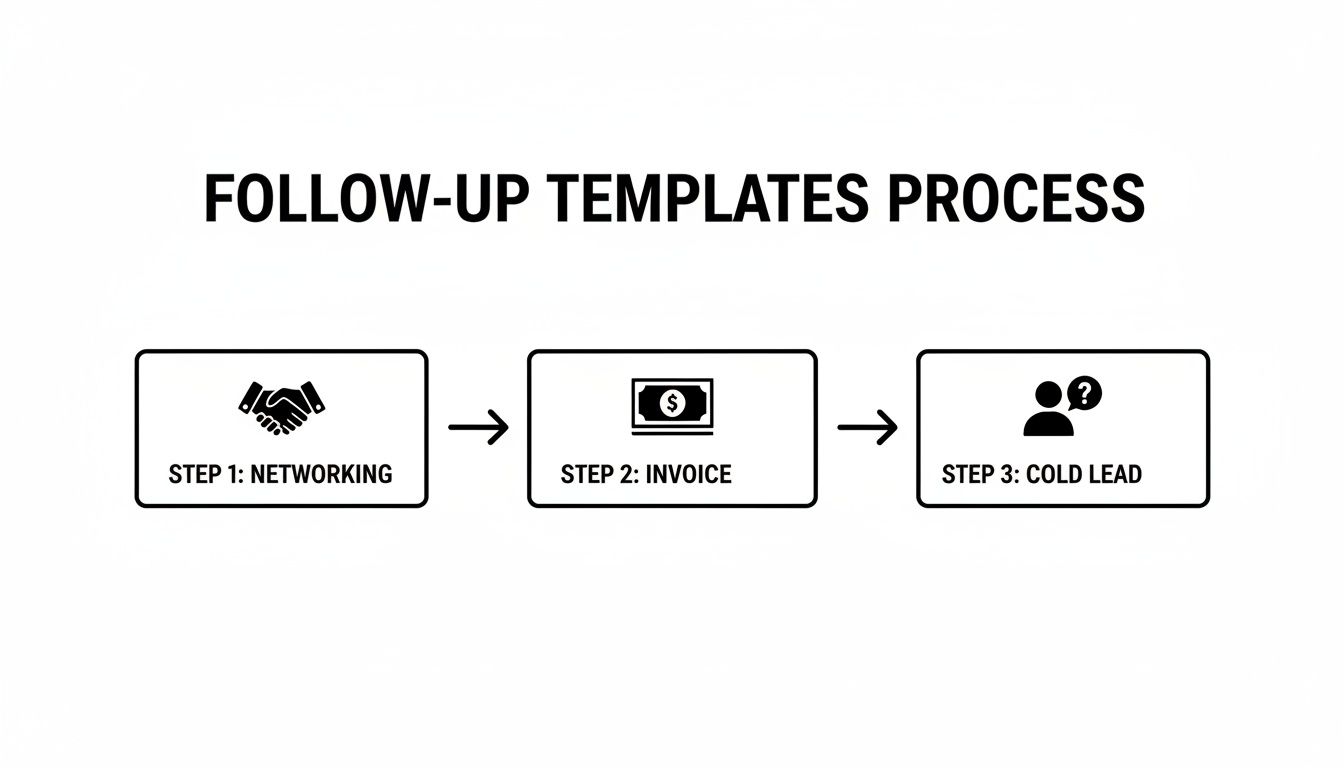
As you can see, the core strategy—providing value and maintaining a professional tone—adapts easily, ensuring your approach always feels relevant to the situation.
The Graceful 'Breakup' Email
Sometimes, no matter how great your sequence is, you'll still get nothing but crickets. This is where the "breakup" email comes in. It’s your final, polite message designed to close the loop and end your sequence on a good note.
The funny thing about these emails? They often get some of the best response rates in the entire sequence. By signaling that you're moving on, you create a little bit of urgency. This usually prompts one of two things: they finally reply to keep the conversation going, or they confirm they aren't interested, which gives you the closure you need to focus your energy elsewhere.
Here's a simple, effective breakup email structure:
Subject: Closing the loop
Hi [First Name],
I've reached out a few times about [Topic] but haven't heard back, so I'll assume it's not a priority right now.
I won't follow up again, but please feel free to reach out if anything changes.
Best,
[Your Name]
It's professional, respectful, and surprisingly effective.
Automating Your Sequence the Smart Way
Trying to manually track a multi-step follow-up sequence for every single lead is a recipe for disaster. It just doesn't scale. This is where automation tools become your best friend. Platforms like Mailchimp or HubSpot can handle the sending schedule for you, freeing you up to focus on strategy.
But remember, automation should never replace personalization. Use the tools to manage the timing, but make sure every message feels like it was written just for them. That blend of efficiency and personal touch is what makes modern outreach work so well.
Common Follow-Up Questions Answered
Even with a solid game plan, you'll hit those tricky follow-up situations that make you pause. Knowing what to write is half the battle; navigating the when and how is where the real expertise comes in. Think of this as your personal troubleshooter for the most common questions we get from founders, sales pros, and marketers.
We're going to tackle the big ones head-on, giving you clear, no-fluff answers so you can handle any scenario with confidence.
How Long Should I Wait Before Following Up?
This is the million-dollar question, isn't it? The honest answer is it depends, but there’s a reliable rule of thumb that works most of the time. Nudge them too soon and you risk looking desperate; wait too long and you've gone from top-of-mind to a distant memory.
For most business scenarios—after sending a proposal, a sales demo, or initial outreach—waiting 2-3 business days is the sweet spot. This gives them just enough time to read and process your first email without completely forgetting who you are. Of course, if it's super time-sensitive, like confirming details for a meeting tomorrow, a 24-hour follow-up is completely fine.
The key is to find that perfect balance between persistence and patience. You want to stay on their radar without becoming a nuisance. A few days of breathing room shows you respect their schedule.
If you’ve sent a nudge and are still hearing crickets, our guide on how to follow up on an email with no response has more advanced strategies for you.
Should I Reply in the Same Thread or Start a New One?
Always, always, reply in the same email thread. I can't stress this enough. Starting a fresh email for every single follow-up is a cardinal sin of outreach. It’s like starting a new conversation every time you see someone—it’s confusing and makes the other person do all the work to catch up.
Keeping everything in the same thread is a game-changer because it:
- Provides Instant Context: They don't have to hunt through their inbox. A quick scroll down shows them your original message and the entire history.
- Reduces Inbox Clutter: The whole conversation is neatly bundled into one easy-to-manage package.
- Looks Professional: It's just good email etiquette. It shows you’re organized and considerate of their time.
The only time I'd ever break this rule is if the original subject line is no longer relevant or was very time-sensitive (e.g., "Meeting Tomorrow"). In that rare case, a new email with an updated subject line makes sense.
How Can I Follow Up Without Being Annoying?
The secret to a non-annoying follow-up is simple: add new value with every single touchpoint. If your email boils down to "Hey, just checking in," you’re essentially asking for their time without offering anything in return. That's what feels like nagging.
To avoid this trap, make sure every follow-up gives them something useful. Think of it as a friendly gift, not a demand.
Here are a few ideas:
- A link to a case study that’s directly relevant to their business.
- A new piece of data or an interesting industry stat.
- A quick answer to a question you anticipate they might have.
- A short, actionable tip related to a goal they mentioned.
When you shift your mindset from "asking" to "giving," your follow-up transforms from a pest to a welcome, valuable interaction. It builds rapport and keeps the conversation positive, even if they're not ready to buy right now.
When Is It Time to Stop Following Up?
Knowing when to walk away is just as crucial as knowing when to follow up. There’s a fine line between being persistent and being spam. My rule? If you’ve sent 4-5 follow-ups over a few weeks and have gotten zero response, it’s probably time to close the loop.
This is where the "breakup email" we talked about earlier comes in handy. It’s a final, no-pressure message that politely lets them know you won't be reaching out anymore. It’s professional, respects their silence, and ironically, often gets a response because it takes all the pressure off.
And if someone does reply and asks you to stop, respect their wishes immediately. The goal is to build relationships, and that includes bowing out gracefully when the timing just isn’t right. You never know, it might leave the door open for the future.
Summary and Your Next Step
Mastering the follow-up email comes down to being persistent, personal, and valuable. Always lead with a clear subject line, provide new information in the body, and end with a simple, low-friction call to action. By treating each follow-up as a chance to serve rather than sell, you'll transform silence into meaningful conversations.
Your Recommended Next Step: Review the last three follow-up emails you sent. Using the "Before and After" makeover example from this guide, rewrite one of them to add more value and include a clearer, low-friction CTA.
Ready to turn these insights into powerful campaigns? EmailGum provides the expert guides, practical tutorials, and modern strategies you need to master every aspect of email marketing. Start learning for free and build campaigns that get results.
