To write a welcome email that truly works, you need to master a few key steps. Start with a compelling subject line that clearly says "welcome." Follow up with a personalized greeting, a quick reminder of why they signed up, and then immediately deliver the value you promised—like a discount code or a free guide. A well-crafted welcome email confirms the subscription, introduces your brand, and guides new subscribers with a clear call-to-action (CTA).
Why Your First Email Is Your Most Important

Let's be clear: your welcome email isn't just a digital handshake. It is hands-down the single most important message you’ll ever send to a new subscriber.
Think of it as the grand opening of your relationship. This is the moment their interest is at its absolute peak—they just willingly handed over their email address, after all. That moment is pure gold. Welcome emails consistently have the highest engagement rates of any email you'll ever send, turning them into a powerful strategic tool. It's your first real chance to build trust, set the tone for all future communication, and gently nudge a new contact toward becoming a loyal customer.
The Strategic Power of a Great First Impression
A well-designed welcome email does so much more than just say hello. It performs several critical jobs that lay the groundwork for a successful and long-lasting customer relationship. If you skip this step, you risk leaving your new subscriber feeling uncertain or, even worse, completely forgotten.
Let’s break down the core goals and the components needed to achieve them.
Welcome Email Goals and Key Components
Here’s a look at the primary objectives of your welcome email and the essential elements required to get the job done.
| Core Goal | Essential Components | Why It Matters |
|---|---|---|
| Confirm the Subscription | A clear "Welcome!" statement, mention of the brand name, and confirmation of what they signed up for (e.g., newsletter, free guide). | This immediately reassures the user their action was successful. It eliminates confusion and builds a foundation of trust from the very first interaction. |
| Deliver Immediate Value | The promised lead magnet (link to a download), a prominent discount code, or access to exclusive content. | Fulfilling your promise instantly shows you're credible and trustworthy. It provides a positive first experience and encourages them to engage further. |
| Introduce Your Brand | Brand voice and tone in the copy, consistent brand colors and logo, a brief "about us" snippet, or links to your social media profiles. | This is your chance to show them who you are beyond your products. Is your brand fun, professional, or inspiring? Personality builds connection. |
| Set Clear Expectations | A simple statement explaining what kind of content they'll receive and how often you'll be in touch (e.g., "tips every Tuesday"). | Managing expectations from the start helps reduce future unsubscribes. People are more likely to stay engaged when they know what's coming. |
| Drive the Next Action | A clear, single call-to-action (CTA) button like "Shop Now," "Read the Blog," or "Follow Us on Instagram." | Guide them on what to do next. A strong CTA moves them deeper into your ecosystem, turning a passive subscriber into an active participant. |
By thinking through these goals, your welcome email transforms from a simple formality into a strategic asset that kicks off the customer journey on the right foot.
Capitalizing on Peak Engagement
The data doesn't lie. Welcome emails are, by far, the most effective type of email marketing you can do.
Welcome emails consistently boast an average open rate between 50% and 64%. To put that in perspective, the average for all other emails across industries hovers somewhere between 24% and 38%. This means your first message is roughly 86% more effective at grabbing someone's attention than a standard newsletter. You can dig into more of these numbers over on Klaviyo's blog about email marketing benchmarks.
By understanding its strategic power, you can transform your welcome email from a simple greeting into the most effective first step in your entire conversion funnel. It defines the customer journey from the very first click.
Ultimately, failing to optimize this initial touchpoint is like leaving money on the table. When you nail the welcome email, you create a positive experience that can dramatically boost long-term engagement and turn a curious visitor into a true brand advocate.
Anatomy of a High-Converting Welcome Email
Alright, let's move past the theory and actually build a welcome email that gets results. A great welcome email isn't just a block of text; it's a carefully engineered machine. Every single component—from the subject line down to the P.S.—has a specific job to do.
By breaking down these critical parts, you can build a message that doesn't just say "hello" but actually guides new subscribers toward taking that all-important first step with your brand.
Step 1: Craft an Irresistible Subject Line and Preview Text
Before anyone can fall in love with your email, they have to open it. This is where your subject line and the preview text come in. Think of them as a one-two punch designed to cut through the noise of a crowded inbox and spark some serious curiosity.
Your subject line is the headline. It needs to be clear, compelling, and instantly show them they're in the right place. Simply including the word "welcome" gives open rates a nice little bump, so consider that your starting point. From there, it's all about adding value.
Here are a few proven angles you can take:
- Lead with the Good Stuff: If you promised a discount for signing up, don't bury it. Put it right in the subject line. Think: "Welcome! Your 15% off code is inside."
- Set the Scene: Let them know what's coming next. Something like: "Welcome to the club! Here's what to expect."
- Create a Little Mystery: Hint at something valuable without giving it all away. Try: "Welcome! A surprise gift is waiting for you."
The preview text—that little snippet of copy you see right next to the subject line—is your secret weapon. Use this space to build on the promise you made in the subject line. If your subject is "Welcome to the family!", your preview text could be "We're so glad you're here. Let's get you started with a special offer." Whatever you do, don't leave it blank. If you do, it will likely pull in ugly default text like, "View this email in your browser."
Expert Tip: Your subject line is the perfect playground for A/B testing. Pit different value propositions against each other—like a discount versus a free guide—and see what your audience actually wants. Small tweaks here can lead to surprisingly big wins.
For a deeper dive into what works, check out our guide packed with compelling email subject line examples to help boost your open rates.
Step 2: Nail the Personalized Greeting and Opening
Once they're in, the first few lines set the entire mood. A warm, personal greeting is non-negotiable if you want to make your new subscriber feel like a person, not just another email address in your database.
Using their first name is table stakes. Hi [First Name], is infinitely more engaging than a cold, generic "Hi there." This simple personalization token instantly shifts the message from a mass broadcast to a one-to-one conversation.
Right after the greeting, say thank you. Genuinely. Acknowledge the specific action they took—whether it was signing up, creating an account, or downloading a resource. This validates their decision and reinforces that they made a good choice. It's also the perfect moment to subtly remind them why they signed up in the first place.
For example, a SaaS company could say something like:
"Thanks for signing up for ProjectFlow! We're excited to help you and your team finally get a handle on your tasks and deadlines."
This little opener confirms their action, reminds them of the pain point you solve, and establishes a helpful, positive tone right from the get-go.
Step 3: Build Trust with a Quick Brand Intro and Social Proof
Now that you've got their attention, it's time to show them who you are and build some instant credibility. People don't just buy what you sell; they buy into who you are. Share a brief, punchy sentence about your mission or the one thing that makes you different.
Are you an e-commerce brand obsessed with sustainable, ethically sourced materials? A software company that geeks out on intuitive design? A media company that bleeds for unbiased reporting? Let that personality shine through. This is your chance to connect on a more human level.
Next, immediately back it up with social proof. People trust other people far more than they trust brands. Weaving in elements that show others have already found value in what you offer can dramatically boost a new subscriber's confidence in you.
Try working in one of these:
- A powerful customer quote: "I love how [Your Brand] helped me..."
- "As seen in" logos: Showcasing logos from publications like Forbes or TechCrunch.
- A snippet of user-generated content: Maybe a glowing post from social media.
- The power of community: "Join 50,000+ marketers who get our newsletter every week."
This tactic is brilliant because it shifts the narrative. Instead of you telling them you're great, you're letting others do the talking for you. It’s a subtle but incredibly powerful way to build trust right out of the gate.
Step 4: Drive Action with a Clear and Compelling CTA
Every single welcome email that converts well has one thing in common: a single, crystal-clear call-to-action (CTA). This might just be the most important part of the entire email. Your job is to remove all friction and guide the subscriber to the next logical step.
Resist the urge to give them a buffet of options. Asking them to shop the new collection, read your latest blog post, and follow you on three different social channels is a recipe for paralysis. Instead, focus on the one single action that provides the most value for them and for your business at this exact moment.
The design and copy of your CTA button matter. A lot. Use punchy, action-oriented language and make the button pop with a contrasting color that's impossible to miss.
Here’s how different types of businesses might approach their primary CTA:
| Business Type | Primary Goal | Example CTA Copy |
|---|---|---|
| E-commerce | Drive the first purchase | Shop The Collection |
| SaaS | Encourage product activation | Log In & Get Started |
| Media/Blog | Build reading habits | Explore Our Top Articles |
| Service-Based | Generate qualified leads | Book a Free Consultation |
Your CTA should feel like the natural conclusion to the story you've just told. You've welcomed them, given them value, and built trust. Now, you've earned the right to ask them to take that next step. Make it obvious, easy, and irresistible.
Moving Beyond a Single Email to a Welcome Series
A single, powerful welcome email nails that first impression. But if you're playing the long game—and you should be—you need to think bigger than just one message. This is where a strategic welcome series comes in. It’s an automated sequence of emails that turns that initial handshake into a guided journey, nurturing your new subscribers from the moment they sign up.
Instead of cramming everything into one email, a series gives you the breathing room to properly tell your brand story, showcase different parts of what you offer, and build genuine trust over time. It’s a multi-touch approach that meets new subscribers right where they are, when their interest in your brand is at its absolute peak.
Why a Welcome Series Outperforms a Single Email
The data on this is crystal clear. While one welcome email is good, a series is hands-down better. Automated welcome series can generate 51% higher conversion rates compared to just sending a single welcome message. That boost comes from smart, extended engagement.
A series lets you introduce your brand methodically. You can educate new contacts on your full value proposition and earn their trust before asking for a big commitment. Each email has its own job to do, and together, they work to turn a passive subscriber into an active, loyal fan.
Think of each individual email in your series as having its own simple, but critical, flow.
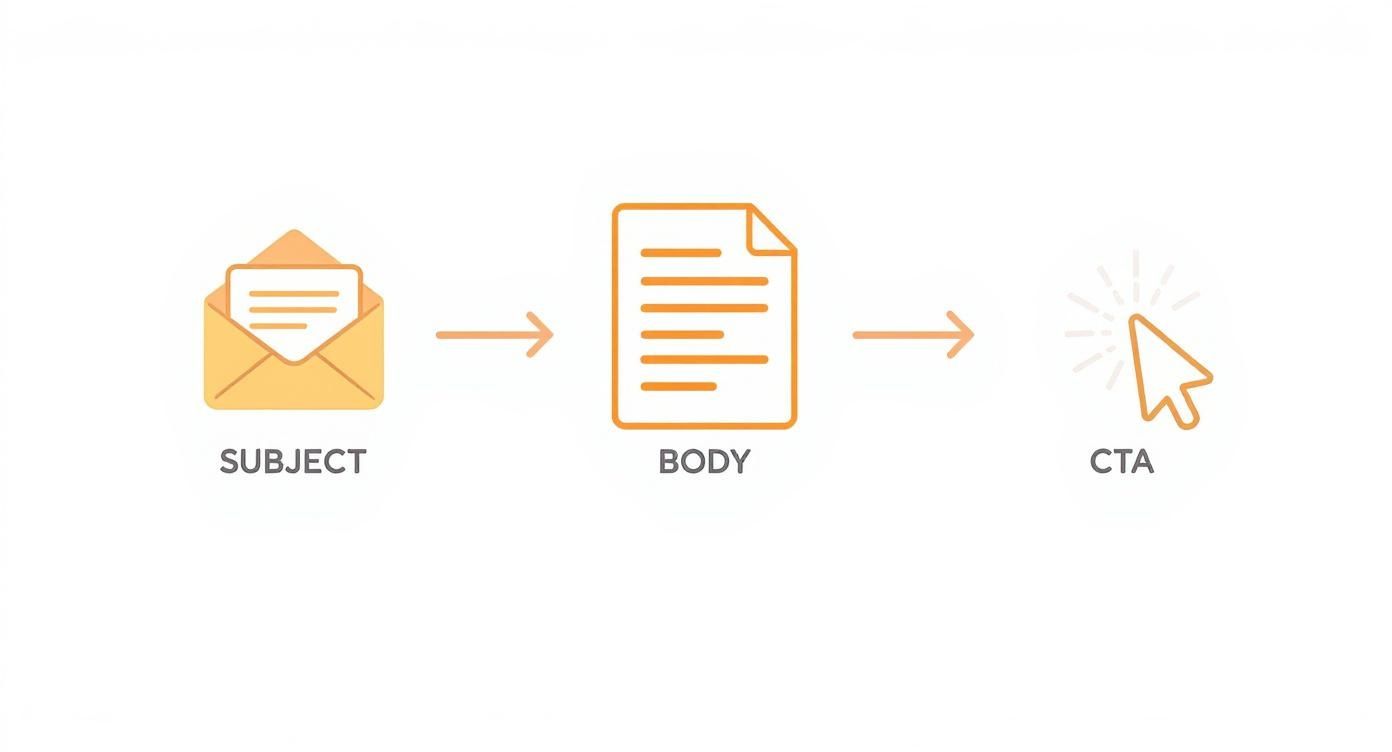
This visual breaks down the core path a reader takes: they're hooked by the subject line, drawn into the body content, and then compelled to click your call-to-action.
Structuring Your 3 to 5 Part Welcome Flow
So, what does a killer welcome series actually look like? While the details will vary based on your business, a proven framework usually involves three to five emails sent over the first week or two. This gives you enough touchpoints to be memorable without completely flooding their inbox.
Here’s a step-by-step breakdown of a classic, high-performing welcome series structure.
Email 1: The Immediate Welcome (Send within 5 minutes)
- Goal: Deliver on your promise and confirm they’re in the right place.
- Content: This is the email we’ve been focusing on. It’s the warm greeting, the discount code or lead magnet you offered, and a single, clear call-to-action. Its job is to provide instant gratification and make them feel good about their decision to sign up.
Email 2: Tell Your Brand Story (Send 1-2 days later)
- Goal: Build a human connection and show what makes you different.
- Content: Go beyond the products and share your mission. Why do you exist? What problem are you passionate about solving? This is your chance to share the founder’s story, highlight company values, or showcase what makes you unique in a crowded market.
Email 3: Showcase Social Proof and Value (Send 2-3 days later)
- Goal: Build credibility and point them toward your best stuff.
- Content: Let your happy customers do the talking for you. Feature your best-selling products, sprinkle in some top-rated testimonials, or link out to your most popular blog posts. The idea is to demonstrate proven value and give them a little nudge of FOMO.
By the third email, your subscriber should have a solid idea of who you are, what you stand for, and how you can help them. This trust is the foundation you need before you make a stronger push for a sale.
Email 4: Address a Common Pain Point (Send 2-3 days later)
- Goal: Solve a real problem and position your brand as the expert solution.
- Content: Show them you truly get it. This email can tackle a common question, offer a genuinely helpful tip, or explain exactly how your product solves a specific nagging issue. This frames you as a helpful guide, not just another salesperson.
Email 5: The Clear Call-to-Action (Send 1-2 days later)
- Goal: Drive your main conversion with one last, compelling offer.
- Content: Now that you’ve built a relationship, it's time for a direct, confident ask. Remind them of that welcome discount (maybe with a touch of urgency like, "it expires soon!"), or guide them to the next logical step, whether that's booking a demo or starting a free trial.
This multi-email approach lets your message unfold naturally, building a connection that a single email just can't replicate. You can even get more advanced by using subscriber behavior to tweak the content of later emails. To dive deeper into that, check out our guide on what is email segmentation to tailor your series for even better results.
Proven Welcome Email Templates and Examples
https://www.youtube.com/embed/tJRvuHM6Qr0
Theory is great, but seeing it in action is where the magic really happens. Let's move from the "what" and "why" to the "how."
To get you started right away, I've put together a few practical, battle-tested templates you can adapt for your own business. Each one is built around a specific goal, whether that's sparking that all-important first sale, getting a new user to actually use your product, or just starting a genuine conversation with a new reader.
After we look at the templates, we’ll break down a couple of real-world examples from brands that absolutely nail their first impression.
Welcome Email Template for E-commerce Brands
For an e-commerce brand, the mission is crystal clear: turn that new subscriber into a paying customer. This template is all about building excitement and knocking down any barrier that stands between them and the checkout button.
- Subject Line: Welcome to [Brand Name]! Your 15% off is inside.
- Preview Text: We're so glad you're here. Let's get you started with a special treat.
- Body:
- The Warm Welcome: Hi [First Name], and welcome to the family!
- Deliver the Goods: Thanks for joining us. As promised, here’s 15% off your first order. Use code: WELCOME15
- A Quick Intro: At [Brand Name], we’re obsessed with [Your Core Mission, e.g., creating sustainable fashion that feels amazing]. We believe you should never have to choose between style and ethics.
- Show, Don't Just Tell: See what our community is loving right now. [This is where you drop in images of your top 3 best-sellers with short descriptions and direct links.]
- The Big, Obvious CTA: You need a large, impossible-to-miss button. Think "Shop The Bestsellers" or "Redeem Your Discount".
- Set the Stage: P.S. Keep an eye on your inbox for new arrivals and exclusive deals every Tuesday.
Why this just works: This approach is laser-focused on conversion. It leads with the incentive, builds instant trust with social proof (your bestsellers are popular for a reason), and uses a single, clear call-to-action to guide them exactly where you want them to go.
Welcome Email Template for SaaS Companies
For a SaaS business, the game is all about activation. The goal isn't a sale—it's getting the user logged in and experiencing that "aha!" moment as quickly as possible. This template is designed to cut through the noise and guide them straight to a quick win.
- Subject Line: Welcome to [Product Name]! Let's get you set up.
- Preview Text: Your journey to [Key Benefit, e.g., streamlined project management] starts now.
- Body:
- Greeting: Welcome aboard, [First Name]!
- Confirmation is Key: We're thrilled to have you. Your account for [Product Name] is all set up and ready to go.
- The Quick Win: The best way to get started is by [First Actionable Step, e.g., creating your first project]. It only takes about two minutes.
- The Obvious Next Step: A prominent button that says "Go to My Dashboard" or "Create My First Project".
- Offer a Lifeline: Need a hand? Check out our quick start guide or watch this 2-minute tutorial video. We're here to help!
- What's Next: Over the next few days, we'll share some tips to help you get the most out of [Product Name].
Why this works: It skillfully avoids the classic mistake of feature-dumping on a new user. Instead, it hones in on one single, high-impact action. By pointing them toward an easy win, you help them see the value of your product immediately, which is absolutely critical for keeping them around long-term.
Welcome Email Template Comparison
Not every welcome email has the same job. The structure and call-to-action need to shift based on what you're trying to achieve. Here's a quick breakdown of how these elements differ across common business models.
| Email Element | E-commerce Focus | SaaS Focus | Newsletter Focus |
|---|---|---|---|
| Primary Goal | Drive the first purchase | Encourage product activation | Build trust and readership |
| Key Incentive | Discount code, free shipping | Guided first step, tutorial | Exclusive content, a "best of" list |
| Main CTA | Shop Now, Redeem Offer | Log In, Create Your First X | Read the Latest Post, Whitelist Us |
| Supporting Content | Bestsellers, reviews, UGC | Help docs, video guides, support links | Popular articles, what to expect |
As you can see, the core components are similar, but the payload is entirely different. An e-commerce email pushes product, a SaaS email pushes action, and a newsletter email pushes engagement. Tailoring your approach is everything.
Real-World Example Analysis: What Works and Why
Let’s look at how a couple of top brands put these ideas into practice.
1. Allbirds: The E-commerce Welcome
The shoe company Allbirds sends a welcome email that feels less like a sales pitch and more like an invitation to join a movement. It’s a masterful blend of brand storytelling with a gentle nudge to shop.
- What They Do Well: The email is visually stunning, with clean design and beautiful product photography. Instead of a hard sell, the copy is all about their mission of sustainability and comfort.
- The Key Takeaway: They sell the experience and the values behind the product, not just the shoe itself. The CTA "Shop The Flock" is clever, perfectly on-brand, and incredibly inviting.
2. Asana: The SaaS Onboarding
Asana, the project management tool, knows its product can look intimidating at first glance. Their welcome email is a masterclass in simplicity and guided onboarding.
- What They Do Well: The email is incredibly focused. It has one mission: get you to take that first, most important step inside the app. No distractions.
- The Key Takeaway: The copy is completely benefit-driven, explaining why you should take the next step. A clear, high-contrast CTA button makes it painfully obvious what to do next, which gets rid of any confusion.
By blending these proven templates with inspiration from brands that are crushing it, you can build a welcome email that doesn't just say "hello"—it actively works to hit your most important business goals from the very first click.
How to Measure and Optimize Your Welcome Emails

Your welcome email isn't a "set it and forget it" campaign. Far from it. This is a dynamic, powerful asset that deserves your ongoing attention. By tracking the right numbers and running smart tests, you can turn a good onboarding flow into a data-driven engine that consistently turns brand-new subscribers into loyal, engaged customers.
The first step is simply knowing what to measure. To really get the most out of your welcome emails, you have to track content performance effectively and make decisions based on what the data tells you. Don't get lost in vanity metrics; focus on the numbers that directly impact your goals.
Key Metrics to Track
Start by benchmarking your performance against these core indicators. They tell the real story of how your welcome email is landing with your audience from the very first interaction.
- Open Rate: This one’s straightforward—it's the percentage of subscribers who open your email. While it’s not the final word on success, a low open rate (anything below 40% for a welcome email is a red flag) suggests your subject line just isn't cutting it.
- Click-Through Rate (CTR): This measures how many people clicked a link inside your email. A healthy CTR tells you that your email copy and your call-to-action are perfectly aligned with what your new subscriber wants.
- Conversion Rate: This is the ultimate success metric. It tracks the percentage of subscribers who actually completed your desired action, whether that's making a purchase, starting a trial, or booking a demo.
- Unsubscribe Rate: You want this number to be as low as possible, ideally well below 0.5%. A sudden spike here is a massive red flag that your content isn’t meeting the expectations you set when they signed up.
Looking at industry benchmarks can give you a solid framework for your strategy. While welcome emails can see conversion rates as high as 15%, a more realistic starting goal is around 3%. That means for every 100 emails delivered, you should aim for about three people to take that key action.
High-Impact A/B Tests to Run
Once you've got your baseline metrics, it’s time to start optimizing. A/B testing, or split testing, is your best friend here. It’s all about sending two variations of your email to different slices of your audience to see which one performs better.
The golden rule of A/B testing is to only test one variable at a time. If you change the subject line and the CTA button color, you'll never know which change was responsible for the results.
Here are a few high-impact tests I always recommend running on a welcome email:
- Subject Line: Pit a benefit-driven subject line ("Your 15% off is inside") against a curiosity-driven one ("A little surprise for our newest member").
- Call-to-Action (CTA): Experiment with the button copy ("Shop Now" vs. "Explore the Collection") or even something as simple as the button's color. You'd be surprised what a difference it can make.
- Personalization: Test a simple first-name greeting against a more personalized recommendation based on how they signed up.
- Timing: While sending immediately is almost always best for the first email, if you have a sequence, test sending your second email one day later versus three days later.
Running these tests on an ongoing basis will give you invaluable data, helping you continuously refine your approach. For example, if you see high open rates but a dismal CTR, that’s a clear sign you need to work on your email’s body copy or CTA.
And remember, sometimes poor metrics can point to deliverability issues. Make sure you're actually landing in the inbox by reviewing our guide on email deliverability best practices.
Your Top Welcome Email Questions, Answered
Even when you've got a solid plan, a few tricky questions always seem to pop up. Think of this as a quick-fire round with an expert, designed to smooth out the last few wrinkles in your welcome email strategy.
How Soon Should I Send a Welcome Email?
Immediately. No hesitation. Your welcome email needs to hit their inbox within five minutes of them signing up.
Think about it: that's the moment your brand is fresh in their mind. They're literally expecting you. Any delay gives them a chance to forget why they signed up in the first place, and that’s a massive missed opportunity. Your best bet is to set up an automated trigger in your email platform to guarantee it goes out instantly.
Does Every Welcome Email Need a Discount or Offer?
Not always, but it absolutely must deliver immediate value. For an e-commerce brand, a sweet discount or a free shipping code is a no-brainer. It's a proven way to nudge that all-important first purchase.
But that's not the only way to play it. If you're a SaaS company, a B2B service, or even a blog, your "offer" might be a killer piece of content, a link to an indispensable resource, or a personal invitation to a product tour. The goal is to give them something genuinely useful that lines up with what they signed up for.
A great welcome email always leads with generosity. Whether it's a coupon code or a piece of game-changing advice, this first act of giving builds a foundation of trust that will pay you back over and over again.
How Many Emails Should Be in a Welcome Series?
The sweet spot is usually a sequence of 3 to 5 emails. This gives you enough runway to properly introduce your brand, build some real rapport, and guide them toward an action without burning them out.
A classic, effective flow often looks something like this:
- Email 1: The instant welcome and initial value drop (the offer, the resource, etc.).
- Email 2: Pull back the curtain a bit. Share your brand story, your mission, or what makes you different.
- Email 3: Time for some social proof. Showcase your best-selling products, most popular blog posts, or glowing testimonials.
- Email 4: The final nudge. A clear, compelling call-to-action, maybe with one last incentive to seal the deal.
Of course, always keep a close eye on your engagement numbers. Your open rates, click-throughs, and especially your unsubscribe rates will tell you if you’ve found the perfect length for your audience.
Summary and Next Step
Mastering your welcome email is one of the highest-impact things you can do for your email marketing. It capitalizes on peak subscriber interest to build trust, deliver value, and drive immediate action. By focusing on a clear subject line, a personal greeting, a compelling CTA, and consistent optimization, you can turn this first impression into a powerful engine for long-term customer loyalty.
Your Recommended Next Step: Review your current welcome email (or plan for your first one) and ensure it has a single, crystal-clear call-to-action. If it has more than one, pick the most important one and cut the rest.