Ever sent an email only to get an automated message back saying it couldn't be delivered? That's an email bounce.
Think of it like old-school snail mail. You write a letter, put a stamp on it, and drop it in the mailbox. A few days later, it shows up back on your doorstep stamped 'Return to Sender.' An email bounce is just the digital version of that—and it's a critical health signal for your entire email program. It tells you exactly how many of your messages failed to reach their intended inbox, and a high rate is a massive red flag for Internet Service Providers (ISPs).
What Is Email Bounce Rate and Why It Matters
Simply put, your email bounce rate is the percentage of total emails you sent that never made it to the recipient's inbox. When an email bounces, it means the receiving mail server rejected your message for either a temporary or permanent reason.
This metric is a direct reflection of your email list's quality and the health of your sending reputation. Getting a handle on this concept is the first, most important step toward making sure your emails are actually seen, not just sent.
Ignoring your bounce rate is like driving with the check engine light on; it points to a deeper problem that will only get worse if you don't address it.
The Impact on Your Sender Reputation
ISPs like Gmail and Outlook are always on the lookout for spammers, and they use bounce rates as a key piece of evidence. When you launch a campaign and a big chunk of your emails bounce, it tells them you might be using a stale, low-quality, or even purchased email list.
This directly tanks your sender reputation—the score an ISP assigns to your sending domain. A poor reputation is bad news and leads to some serious consequences:
- Future emails land in spam: ISPs will start filtering your messages straight to the junk folder, meaning far fewer people will ever see them.
- Your domain or IP gets blocked: In the worst-case scenarios, your sending IP address or domain can get blacklisted, preventing any of your emails from being delivered.
- Your campaign ROI plummets: When emails don't hit the inbox, your open rates, click-through rates, and conversions crater, essentially wasting your marketing budget.
A high bounce rate isn't just a failed delivery; it's a warning shot from mailbox providers. It tells them your sending practices may be questionable, which directly threatens your ability to reach anyone's inbox in the future.
Let's break down the essential concepts of email bounce rate with a quick summary.
Email Bounce Rate At a Glance
The table below gives you a bird's-eye view of what bounce rate is all about and why every email marketer needs to pay close attention to it.
| Concept | Brief Explanation | Why It's Important |
|---|---|---|
| Email Bounce Rate | The percentage of sent emails that were rejected by the recipient's server. | It's a direct measure of your list quality and sender reputation health. |
| Sender Reputation | A score assigned to you by ISPs based on your sending history and practices. | A low score means your emails are more likely to be sent to spam or blocked entirely. |
| List Hygiene | The practice of regularly cleaning and updating your email list to remove bad addresses. | Good hygiene is the #1 way to keep your bounce rate low and your reputation high. |
| Deliverability | The ability to get your emails successfully delivered to the recipient's inbox. | A high bounce rate is a primary obstacle to achieving good deliverability. |
Understanding these core ideas is the foundation for building a successful email program that consistently reaches its audience.
Setting a Healthy Benchmark
So, what's considered a "high" bounce rate? It can vary a bit by industry, but for a healthy, permission-based list, you should aim for a bounce rate under 2%. Many of the best email programs consistently keep it below 1%.
If your campaigns are regularly hitting bounce rates above 5%, you have a serious list quality problem on your hands that needs immediate attention.
Ultimately, keeping a low bounce rate is the cornerstone of strong email deliverability, which is the whole game of getting your emails where they belong: the inbox. But before we get into fixing the problem, it's crucial to understand that not all bounces are created equal. There are two very different types.
Hard Bounces vs. Soft Bounces: What’s the Difference?
When an email bounces, it’s a clear signal that something went wrong. But to fix the problem, you first have to understand why it happened. Not all bounces are created equal—they fall into two distinct categories that demand very different responses from you.
Think of it this way: one type is a temporary roadblock, while the other is a permanent dead end. Knowing the difference is absolutely critical for protecting your sender reputation and keeping your email list healthy.
Understanding Hard Bounces
A hard bounce is a permanent, irreversible delivery failure. This is the more serious of the two because there's zero chance the email will ever reach that address. It’s like sending a physical letter to a house that was knocked down last year—that address simply doesn't exist anymore.
Continuing to send emails to a hard-bounced address is a major red flag for Internet Service Providers (ISPs). It basically tells them you aren’t managing your list quality, which can quickly tank your sender score and get your future emails flagged as spam.
Key Takeaway: A hard bounce is a final rejection. You must remove these email addresses from your active list immediately and permanently. There's no fixing them, and trying to will only hurt your deliverability.
Common causes for a hard bounce include:
- The email address doesn't exist: This is the most common culprit, often the result of a simple typo or a fake address.
- The domain name is invalid: The part after the "@" symbol is spelled wrong or doesn't exist (e.g.,
jane.doe@gamil.cominstead ofgmail.com). - The recipient's server has blocked you: In some cases, the receiving email server has a policy that completely blocks delivery from your domain.
Real-World Example: Let’s say you collect an email address at a trade show, but the person hastily scribbled john.doe@hotmal.com. That tiny typo in "hotmail" is enough to cause a permanent delivery failure. Your email platform should automatically flag and suppress this address so you never send to it again.
Understanding Soft Bounces
A soft bounce indicates a temporary delivery problem. The good news is the email address is valid, and the recipient's server recognized it. The bad news is something is preventing the message from getting into the inbox right now.
Think of this as trying to deliver a letter to a mailbox that’s already stuffed to the brim with junk mail. The address is correct, the house is there, but there’s just no room for your letter at the moment. Most email service providers will try to resend the email a few more times over the next day or so, hoping the issue resolves itself.
Common causes for a soft bounce include:
- The recipient's mailbox is full: The user has hit their storage quota and can't receive any new mail.
- The email server is down: The recipient's mail server might be offline for maintenance or experiencing a temporary outage.
- The email message is too large: Your message, often due to heavy attachments, exceeds the size limit set by their server.
Real-World Example: Imagine you send a weekly newsletter to a loyal subscriber. One week, it soft bounces because their work inbox is full while they're on vacation. Your email platform will likely try sending it again a few hours later. If it goes through, great! But if that same address soft bounces over several campaigns, it might be a sign the account is abandoned, and it's probably time to clean it from your list.
How to Calculate and Track Your Bounce Rate
So, you know the difference between a hard and soft bounce. Great. Now let's get our hands dirty and figure out what your bounce rate actually is. Calculating this number is the first real step toward improving it, and thankfully, the math is about as simple as it gets.
It's a straightforward formula that gives you a crystal-clear snapshot of your list health for any campaign you send.
(Total Number of Bounced Emails / Total Number of Emails Sent) x 100 = Your Bounce Rate (%)
This percentage tells you exactly what slice of your audience was impossible to reach. While the formula is easy, understanding what it means at different scales is where things get interesting.
Putting the Formula into Practice
Theory is one thing, but seeing it in action makes it stick. Let's walk through a couple of real-world scenarios to see how this plays out for different businesses.
Example 1: The E-commerce Brand
Imagine a small online store sending a holiday promotion to its list of 5,000 subscribers. After the dust settles, their email platform reports that 125 emails bounced back.
Here’s how they'd figure it out:
- (125 Bounced Emails / 5,000 Emails Sent) x 100 = 2.5%
A 2.5% bounce rate isn't a five-alarm fire, but it's a little higher than the ideal 2% benchmark. It’s a gentle nudge, a signal that they should probably investigate those bounces and clean things up before their next big sale.
Example 2: The B2B SaaS Company
Now, picture a B2B software company sending a new feature announcement to a segment of 50,000 leads. Their campaign report shows a whopping 2,000 emails bounced.
Let's do the math:
- (2,000 Bounced Emails / 50,000 Emails Sent) x 100 = 4.0%
A 4.0% bounce rate is a serious red flag. At this scale, it's not just a few bad addresses—it's a significant problem that poses an immediate threat to their sender reputation. If they don't fix this, they'll find it harder and harder for any of their emails to land in the inbox.
Where to Find Your Bounce Rate Data
The good news is you don't need to break out a calculator every time you send a campaign. Every email service provider (ESP) worth its salt tracks this for you automatically and puts it front and center in your reports.
Here’s where you can typically find it on a few popular platforms:
- Mailchimp: Your bounce rate is right there in the main overview section of your campaign report, usually sitting next to your open and click rates.
- ConvertKit: After sending a broadcast, the bounce rate is clearly displayed on the main report page for that specific email.
- HubSpot: Just head to Marketing > Email and click on a sent campaign. You'll find the bounce rate featured on the "Performance" tab.
Finding this number is your starting line. By keeping an eye on it from one campaign to the next, you can see if your list cleaning efforts are working and spot trouble before it spirals out of control. Once you know your number, the next logical question is: is it any good?
What Is a Good Bounce Rate and How Do You Compare
So, you can now calculate your bounce rate. The big question is, what does that number actually mean? A 3% bounce rate might sound small, but in the world of email deliverability, context is everything. The only way to know if you're a top performer or if you have a serious problem brewing is to understand where you stand.
As a general rule of thumb, a healthy email list should have a bounce rate under 2%. This is the standard benchmark that shows internet service providers (ISPs) that you’re keeping your lists clean and tidy.
But the real pros—those with highly engaged, mature email programs—often chase a gold standard of under 0.5%.
Reaching a near-zero bounce rate isn't just about technical excellence; it's a reflection of a strong relationship with your audience. It proves your subscribers are real, engaged, and actively want to hear from you.
Of course, what’s "good" can shift. A brand-new list might have a slightly higher bounce rate at first, while a finely tuned, years-old list should be nearly perfect. The simple formula at the heart of this metric is broken down below.
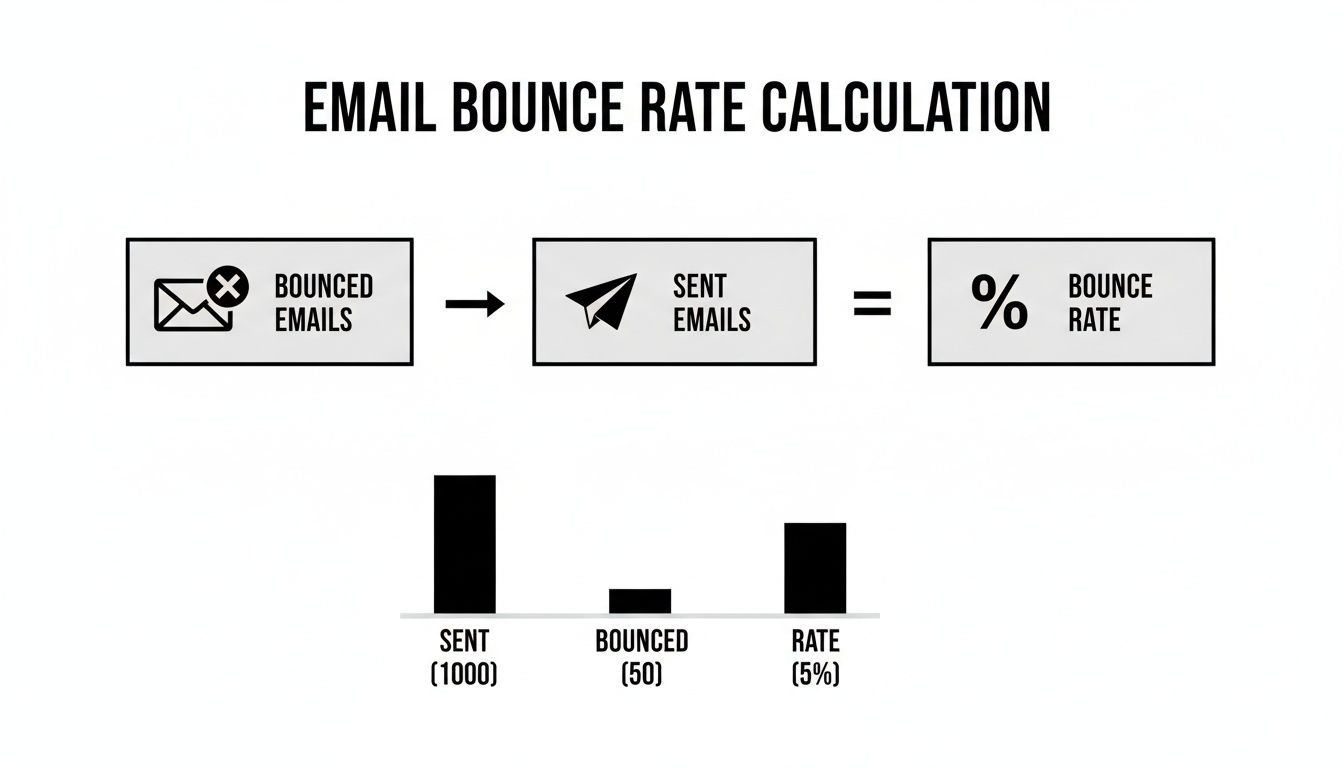
This visual just reinforces that your bounce rate is a direct percentage of failed deliveries out of your total sends. It's that straightforward.
Average Email Bounce Rate by Industry
To get a true sense of your performance, you need to compare yourself to your peers. A non-profit building a community will naturally have different engagement patterns than a fast-paced retail brand sending daily deals.
The table below gives you a snapshot of average bounce rates across various sectors. Use it to see how you stack up.
| Industry | Average Bounce Rate | Target Bounce Rate |
|---|---|---|
| Retail | 0.62% | < 0.5% |
| B2B Services | 0.5% | < 0.4% |
| Non-Profit | 0.8% | < 0.6% |
| SaaS | 0.5% | < 0.4% |
| Hospitality & Travel | 0.5% | < 0.4% |
If your numbers are sitting higher than your industry's average, it’s a clear signal that it’s time to focus on improving your email list quality.
Factors That Influence Your Bounce Rate
Your bounce rate isn't just a number; it’s a story about your audience and sending practices. Several key factors can cause your rate to fluctuate, and understanding them helps you make a fair assessment.
- List Source: Where did your subscribers come from? A list built through clean, double opt-in forms will always outperform one sourced from trade show badge scans or, even worse, purchased from a third party.
- List Age: An older list that hasn't been cleaned regularly will naturally have more bounces. People change jobs, switch providers, or abandon old email addresses all the time.
- Email Type: Transactional emails, like password resets or shipping confirmations, typically have very low bounce rates because they're sent to active users expecting them. In contrast, marketing emails sent to a broader, less-engaged segment are far more likely to bounce.
- Sending Frequency: If you email your list infrequently, you might see a spike in bounces when you finally send a campaign. Why? More addresses will have become inactive in the downtime.
Beyond these core factors, deliverability is also shaped by things outside your direct control. Bounce rates and inbox placement can vary significantly by geography and by the mailbox provider—think Gmail vs. Outlook.
For instance, industry analyses often show Europe sees higher inbox placement, with one dataset reporting it at 89.1%, partly due to stricter consent laws like GDPR. Provider-level differences are also huge; reported inbox placement for major providers in 2025 ranged from 87%–95% for Gmail down to about 75.6% for Microsoft Outlook. You can dig into more of these global deliverability statistics on TrulyInbox.com.
By considering all these variables, you can move from simply knowing your bounce rate to truly understanding it. This deeper knowledge is the foundation for the next crucial step: taking targeted action to fix the problem.
Proven Strategies to Slash Your Email Bounce Rate

Knowing your bounce rate is one thing; actually doing something about it is another game entirely. A high bounce rate is a flashing red light on your marketing dashboard, a clear sign that something is broken. Taking action is the only way to protect your sender reputation and make sure your carefully crafted messages actually reach their destination.
The good news? Lowering your bounce rate isn't some dark art. It all comes down to building good, sustainable email habits. We'll walk through four critical pillars of email health that, together, create a complete playbook for crushing your bounce rate and boosting deliverability.
Strategy 1: Practice Proactive List Hygiene
Let's be blunt: the single biggest reason for a high bounce rate is a messy, outdated email list. List hygiene is the ongoing process of keeping your list clean, accurate, and filled with people who actually want to hear from you. It’s not a one-and-done task—it’s a discipline that pays off big time.
A clean list means fewer hard bounces, which sends a crystal-clear signal to Internet Service Providers (ISPs) that you’re a responsible sender. This builds your reputation and dramatically improves your chances of landing in the primary inbox instead of the spam folder.
Here’s a step-by-step approach to put proactive list hygiene into practice:
- Step 1: Make Double Opt-In Your Best Friend: When someone new signs up, send them a confirmation email with a link they have to click. This simple step confirms the address is valid, spelled correctly, and belongs to a real person who's paying attention. It stops bad email addresses at the front door.
- Step 2: Create a Sunset Policy: This is a system that automatically phases out subscribers who have gone quiet. For instance, create a segment of people who haven't opened or clicked an email in the last 90 days. Try hitting them with one last re-engagement campaign ("Are we breaking up?"). If they still don't bite, it's time to let them go.
- Step 3: Prune Your List Regularly: Automation is great, but a manual review at least twice a year can work wonders. Hunt for obvious typos, old role-based addresses (like
info@company.com), and anyone who has been inactive for more than six months. For a deeper look, our guide on how to clean an email list offers a detailed, step-by-step process.
Strategy 2: Use Real-Time and Bulk Email Verification
While list hygiene helps you manage the subscribers you already have, email verification is all about validating addresses before they can ever cause a bounce. Verification services use sophisticated checks to see if an email address is real and can receive mail, all without actually sending anything.
Think of it like a bouncer at a club checking IDs. It stops the bad addresses from ever getting on your list in the first place.
Actionable Takeaway: Using an email verification tool isn't just a best practice; it's an essential insurance policy for your sender reputation. A single bad list upload can cause lasting damage, and verification is your first line of defense.
Here are the two main ways to use verification:
- Real-Time Verification: This is magic. You integrate an API from a service like ZeroBounce or NeverBounce directly into your signup forms. When someone types in their email, the API checks it on the spot. If it finds a typo (like
user@gamil.com), it instantly prompts the user to fix it. - Bulk List Verification: Got a new list from a trade show or a big import? Before you even think about sending to it, upload the whole file to a verification service. It will scan every address and give you a report showing which ones are valid, risky, or flat-out invalid. You should only ever send to the valid ones.
Strategy 3: Implement Sender Authentication
Sender authentication is basically your digital passport. It’s a set of technical standards that prove to receiving mail servers that you are who you claim to be. Without it, your emails look suspicious and are way more likely to be rejected or routed to spam, even if the address is perfectly valid.
The three key protocols you need to know are:
- SPF (Sender Policy Framework): A simple record that lists all the servers authorized to send email for your domain.
- DKIM (DomainKeys Identified Mail): This attaches a digital signature to your emails. The receiving server checks this signature to make sure the message wasn't messed with in transit.
- DMARC (Domain-based Message Authentication, Reporting & Conformance): This protocol ties SPF and DKIM together and tells receiving servers what to do with emails that fail those checks (e.g., reject them or flag them as spam).
Setting these up might sound intimidating, but nearly every email service provider has simple, step-by-step guides to walk you through it. Getting your authentication right is one of the most powerful moves you can make to improve deliverability.
Strategy 4: Adopt Smart Sending Practices
Finally, how you send emails is just as important as who you send them to. Smart sending practices show ISPs that you’re a consistent, predictable sender, which helps build and maintain a rock-solid reputation.
Think of these habits as the final polish on your deliverability strategy.
- Warm-Up New Sending Domains: If you’re starting with a new domain or IP address, you can't just blast an email to 50,000 people on day one. You have to "warm it up" by starting with a small batch of your most engaged subscribers and slowly increasing the volume over a few weeks. This is how you build trust with ISPs.
- Maintain a Consistent Schedule: Avoid sending erratically. A regular, predictable cadence—like every Tuesday morning—helps ISPs recognize you as a legitimate sender. Huge, sudden spikes in volume can look like a spam attack and get you blocked.
- Monitor Your Performance: Pay close attention to your metrics after every single campaign. If you see a sudden jump in your bounce rate, investigate right away. Was it a new list segment? A different type of content? Catching problems early is everything.
Beyond these individual tactics, using broader marketing automation for small business tools can help you systemize list cleaning and audience segmentation, which proactively keeps bounce rates down. When you combine all four strategies, you create a powerful system for keeping your bounce rate low and your deliverability sky-high.
Mastering Your Bounce Rate: A Quick Summary
We’ve walked through what an email bounce rate really is, the critical difference between hard and soft bounces, and the practical strategies you can use to get things back on track. A low bounce rate isn't just a number to show your boss—it’s the very foundation of a successful email program that delivers real results. Getting this right leads directly to better inbox placement, higher engagement from your subscribers, and a much stronger return on your investment.
Of course, the best way to fix a bounce problem is to prevent it in the first place. That’s why it’s so helpful to understand how to build email lists that prioritize quality from day one. Using simple techniques like a double opt-in can make a world of difference in keeping bad addresses off your list. You can get the full rundown on that strategy in our guide on what is double opt-in.
Summary: Your email bounce rate is a direct measure of your list quality and sender reputation. By practicing regular list hygiene, using verification tools, authenticating your domain, and sending emails intelligently, you can keep your bounce rate low, your deliverability high, and your marketing effective.
Recommended Next Step: Log into your email platform, pull up the report from your last campaign, and find your bounce rate. Compare it to the industry benchmarks in this guide. This single number is your starting point for building a healthier, more powerful email list.
Frequently Asked Questions About Email Bounce Rate
Even after you've got the basics down, a few questions always seem to pop up when you're wrestling with deliverability. Nailing these details is what separates the pros from the amateurs, moving you from simply knowing what a bounce rate is to truly understanding how to manage it. Let's dig into the most common ones.
Is a 0% Bounce Rate a Realistic Goal?
Short answer? No. And honestly, chasing it is a waste of good energy. Aiming for a zero percent bounce rate is like trying to find a phone book from 1995 where every single number still works. It’s a nice thought, but it’s just not going to happen.
People switch jobs, abandon that old Hotmail account from college, or just plain make typos when they sign up. Even the most perfectly curated list is going to have a few bounces now and then from things that are completely out of your hands.
A much healthier (and saner) goal is to keep your bounce rate consistently below 0.5%. This is the gold standard. It shows you're on top of your list hygiene and have a solid sender reputation, all without chasing an impossible number.
So, instead of obsessing over perfection, focus on keeping that rate incredibly low and steady. That's the real win.
How Often Should I Clean My Email List?
List hygiene isn't a one-and-done chore; it's more like brushing your teeth—something you have to do regularly to keep things healthy. Exactly how often you need to scrub your list depends on how fast it's growing and how much you're sending, but having a set schedule is non-negotiable for keeping bounces down.
Here’s a simple, effective routine you can start today:
- Real-Time Verification (Always On): This is your first line of defense. Put an email verification tool right on your signup forms. It acts like a bouncer at a club, catching typos and fake addresses at the door before they ever get on your list.
- Full List Scrub (Every 6 Months): At least twice a year, you should run your entire list through a bulk verification service. This is your deep clean. It'll catch all the emails that have gone bad since they first subscribed, like accounts that have been deleted or deactivated.
- Pre-Send Check (For Old or New Segments): About to send a campaign to a list you bought, or a segment that's been gathering dust for three months or more? Pump the brakes. Run that specific group through a verification tool first. This one step can save your sender reputation from taking a massive hit from a sudden spike in bounces.
Do Transactional Emails Bounce Less Than Marketing Emails?
Yes, they absolutely do. And the reason why is a masterclass in list quality.
Transactional emails are things like password resets, shipping confirmations, or welcome messages. They’re sent automatically in response to something a user just did. This means the email address is not only active but was just used, making it highly verified and engaged.
Because of that immediate validation, their bounce rates are naturally rock-bottom. Marketing emails, on the other hand, often go out to wider audiences that might include older, less-engaged subscribers whose addresses could have quietly expired.
The gap between the two really drives home a core email principle: the cleaner and more deliberate your data collection is from day one, the healthier your entire email program will be. Good data in, good results out. It's the foundation of everything.
Here at EmailGum, we’re all about helping you master every piece of the email puzzle. For more deep dives and guides that turn knowledge into real results, check out our other resources.