
Email marketing automation is the secret to sending the right message, to the right person, at the perfect time—without you having to manually press "send" every time. Instead of blasting out one-size-fits-all newsletters, you use smart software to automatically send personalized emails based on your subscribers' actions. This creates a more personal, timely, and effective way to connect with your audience.
In short, it’s a system that lets you build relationships and drive sales on autopilot.
Decoding Email Marketing Automation
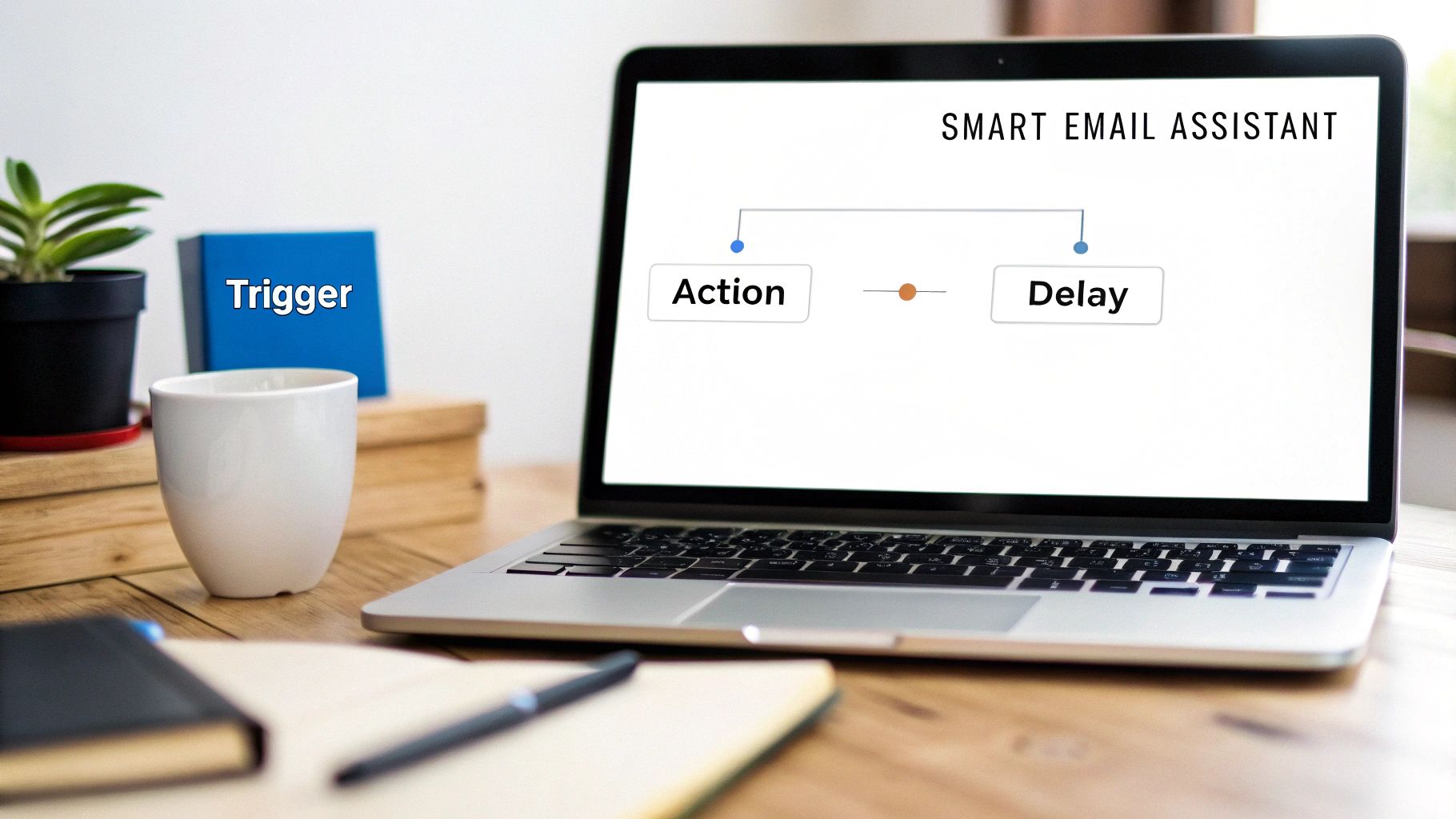
Think of email automation like setting up a series of dominoes. You strategically arrange them, and when a subscriber takes an action—like signing up for your list or buying a product—they tip over that first domino. The rest of the sequence unfolds exactly as you planned, all on its own.
This process lets you build powerful, automated sequences called workflows. Each workflow is a pre-planned journey that guides a subscriber based on their specific behavior. It saves you countless hours while making every person feel like you're talking directly to them.
Manual Campaigns vs Automated Workflows
So, how does this really differ from the old-school way of sending emails? Let's break it down.
| Feature | Manual Email Marketing | Automated Email Marketing |
|---|---|---|
| Trigger | Manual send by a marketer | A specific user action or event |
| Timing | Sent at a scheduled time to everyone | Sent immediately after the trigger |
| Audience | One large, general segment | Individual or small, targeted group |
| Content | Broad, one-size-fits-all message | Personalized and context-specific |
| Scalability | Labor-intensive and hard to scale | Highly scalable and efficient |
| Effort | Requires constant manual work | "Set it and forget it" once built |
The difference is night and day. Automation lets you shift from broad, manual broadcasts to timely, personalized conversations that run in the background.
The Core Components of Automation
No matter how simple or complex an automated email sequence gets, it’s always built on three basic parts. Once you understand these, you can build almost anything.
- Trigger: This is the “if this happens” event that kicks everything off. A trigger could be a new user subscribing to your newsletter, someone leaving an item in their shopping cart, or a customer buying a product. It's the starting pistol for the workflow.
- Action: This is the “then do that” response. Once a trigger fires, the system performs an action. Most of the time, that action is sending a specific email, but it could also be adding the subscriber to a new list, updating their contact info, or even alerting your sales team.
- Workflow: This is the whole sequence put together—the combination of triggers, actions, and even time delays that create a complete customer journey. For example, a welcome workflow might start with a "new subscriber" trigger, followed by an immediate welcome email (action), a two-day delay, and then a second email with helpful tips (another action).
This strategic approach has become a non-negotiable part of modern marketing. In fact, 63% of marketers now use email marketing automation, making it far more popular than social media or paid ad automation tools. It’s simply that effective.
If you want to really dig into how this can transform your business, a great next step is understanding automated email marketing and its power. This technology is what takes your email strategy from shouting at a crowd to having meaningful, one-on-one conversations that scale.
Why Automation Is a Game-Changer for Your Business
Email marketing automation does more than just send emails; it fundamentally changes how you connect with your audience and grow your business. When you put your email strategy on autopilot, you stop wrestling with manual, time-consuming tasks and instead build a system that works around the clock to nurture leads, drive sales, and build loyalty.
Real-World Example: Imagine an e-commerce store that automatically recovers 15% of its abandoned carts with a single, perfectly timed reminder email. Or a content creator who guides every new subscriber through a carefully crafted welcome series, turning casual readers into loyal fans—all without lifting a finger after the initial setup. This is the practical power of automation in action.
Unlock Scalable Personalization and Efficiency
One of the biggest wins with automation is delivering one-on-one personalization at a massive scale. Instead of blasting a generic newsletter to thousands of people, you create unique, tailored experiences based on what each person actually does. This makes your communication feel genuinely relevant, which is exactly what modern customers expect.
Of course, this targeted messaging also saves an incredible amount of time. Once your workflows are live, they handle the repetitive work, freeing you and your team to focus on the bigger picture—strategy, creative content, and other high-impact activities that grow your business. It’s like having a tireless marketing assistant who never misses a beat.
By sending the right message at the right moment, automation transforms your email list from a simple audience into an engine for predictable, sustainable revenue growth. It’s a strategic shift from broadcasting to building relationships.
Drive Significant Revenue Growth
The return on investment from automation is undeniable. Because automated emails are triggered by specific user behaviors—like making a purchase or clicking a link—they are incredibly timely and relevant by nature. This context is precisely why they perform so much better than standard, one-off campaigns.
In fact, the revenue power of what is email marketing automation is clear, as automated workflows can generate up to 30x more revenue per recipient than traditional campaigns. This is all thanks to their hyper-targeted nature, seen in workflows like abandoned cart reminders that effectively recover lost sales. You can explore more revealing email marketing statistics to see the full picture of its impact.
At the end of the day, automation isn't just a convenience—it's an essential strategy for anyone serious about maximizing their email marketing results.
Essential Automated Workflows You Can Set Up Today
Alright, you understand the "why." Now let's dig into the "how." The best way to start is by building a few foundational workflows that deliver value right away—for you and your subscribers.
Think of it this way: these core automations work together to grow your business by saving you time, boosting sales, and turning new customers into loyal fans.

As you can see, it’s a powerful cycle. You free up your time, which lets you focus on improving the customer experience, which in turn fuels more growth.
The Welcome Series
Your welcome series is your one shot at a great first impression. The goal is to introduce new people to your brand, build trust, and guide them toward their first important action, whether that's making a purchase or checking out your best content.
- Goal: Nurture new subscribers and make them feel right at home.
- Trigger: Someone new signs up for your email list.
- Step-by-Step Plan:
- Email 1 (Immediately): Send a warm "hello," deliver the discount code or lead magnet you promised, and set expectations for what kind of emails they'll receive.
- Email 2 (Day 2): Share your brand's story or point them to your most popular products. This is how you start building a real connection.
- Email 3 (Day 4): Provide social proof. Customer testimonials or a short case study go a long way in building credibility and trust.
The Abandoned Cart Reminder
If you run an e-commerce store, this workflow is essential. Studies consistently show that over 70% of online shopping carts are abandoned. A well-timed email can bring a surprising number of those sales back.
Honestly, this single automation is often the most profitable one a business can set up. You're catching people with high buying intent right when they need a little nudge.
- Goal: Recover sales that would otherwise be lost.
- Trigger: A user adds an item to their cart but leaves without buying.
- Step-by-Step Plan:
- Email 1 (1 Hour Later): Keep it simple and helpful. A subject line like, "Did you forget something?" with a picture of the item and a direct link to their cart works wonders.
- Email 2 (24 Hours Later): Address potential hesitation. Gently remind them about your easy return policy or mention what other customers love about the product.
- Email 3 (3 Days Later): Create a little urgency. A small, limited-time offer like a 10% discount or free shipping can be the final push they need.
If you want to see how more complex, multi-step sequences like this play out in the wild, check out these powerful drip marketing examples.
The Post-Purchase Follow-Up
The customer relationship doesn’t end when they click "buy"—that's just the beginning. A good post-purchase sequence makes customers feel great about their decision, which reduces buyer's remorse and turns one-time shoppers into repeat customers.
Of course, this is just one piece of a much larger puzzle. To get the most out of these automations, you'll eventually want to start mastering customer lifecycle management as a whole.
- Goal: Boost customer loyalty and collect valuable feedback.
- Trigger: A customer completes a purchase.
- Step-by-Step Plan:
- Email 1 (Immediately): Send the order confirmation right away and thank them for their business.
- Email 2 (7-14 Days After Delivery): Once they’ve had a chance to use the product, ask for a review or quick feedback on their experience.
- Email 3 (30 Days After Purchase): Come back with a relevant cross-sell or upsell. Recommend a related product or offer a small discount to entice them back for another purchase.
Choosing the Right Automation Tools
Once you have a strategy, the next step is picking the right technology. Choosing an email marketing automation platform can feel overwhelming, but it boils down to finding a tool that fits your goals, technical comfort level, and budget. The right software doesn't just send emails; it becomes the central hub for your customer conversations.
Think of these platforms as the engine for your automation strategy. A powerful engine needs a clear dashboard, which is why a visual workflow builder is an absolute must-have. This feature lets you map out your automation sequences with simple drag-and-drop controls, making it easy to see exactly how triggers, actions, and delays connect in a logical flow.
This visual approach demystifies building complex customer journeys and empowers you to design sophisticated campaigns without knowing a single line of code.
Must-Have Features for Your Shortlist
Beyond a visual builder, a few other features are non-negotiable for effective automation. You need a tool that can grow with your business and provide the data-driven capabilities to create truly personal experiences.
Your checklist should include:
- Powerful Segmentation: The ability to group subscribers based on their behavior (like purchase history or website visits), demographics, or engagement is what lets you send ridiculously relevant content. This is crucial.
- Seamless Integrations: Your email tool has to "talk" to the other parts of your business, like your e-commerce platform or CRM. This is how a trigger on your site can kick off an email sequence in your automation tool.
- Robust Analytics: Look for clear, easy-to-read dashboards that show you what’s working. You’ll need to track metrics like conversion rates and revenue per email to understand the real-world impact of your automations.
How to Make the Right Choice
Comparing software can make your head spin, but focusing on your specific needs will bring clarity. Start by outlining your primary goal. Are you an e-commerce store trying to recover abandoned carts? Or a creator who wants to build an amazing welcome series? Your core objective will immediately highlight which features matter most.
Getting this choice right is more important than ever. Today, 71% of marketers use automation for email, making it the bedrock of their broader strategies. And as you evaluate your options, it's worth noting that 64% are already using AI in their marketing, with 62% saying it's crucial for their success.
Choosing a tool isn't just about the features it has today, but also its ability to support your growth tomorrow. Pick a platform that feels intuitive to you and has a reputation for reliable customer support.
To make your search a bit easier, we’ve already done some of the heavy lifting. You can explore our curated list of the best email marketing tools to compare the top contenders and find one that’s a perfect fit for your business.
Best Practices for Effective Automation

Getting a workflow up and running is just the start. The real magic happens when you shift from setup to optimization. Following a few key practices is what separates a sequence that delights subscribers from one that just adds to the inbox noise.
The foundation of any great automation strategy is simple: make every message relevant. This means sending the right content to the right person at the right time, which is impossible without first organizing your audience into smaller, targeted groups.
Segment Your Audience for Maximum Relevance
Never send the same message to everyone. Segmentation is the art of dividing your email list into specific groups based on shared characteristics, behaviors, or interests. Once you do this, you can tailor your automated messages to feel incredibly personal and timely.
For example, you could create segments for:
- New subscribers who are still getting to know your brand.
- Repeat customers who might appreciate early access to new products.
- Inactive users who haven't opened an email in 90 days and need a gentle re-engagement campaign.
This level of targeting ensures that every email feels like it was written just for them, which dramatically boosts engagement. To really nail this, you can learn more about what is email segmentation and how to apply it like a pro.
Write Copy That Sounds Human
One of the biggest traps in automation is writing emails that sound robotic. Remember, your goal is to build relationships, and that requires a human touch. Write your copy as if you're talking to a single person, not a faceless crowd.
Use a conversational tone, inject your brand's personality, and ditch the corporate jargon. Ask questions, use emojis where it makes sense, and focus on providing genuine value in every message.
Remember, behind every email address is a real person. Automation should handle the sending, but a human should always be behind the voice. Your subscribers will notice and appreciate the difference.
Constantly Test and Optimize Your Workflows
An automation is never truly "set it and forget it." To ensure your workflows perform at their best, you have to constantly test different elements and make improvements based on data. This process is known as A/B testing.
The key is to test one variable at a time so you can clearly see what's making a difference.
- Subject Lines: Test a straightforward subject line against a more creative one to see what gets more opens.
- Call to Action (CTA): Try different button colors, text ("Buy Now" vs. "Shop the Collection"), or placement to see what drives more clicks.
- Send Times: Experiment with sending emails at different times of the day or week to discover when your audience is most likely to be in their inbox.
By consistently testing and refining, you can turn a good automation into a powerful, revenue-generating machine.
How to Measure Your Automation Success
If you're not measuring your email automation, you can't improve it. While metrics like open rates and click-through rates (CTR) are useful for a quick check on engagement, they don't tell the whole story. To truly understand performance, you need to focus on metrics that connect directly to business goals.
The key is shifting your focus from "Are people opening this?" to "Is this driving revenue and building customer loyalty?" That's how you make smart, effective optimizations.
Key Performance Metrics to Track
For every automated workflow you set up, start tracking these crucial numbers. This is where you see how well your sequences are turning subscribers into customers.
- Conversion Rate: This is the big one. It’s the percentage of people who complete the goal of your sequence, whether that’s making a purchase, booking a demo, or downloading a resource. This is the most direct measure of an automation's success.
- Revenue Per Recipient (RPR): Want to know what an automated email is worth? This is your metric. Divide the total revenue a workflow generated by the number of people who received it. The result tells you exactly how much money each subscriber in that sequence brings in.
- List Churn Rate: This is your "uh-oh" metric. It tracks how many subscribers unsubscribe during an automation. If you see a spike during a specific sequence, it’s a red flag that your messaging might be off, or perhaps you're sending too many emails.
By digging into these numbers, you can spot weak links in your strategy. For instance, if a welcome series has a dismal conversion rate, you know it’s time to A/B test your calls-to-action or sweeten the initial offer. This data-first approach lets you stop guessing and start making strategic improvements.
Still Have Questions About Email Automation?
Jumping into email automation can feel like a big step, even with the basics down. It's normal for a few practical questions to pop up. Here are some of the most common ones we hear, with straightforward answers.
How Is Automation Different From a Regular Newsletter?
Think of it like this: a newsletter is a one-to-many broadcast, like a radio show. You craft one message and send it to your entire list at the same time.
Automation, on the other hand, is about one-to-one conversations triggered by an individual's specific actions—like signing up, buying a product, or clicking a link. This makes the message incredibly timely and personal. While newsletters are great for general updates, automations are built for guiding each subscriber on their own unique journey.
Can Email Automation Feel Too Robotic?
That's a valid concern, but the short answer is no—not if you do it right. The secret is to inject your brand's personality into every automated email and use personalization tags (like your subscriber's first name) to make the message feel like it was written just for them.
Good automation doesn't feel automated at all. When your message is triggered by a relevant action and speaks directly to a subscriber's needs, it feels helpful and personal, not robotic.
The key is to focus on delivering real value and writing in a warm, conversational tone. Remember, the software handles the sending, but a human—you—should always be behind the voice.
Is It Expensive to Get Started?
Not at all. This is one of the biggest myths out there. Almost every major email marketing platform—from Mailchimp to ConvertKit—now includes powerful automation features in their entry-level plans. Many even offer free tiers for businesses just starting out.
You can set up crucial workflows like a welcome series or an abandoned cart sequence without spending a dime upfront. As your list and needs grow, you can upgrade to a paid plan. Given the incredibly high ROI of email automation, the software usually pays for itself many times over.
Summary & Your Next Step
Email marketing automation uses software to send personalized, timely messages to subscribers based on their actions. It's a powerful way to save time, build stronger customer relationships, and drive revenue on autopilot. By setting up core workflows like welcome series and abandoned cart reminders, you can create a system that works for your business 24/7.
Your Recommended Next Step: Choose one of the three essential workflows discussed—the Welcome Series is a great place to start—and map out the first email. Don't worry about perfection; just get started.
Ready to build powerful email workflows that drive results? EmailGum provides expert guides, tool reviews, and actionable strategies to help you master email marketing. Start learning for free today at EmailGum.com and turn your subscribers into loyal customers.